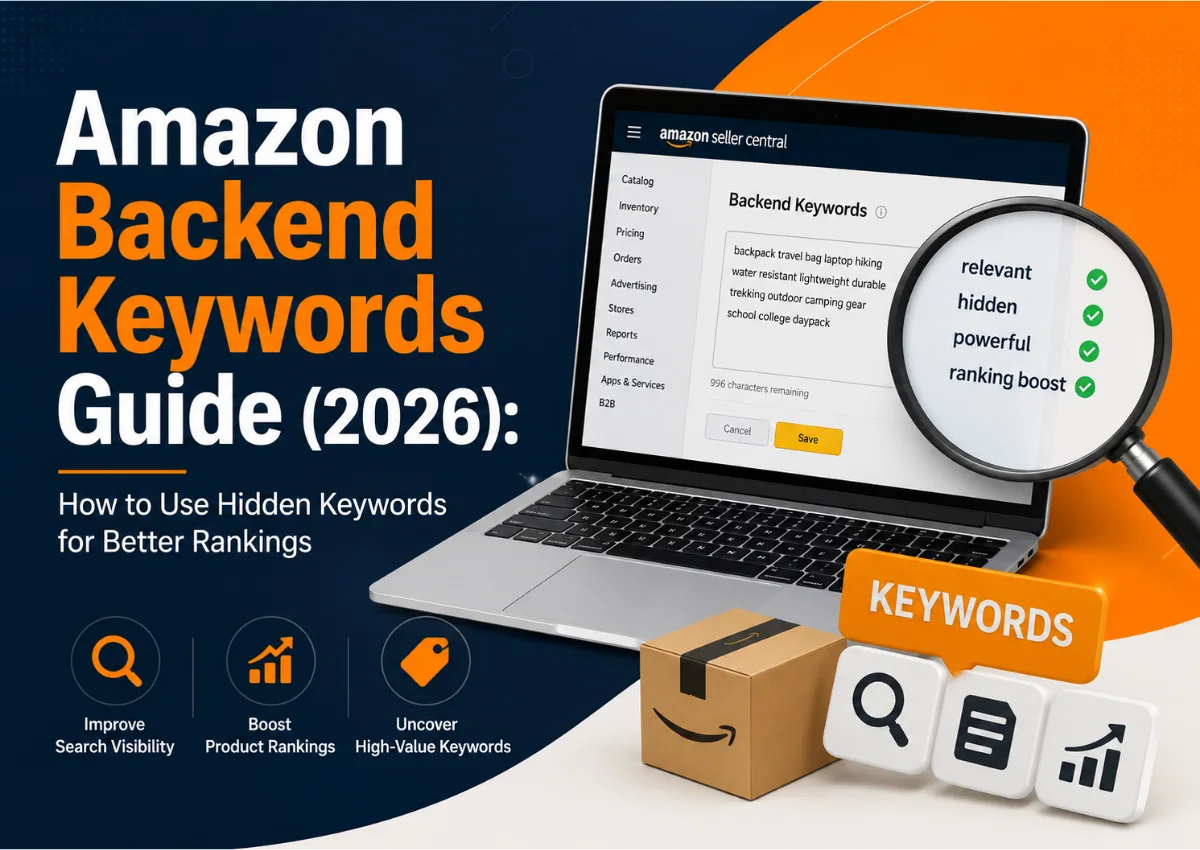
Amazon Backend Keywords Guide (2026): How to Use Hidden Keywords for Better Rankings
Amazon Backend Keywords Guide (2026): How to Use Hidden Keywords for Better Rankings You could have the best product on…
You could have the best product on Amazon. Professional images, competitive pricing, excellent reviews, and yet somehow your competitors still outrank you.
Why?
The answer often hides where customers never look: Amazon backend keywords.
Most sellers spend weeks optimizing titles, bullet points, and product descriptions. Meanwhile, the hidden keyword fields inside Amazon Seller Central are either ignored or filled with random phrases copied from keyword tools.
That’s a missed opportunity.
This guide explains everything you need to know: from understanding Amazon backend keywords, the 250-byte keyword limit, and Amazon generic keywords, to using the right tools, avoiding indexing mistakes, and building a backend keyword strategy that actually improves rankings.
Whether you’re launching a new ASIN or refreshing an existing catalog, this guide will help you unlock one of Amazon SEO’s most underutilized ranking factors.
Amazon backend keywords are hidden search terms added in Amazon Seller Central that help Amazon assess product relevance without displaying them to customers. Although invisible on the product page, these keywords influence indexing, discoverability, and organic visibility when used correctly.
In 2026, successful Amazon SEO isn’t about adding more keywords; it’s about adding the right keywords within Amazon’s 250-byte backend keyword limit while avoiding duplication, irrelevant phrases, and wasted space.Β
A structured backend keyword strategy, supported by competitor research and ongoing optimization, helps products rank for additional search queries while keeping listings clean and customer-focused.
Backend keywords remain an important Amazon ranking signal in 2026.
Customers never see hidden keywords, but Amazon’s search engine does.
Amazon allows 250 bytes, not 250 characters, for generic keywords.
Avoid repeating keywords already present in titles or bullet points.
Backend keywords should complement, not replace, frontend optimization.
Updating backend keywords regularly helps maintain search relevance.
AI-driven keyword research tools are improving backend keyword discovery.
When most sellers think about Amazon SEO, they immediately focus on titles, bullet points, and descriptions.
That’s only half the story.
Amazon backend keywords are hidden metadata stored inside Amazon Seller Central. Unlike customer-facing content, these keywords remain invisible to shoppers but help Amazon understand exactly what your product should rank for. Think of them as additional instructions you give Amazon’s search engine.
For example, imagine you’re selling a stainless steel insulated water bottle. Your title might already contain:
But your backend keywords can include related searches such as:
Without making your title look cluttered.Β
This allows Amazon to associate your listing with more relevant searches while maintaining a clean customer experience.
One misconception I still hear from sellers is:
“Customers can’t see backend keywords, so they probably don’t matter.”
Actually, they’re designed for Amazon, not customers.
They’re one of the few places where you can expand keyword coverage without affecting readability or conversion.
Category : Amazon Backend Keywords
Category Type : Amazon SEO Ranking Factor
Related Entities : Amazon Seller Central, Amazon Search Query Performance, Amazon Listing Optimization
Common Synonyms : Amazon hidden keywords, Amazon backend keywords, Amazon generic keywords, Back end keywords
Primary Metrics : Keyword Indexing, Organic Ranking, Search Visibility, Impressions
Amazon’s algorithm has evolved dramatically over the past few years. Earlier versions relied heavily on keyword matching.
Today’s system evaluates much more. It considers customer intent, listing quality, shopping behavior, conversion history, and semantic relevance.
Backend keywords help Amazon understand searches that may not naturally appear in visible content. That doesn’t mean adding hundreds of keywords will magically improve rankings. It means helping Amazon build a more complete understanding of your product.
For instance:
A yoga mat may also be searched for:
Including these related search terms in backend keywords expands indexing opportunities without sacrificing title quality.
Two identical yoga mats launch on Amazon.
Seller A repeats “Yoga Mat” five times throughout the listing.
Seller B uses the title naturally while placing additional relevant phrases inside backend keywords.
Everything else being equal, Seller B usually has broader indexing coverage because Amazon receives stronger contextual signals. Backend keywords don’t replace good listings; they strengthen them.
Short answer? Yes. What has changed is how Amazon interprets them.
Years ago, sellers could stuff hundreds of loosely related keywords into backend fields and often rank surprisingly well.
That approach no longer works. Amazon now evaluates:
If your backend keywords don’t align with your visible content, Amazon simply ignores many of them.
Think of backend keywords as supporting evidence.Β
When all four align, Amazon gains confidence about your product’s relevance. That’s what improves indexing.
| Frontend Keywords | Backend Keywords |
|---|---|
| Visible to customers | Hidden from customers |
| Appear in titles and bullets | Stored inside Seller Central |
| Influence SEO and conversions | Primarily improve indexing |
| Affect click-through rate | Expand search visibility |
| Should remain readable | Can include additional search variations |
This is probably the single most misunderstood topic in Amazon SEO. Amazon does not allow 250 characters. It allows 250 bytes. Those are completely different measurements. Different characters occupy different byte values.
For example:
That means a field containing 240 characters could still exceed Amazon’s byte limit.
Once the limit is crossed, Amazon may ignore everything after the first 250 bytes.
Many sellers paste entire keyword exports from research tools into the backend field.
The result? Amazon cuts off the data. Valuable keywords never get indexed. Sometimes, fewer keywords actually produce better results.
Knowing what backend keywords are is only the beginning. The real value comes from knowing where to place them and how to optimize them properly.
Inside Amazon Seller Central, every product listing includes a Generic Keywords field under the Keywords tab. This is where sellers add hidden search terms that help Amazon better understand their products. The process is straightforward:
Many sellers either leave this field empty or copy keywords directly from their titles, wasting valuable indexing space.
One of the first things we audit at Krolog is the backend keyword field.
Surprisingly, even established brands generating six or seven figures often use less than 30% of the available keyword space or fill it with duplicate keywords that Amazon already recognizes from the title. That’s free visibility being left on the table.
If you’ve explored Seller Central, you’ve probably come across the term Amazon Generic Keywords. Many sellers assume they’re different from backend keywords. They’re actually the same thing.
Amazon simply labels the backend keyword field as Generic Keywords inside Seller Central.
This field allows you to include relevant search terms that don’t naturally fit within your:
For example, imagine you’re selling a bamboo cutting board. Your title already includes:
Your Amazon generic keywords might include:
These terms broaden keyword coverage while keeping the visible listing clean and customer-friendly.
Another frequently overlooked opportunity is Amazon Intended Use Keywords. Instead of describing the product itself, these keywords describe how customers plan to use it.
Amazon increasingly understands shopping intent.
That’s why intended-use phrases can improve relevance for long-tail searches.
Instead of only targeting:
Consider adding phrases related to usage:
You’re no longer describing the product. You’re describing the customer’s situation. That’s often how shoppers search.
One pattern we’ve consistently noticed across successful Amazon accounts is this:
High-ranking listings don’t only answer “What is this?” They also answer, “When would someone use this?”
Backend keywords provide the perfect place to capture that intent.
Many sellers approach keyword optimization backwards. They start with search volume.
Amazon starts with relevance.
Instead of trying to squeeze every keyword into your title, think about your listing as a complete ecosystem. Each section has a purpose.
| Listing Section | Purpose |
|---|---|
| Title | Primary keywords |
| Bullet Points | Features & benefits |
| Description / A+ | Customer education |
| Backend Keywords | Additional indexing opportunities |
Every keyword should have a home. Backend keywords exist to support, not replace, the rest of your listing.
Suppose you’re selling an ergonomic office chair.
Visible keywords:
Backend keywords:
Notice how there is no unnecessary repetition. Instead, you’re expanding Amazon’s understanding of the product.
This question appears in almost every Amazon SEO discussion. The answer is simple.
Amazon automatically separates words during indexing. Using commas only wastes valuable bytes.
βergonomic chair office chair lumbar support executive seating adjustable desk chairβ
ergonomic chair, office chair, lumbar support, executive seating, adjustable desk chair
The second version consumes more bytes while providing no additional ranking benefit.
Every byte matters.
Years ago, many sellers deliberately added common spelling mistakes to backend keywords.
That strategy rarely provides value today. Amazon automatically recognizes many spelling variations.
For example, Someone searching for a vacuum bottle will often still see listings optimized forΒ
vacuum bottle.
Instead of filling valuable backend space with spelling errors, prioritize:
Only include a misspelling if keyword research confirms meaningful search volume.
Before publishing your listing, run through this checklist:
A home storage brand approached Krolog after months of stagnant organic rankings.
Their product title was well optimized, images were excellent, and reviews were strong.
The problem?
Their backend keyword field contained just 42 bytes of data, most of which duplicated the title.
We rebuilt the backend keyword strategy using:
Within eight weeks, the listing was indexed for dozens of additional search queries, leading to a noticeable increase in organic impressions and reduced dependence on PPC for visibility.
The title never changed; hidden keywords did.
Finding backend keywords isn’t about collecting the biggest keyword list. It’s about finding the right keywords.
The best-performing sellers combine customer search data, competitor research, and Amazon’s own insights instead of relying on guesswork.Β
Β
Some of the most reliable tools to discover Amazon listing backend keywords include:
Available to registered brands, this provides valuable insights into:
It’s one of the most accurate sources because the data comes directly from Amazon.
Β
This tool has become increasingly valuable in 2026. Rather than simply showing search volume, it reveals:
This helps identify keywords where visibility exists, but conversions need improvement.
One of the leading keyword research platforms in the industry. Useful features include:
Many sellers use Helium 10 as their primary Amazon backend keyword tool.
Β
DataDive has become particularly popular among advanced Amazon SEO specialists.
Instead of simply generating keywords, it identifies semantic keyword gaps between your listing and top-performing competitors.
This makes backend keyword planning significantly more strategic.
Β
These platforms remain excellent for:
No single tool tells the entire story. The strongest keyword strategies combine multiple data sources.
An Amazon backend keyword extractor helps sellers identify hidden keyword opportunities by analyzing competing listings.
Although no tool can reveal a competitor’s actual backend keywords, extractors use publicly available listing data, ranking signals, and search behavior to estimate which hidden terms may contribute to their visibility.
Think of them as research assistants rather than keyword generators. A good extractor helps answer questions like:
One mistake I see frequently is sellers exporting thousands of keywords from these tools and trying to use all of them. Volume doesn’t win; relevance does.
25 highly relevant backend keywords are more effective than 300 loosely related ones.
Adding keywords doesn’t automatically mean Amazon indexes them. Fortunately, checking indexing is relatively simple.
Search Amazon using: ASIN + Keyword
If your listing appears, that keyword is likely indexed.
Example:
B0XXXXXXX insulated hiking bottle
Β
Several SEO platforms provide indexing reports, including:
These tools monitor keyword indexing over time and alert sellers when keywords drop.
Β
For Brand Registered sellers, Amazon’s Search Query Performance Dashboard offers valuable insight into which customer searches actually generate impressions.
This is often more useful than simply knowing whether a keyword is indexed.
Indexing isn’t the finish line; it’s the starting line.
A keyword can be indexed yet never generate impressions because Amazon doesn’t consider your listing competitive enough.
Visibility comes first. Relevance and conversions come next.
Amazon search has become far more intelligent. Rather than matching exact keywords, Amazon increasingly understands:
This means Amazon recognizes that:
May all satisfy similar shopping intent.
Instead of chasing exact-match phrases, successful sellers now build listings around topical relevance. Backend keywords play an important supporting role by reinforcing those semantic relationships.
If your visible listing focuses on:
Backend keywords might include:
Amazon understands the broader topic, not just the exact wording.
One area many sellers overlook is seasonal optimization. Customer searches change dramatically throughout the year. That’s especially true during:
For example, a reusable water bottle may receive searches such as gym bottle or hiking bottle throughout the year.
However, during summer, those searches may shift toward:
Updating backend keywords before Amazon peak season events helps listings remain aligned with evolving customer intent.
Seasonality doesn’t always require changing your product title. Often, refreshing backend keywords is enough to capture new search behavior without affecting listing stability.
Even experienced sellers make backend keyword mistakes. Here are the ones we encounter most often during listing audits.
Amazon SEO continues evolving faster than ever. Several trends are reshaping how backend keywords contribute to organic visibility.
Every recommendation in this guide is based on practical Amazon account management rather than theory.
At Krolog, we evaluate backend keyword strategies using factors that directly impact search visibility and long-term organic growth. Our framework includes:
Instead of chasing every keyword opportunity, we prioritize the keywords most likely to generate qualified traffic and sustainable rankings.
Amazon allows approximately 250 bytes in the Generic Keywords field. Since bytes differ from characters, the total number of words you can add depends on the characters used. Focus on maximizing relevant keywords within the byte limit instead of counting words.
Use spaces only. Amazon automatically separates individual words during indexing, so commas and punctuation simply waste valuable bytes.
Β
Generally, no. Amazon's search engine automatically recognizes many common spelling variations. Instead, prioritize relevant synonyms, alternate product names, and customer intent phrases.
Β
The simplest method is an ASIN + keyword search. You can also use tools like Helium 10, DataDive, or Amazon's Search Query Performance dashboard to monitor indexing and keyword visibility.
Review backend keywords at least every quarter, or sooner if you're entering a peak selling season, launching new campaigns, noticing ranking declines, or expanding your keyword strategy based on new customer search behavior.
Β
There isn't a single "best" tool. Most experienced sellers combine Amazon Brand Analytics, Search Query Performance, Helium 10, DataDive, MerchantWords, and Jungle Scout to build a complete keyword strategy.
Amazon increasingly relies on semantic understanding rather than exact keyword matching. Its AI evaluates customer intent, contextual relevance, and related search terms, making well-structured backend keywords even more valuable than repetitive keyword stuffing.
Backend keywords may be invisible to customers, but they’re far from invisible to Amazon.
In 2026, Amazon backend keywords remain one of the easiest ways to strengthen listing relevance, capture additional search intent, and improve discoverability, provided they’re used strategically.Β
Simply stuffing every keyword you find into the Generic Keywords field won’t work anymore. Amazon’s algorithm is smarter. It rewards relevance, semantic coverage, and customer intent.
The sellers who consistently rank higher are the ones treating backend keywords as part of a broader Amazon SEO strategy, not as an afterthought.
At Krolog, we’ve seen well-optimized backend keywords help brands unlock additional indexing opportunities, reduce dependency on paid advertising, and improve organic visibility across competitive categories. Small changes, when backed by the right data, often produce meaningful long-term results.
If your listings haven’t been reviewed in months, now is the right time to revisit them. Audit your hidden keywords, remove wasted bytes, and align your listings with how customers actually search today. Because sometimes, the biggest ranking opportunity is the one your customers never see.
Sandeep K., Founder & CEO of Krolog, has over a decade of experience helping ecommerce brands grow through Amazon SEO, marketplace management, PPC advertising, conversion optimization, catalog strategy, and multi-channel commerce.
His team has worked with brands across diverse product categories, helping sellers improve rankings, increase profitability, and build sustainable growth on Amazon.
Β
Strong Amazon rankings don’t come from visible content alone. Hidden keyword optimization, listing relevance, and continuous SEO refinement all play an equally important role.
At Krolog, we help brands uncover missed keyword opportunities, optimize backend fields, improve listing visibility, and build data-driven Amazon SEO strategies that support long-term organic growth.
Request an Amazon Listing Audit to identify indexing gaps, hidden keyword opportunities, and actionable improvements that can strengthen your product rankings in 2026.
Amazon Backend Keywords Guide (2026): How to Use Hidden Keywords for Better Rankings You could have the best product on…
How to Expand From Amazon to Shopify: The 2026 Checklist If you’re relying entirely on Amazon for sales, you’re also…
Why Amazon Sellers Are Launching Shopify Stores in 2026 Discover why thousands of Amazon sellers are expanding into Shopify ecommerce…
Krolog was born from a simple yet powerful idea: to empower businesses with the tools and strategies needed to thrive in the ever-evolving digital marketplace. Our journey is a testament to the transformative impact of strategic E-commerce solutions.


Copyright Β© 2026 All Right ReservedΒ