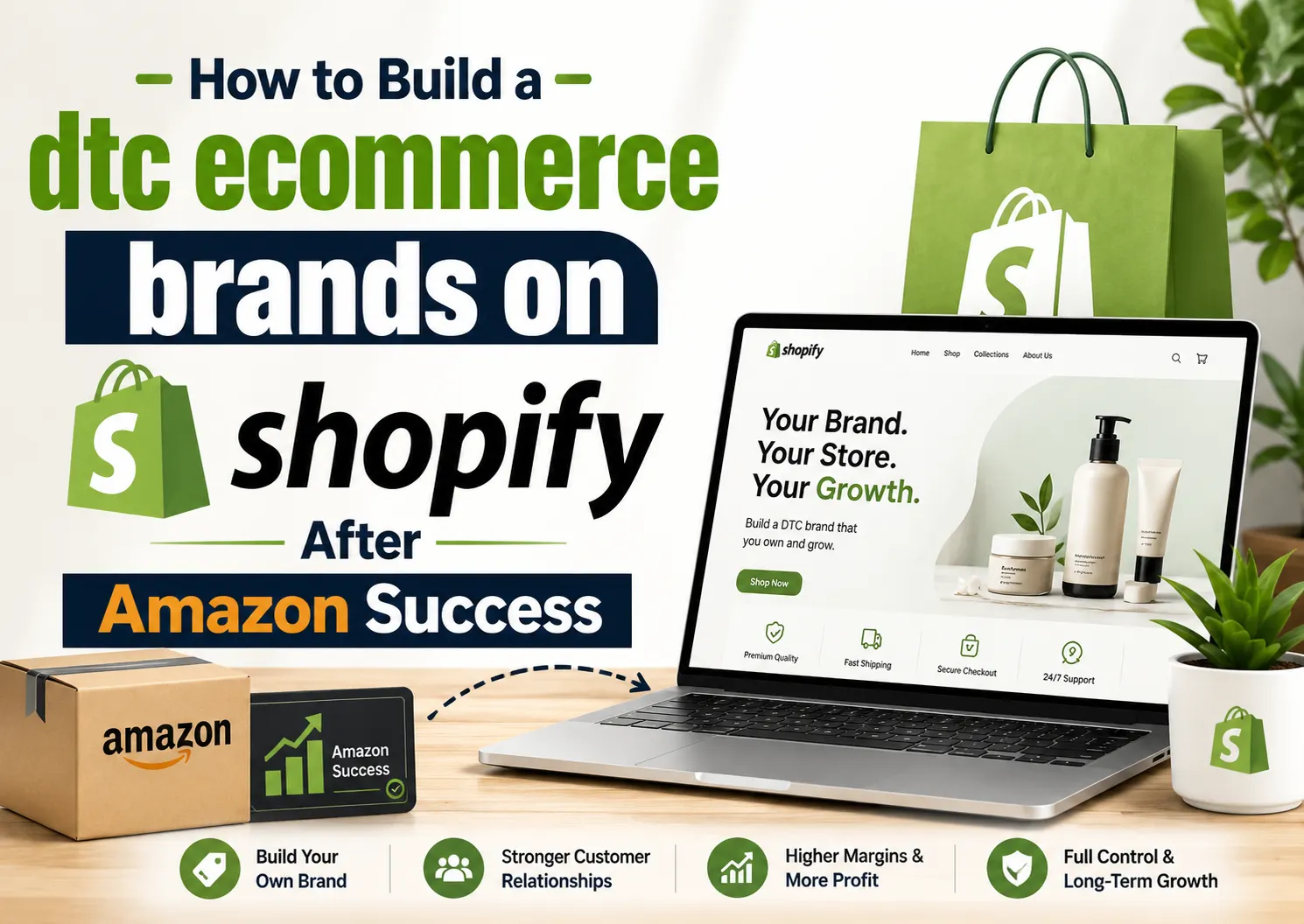
How to Build DTC Ecommerce Brands on Shopify After Amazon Success
How to Build DTC Ecommerce Brands on Shopify After Amazon Success Building DTC ecommerce brands after Amazon success isn’t about…

Building DTC ecommerce brands after Amazon success isn’t about leaving Amazon; it’s about owning your customers.Β
Many Amazon sellers eventually struggle with the same challenges: shrinking margins, limited customer data, and little control over repeat purchases.Β
That’s where Shopify changes the game. It gives your DTC brand ownership of the customer journey, loyalty, and long-term growth.Β
This guide shows how to turn Amazon success into a scalable Shopify-powered DTC business.
Amazon helps brands get discovered; Shopify helps brands get remembered.
The strongest DTC brands in 2026 don’t choose Amazon or Shopify. They build both together.Β
Amazon drives marketplace visibility, while Shopify creates a direct-to-consumer ecosystem that improves customer retention, higher margins, and long-term brand value.
If you’re already selling on Amazon, this guide shows how to build a Shopify store that supports sustainable DTC growth instead of competing with your marketplace sales.
Amazon brings reach; Shopify builds customer relationships and repeat revenue.
A successful DTC ecommerce brand controls marketing, loyalty, customer data, and post-purchase experiences.
Traffic alone doesn’t grow revenue. Every product page, checkout, and mobile experience should be built for conversions.
Top-performing brands combine Amazon, Shopify, email marketing, social commerce, and paid ads into one connected ecosystem.
Let’s start with the most basic question: what are DTC brands?
A DTC brand sells products directly to customers instead of relying entirely on marketplaces or retail stores. That means customers buy from your own website, interact with your brand, and return to your store when they need another purchase.
It’s a simple shift, creating a big impact though.
Amazon owns the marketplace experience. Shopify lets you own the brand experience.
Think about it. A customer buys your product on Amazon. Great sale. But you don’t control follow-up emails, loyalty rewards, subscriptions, or personalized offers. With Shopify, you do.
That’s why DTC ecommerce brands are growing faster across beauty, wellness, fashion, home dΓ©cor, supplements, and lifestyle categories.
The ecommerce direct-to-consumer brand criteria usually include:
It’s less about having a website, and more about creating an ecosystem customers remember.
One mistake we often see at Krolog? Sellers launch Shopify only because “everyone says you need a website.”
Wrong reason.
The website should solve a business problem, like lower acquisition costs, more repeat purchases, or improved margins. Without that strategy, Shopify becomes another expense instead of another revenue channel.
Amazon is still one of the fastest ways to scale products; no doubt.
But relying only on Amazon creates limitations over time.
That’s where Shopify changes the game.
The smartest DTC ecommerce brands use Amazon to acquire customers and Shopify to build lasting relationships beyond a single purchase.
Turn Your Amazon Success Into a Scalable DTC Brand
Many top DTC brands start with marketplace validation before investing in Shopify ecommerce development.
It’s a smarter expansion path than launching hundreds of products on Shopify from day one.
The biggest takeaway? Amazon proves demand;Β Shopify builds the brand that customers actually come back to.
This is where most Amazon sellers get it wrong.
Nothing happens.
A Shopify store isn’t another marketplace listing. It’s your brand’s home. The experience has to feel different.
Don’t move your entire catalog. Start with products that already have demand. Your Amazon data tells you everything you need: best sellers, repeat purchases, high-margin SKUs, and products customers actually search for.
Build your Shopify store around those winners first.
Customers don’t visit Shopify looking for the cheapest option. They want a reason to buy from you.
Include:
This is what separates ordinary stores from memorable DTC brands.
Amazon owns customer communication; Shopify gives it back.
Set up welcome emails, abandoned cart reminders, loyalty rewards, post-purchase emails, and SMS campaigns before driving traffic.
The biggest shift we see? Successful DTC ecommerce brands spend as much time on retention as acquisition. Repeat customers almost always cost less than finding new ones.
A beautiful Shopify store means nothing if customers can’t navigate it.
We’ve audited stores with expensive themes that converted poorly because the buying journey was confusing.
Good Shopify ecommerce development focuses on function first.
| Feature | Why It Matters |
|---|---|
| Mobile-first design | Most DTC traffic comes from mobile. |
| Fast page speed | Reduces bounce rates and improves conversions. |
| Simple navigation | Helps customers find products quickly. |
| Clear product pages | Answer buying questions before checkout. |
| Secure checkout | Builds trust and reduces abandonment. |
Every click should move customers closer to purchase, not create friction.
Small improvements usually create bigger conversion gains than flashy redesigns.
Traffic isn’t the problem for many sellers; conversion is.
Shopify conversion optimization is the process of turning more visitors into buyers without increasing ad spend.
Launching isn’t the finish line.
Strong Shopify store optimization means testing product pages, checkout flow, homepage messaging, pop-ups, and mobile usability regularly.
Track conversion rate, add-to-cart rate, checkout completion, and returning customer rate every week. Those numbers usually reveal problems before revenue drops.
Almost every failed Shopify launch follows a familiar pattern.
Another mistake? Expecting Shopify sales overnight.
Amazon gives you built-in traffic; Shopify doesn’t. You’ll need SEO, paid ads, content, influencers, and retention working together.
Build gradually.
That’s how scalable DTC ecommerce brands grow in 2026.
Every successful DTC brand didn’t start as a household name. They started with one product, one audience, and one clear promise.
Look at some of the biggest DTC brands today. They don’t just sell products; they build experiences customers remember.
| Top DTC Brand Strategy | What Amazon Sellers Can Learn |
|---|---|
| Strong brand storytelling | Build an emotional connection beyond product features. |
| First-party customer data | Collect emails and SMS subscribers from day one. |
| Loyalty and subscription programs | Increase repeat purchases and customer lifetime value. |
| Consistent branding across channels | Keep Amazon, Shopify, and social media aligned. |
Some of the top DTC brands like Allbirds, Gymshark, Glossier, and Native proved one thing: marketplaces help discover products, but owned channels build loyal communities.
The lesson is simple: don’t chase every trend; build a brand customers recognize whether they shop on Amazon, Shopify, Instagram, or Google.
The next wave of DTC ecommerce brands is becoming omnichannel. Brands are combining Amazon, Shopify, TikTok Shop, Walmart Marketplace, and email marketing into one connected customer journey instead of treating each platform separately.
Building a Shopify store is easy; building a store that converts consistently is different.
At Krolog, we help Amazon sellers turn marketplace success into a scalable DTC ecommerce business with a strategy-first approach.
Our Shopify growth services include:
The goal isn’t to replace Amazon but to build another profitable revenue channel that you fully own.
Amazon is an incredible launchpad, but long-term growth comes from owning your audience, your customer data, and your brand experience.
The strongest DTC ecommerce brands don’t rely on one platform. They use Amazon for discovery and Shopify for retention, repeat purchases, and higher customer lifetime value.
Your Amazon business got customers through the door. Your Shopify store is what keeps themΒ
coming back.
DTC ecommerce brands sell products directly to customers through their own website instead of relying entirely on marketplaces or retailers. This gives brands more control over customer relationships and marketing.
Yes, in fact, many successful DTC brands use Amazon and Shopify together. Amazon drives product discovery, while Shopify helps build repeat purchases and customer loyalty.
Shopify gives brands ownership of customer data, email marketing, subscriptions, loyalty programs, and the complete shopping experience; things Amazon doesn't fully provide.
A Shopify store can launch in a few weeks, but building a profitable DTC ecommerce brand takes consistent optimization, marketing, and customer retention over time.
Sandeep K, Founder & CEO of Krolog Inc., has over 10 years of experience helping ecommerce brands grow across Amazon, Shopify, Walmart Marketplace, SEO, PPC, and DTC marketing strategies.
Selling on Amazon is just the first milestone. Building a profitable Shopify brand is the next one.
Krolog helps Amazon sellers launch, optimize, and scale DTC ecommerce brands through Shopify store development, conversion optimization, SEO, and multi-channel growth strategies.Β
Request a free Shopify audit and discover how your brand can grow beyond the marketplace.
How to Build DTC Ecommerce Brands on Shopify After Amazon Success Building DTC ecommerce brands after Amazon success isn’t about…

Amazon Suspension Appeal Rejected? What Sellers Should Do Next Your Amazon suspension appeal was rejected. Frustrating? Absolutely. But it doesn’t…
Shopify SEO Checklist 2026: The Steps That Actually Move the Needle Shopify SEO checklist isn’t just another list of technical…
Krolog was born from a simple yet powerful idea: to empower businesses with the tools and strategies needed to thrive in the ever-evolving digital marketplace. Our journey is a testament to the transformative impact of strategic E-commerce solutions.


Copyright Β© 2026 All Right ReservedΒ