Nav Preview
  • Best Amazon Keyword Research Tools in 2026: Features, Pricing & Comparison

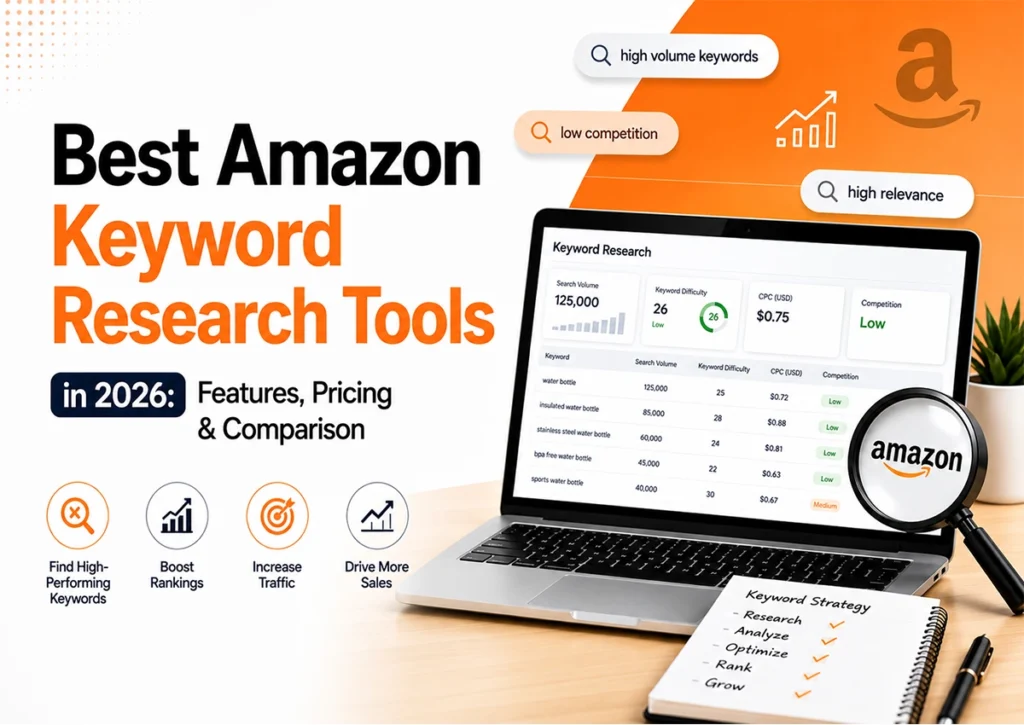
    Best Amazon Keyword Research Tools in 2026 comparison showing features, pricing, and keyword research dashboard

    Introduction

    Choosing the right Amazon keyword research tool can make or break sellers’ Amazon game in 2026. From discovering high-converting search terms to tracking rankings and optimizing listings for Amazon’s AI-driven shopping experience, keyword research now influences every stage of marketplace success.
    This guide compares the best Amazon keyword research tools, pricing, features, use cases, and expert recommendations to help sellers choose the right solution for sustainable growth.

    Summary

    Amazon keyword research is no longer limited to finding high-volume search terms. Modern Amazon keyword research tools help sellers discover profitable keywords, monitor ranking performance, analyze competitors through reverse ASIN lookup, optimize listings, and improve advertising efficiency.

    Whether you’re a beginner using a free Amazon keyword research tool or an established brand investing in enterprise software, choosing the right platform directly impacts visibility, conversions, and long-term profitability.

    Β 

    Key Takeaways

    Better Keywords Mean Better Rankings

    Effective keyword research for Amazon helps products appear in relevant customer searches while improving both organic and paid visibility.

    Keyword Tracking Matters

    A reliable Amazon keyword ranking performance tracking tool helps sellers understand whether optimization efforts are delivering measurable improvements.

    AI Is Changing Search

    Amazon Rufus and conversational shopping experiences now reward listings that answer customer intent instead of repeating keywords.

    Tool Selection Depends on Growth Stage

    Not every seller needs enterprise software. Beginners often benefit from a free Amazon keyword research tool, while scaling brands typically require advanced keyword tracking and competitor intelligence.

    What Is Amazon Keyword Research and Why Does It Matter More in 2026 Than Ever Before?

    Amazon keyword research is the process of identifying the exact words and phrases shoppers use before purchasing products.
    Sounds simple.
    But today’s marketplace is much smarter than it was even two years ago.
    Customers no longer type only “coffee mug.” They search conversationally.
    “Best insulated coffee mug for long office hours.”
    “BPA-free lunch box for toddlers.”

    Amazon’s algorithms, and now Rufus AI, understand these longer, intent-driven searches far better than before. Consequently, keyword research has shifted from simply chasing search volume to understanding customer intent.
    That’s why choosing the best Amazon keyword research tool has become essential rather than optional.

    Β 

    Β 

    Entity Overview

    Category: Amazon Marketplace SEO Tool

    Related Entities:

    • Amazon Seller Central
    • Amazon Advertising
    • Amazon Rufus
    • Amazon SEO
    • Reverse ASIN Lookup
    • Search Query Performance
    • Amazon Brand Analytics
    • Product Opportunity Explorer

    How Do Amazon Keyword Research Tools Actually Work?

    Most sellers assume these platforms simply estimate search volume.
    That’s only one piece of the puzzle. Today’s Amazon keyword research tools combine multiple datasets to provide actionable insights.

    Typically, they analyze:

    For example, imagine you’re launching a reusable water bottle.
    Instead of targeting only “water bottle,” an advanced Amazon keyword finder may reveal profitable opportunities like:

    • leakproof sports bottle
    • insulated gym bottle
    • stainless steel travel flask
    • BPA-free hiking bottle

    Although search volume may be lower individually, collectively these long-tail keywords often generate higher conversion rates because purchase intent is stronger.

    Expert Observation

    One mistake we frequently see at Krolog is sellers optimizing for the biggest keyword instead of the most relevant keyword.
    A term with 5,000 monthly searches and strong buying intent often outperforms one with 100,000 searches but weak conversion potential. Intent almost always beats volume.

    What Are Backend Keywords on Amazon?

    Backend keywords are hidden search terms added inside Amazon Seller Central.
    Customers never see them, but Amazon does.
    They’re designed to capture additional search variations without cluttering product titles or bullet points.

    Effective backend keywords include:

    • Alternate spellings
    • Synonyms
    • Regional terminology
    • Common abbreviations
    • Misspellings buyers frequently use

    Avoid repeating words already present in your listing. Amazon indexes duplicate terms only once. Likewise, stuffing irrelevant keywords rarely improves rankings and can reduce listing relevance.

    Β 

    How Has Amazon’s Rufus and Alexa for Shopping Changed Keyword Research in 2026?

    This is arguably the biggest shift sellers need to understand. Amazon’s AI assistant, Rufus, doesn’t simply match keywords; it interprets intent.

    If someone asks:
    “What’s the best cutting board for meal prep?”
    Rufus evaluates listings based on product attributes, customer reviews, content quality, images, and contextual relevance.

    As a result, keyword optimization now focuses on answering customer questions rather than repeating exact phrases. Accordingly, listings should include:

    The best Amazon keyword search tools increasingly recommend semantically related keywords instead of isolated exact-match phrases.

    Option

    Best For

    Strengths

    Limitations

    TypicalFit

    Freelancer

    Small Budgets

    Flexible and Affordable

    Limited Strategic Depth

    New Sellers

    Small agency

    Growing Brands

    PPC and Listing Support

    Limited Operational Oxpertise

    10+ SKUs

    Full-Service Agency

    Scaling Businesses

    Complete Growth Support

    Helium 10 vs. Jungle Scout in 2026: Which Is the Better Amazon Keyword Research Tool?

    Choosing between Helium 10 and Jungle Scout has become one of the most common questions among Amazon sellers. Both platforms dominate the market, yet they serve slightly different audiences.

    If you’re looking for an all-in-one Amazon keyword research tool with advanced optimization features, Helium 10 usually takes the lead. On the other hand, Jungle Scout is known for its intuitive interface and product research capabilities, making it a popular choice for beginners.

    FeatureHelium 10Jungle Scout
    Keyword Research5 stars4 stars
    Reverse ASIN LookupExcellentVery Good
    Keyword TrackingAdvancedGood
    Listing OptimizationExcellentGood
    PPC FeaturesComprehensiveLimited
    Product ResearchExcellentExcellent
    Ease of UseModerateBeginner Friendly
    Best ForGrowing & Enterprise SellersNew & Mid-Level Sellers

    Expert Observation

    At Krolog, we’ve worked with brands using both platforms. Helium 10 often becomes the preferred choice once sellers begin scaling because it combines keyword research, listing optimization, competitor tracking, PPC insights, and operational tools under one ecosystem.

    However, Jungle Scout remains a great starting point for newer sellers who need straightforward insights without a steep learning curve.

    Best Amazon Keyword Research Tools Comparison

    Not every seller needs enterprise software. Accordingly, choosing the right solution depends on your catalog size, advertising budget, and growth goals.

    Tool

    Best For

    Starting Price

    Helium 10

    Complete Amazon Growth

    ~$39/month

    Jungle Scout

    Product & Keyword Research

    ~$49/month

    DataDive

    Advanced Listing Optimization

    Custom Pricing

    SellerApp

    PPC & Keyword Intelligence

    ~$49/month

    Viral Launch

    Product Launch & Keyword Research

    ~$69/month

    ZonGuru

    Small & Mid-Sized Sellers

    ~$49/month

    Amazon Brand Analytics

    Brand Registered Sellers

    Free

    Each platform approaches Amazon keyword research differently. While some prioritize competitor analysis, others emphasize listing optimization or PPC intelligence.

    How Much Do Amazon Keyword Research Tools Cost in 2026?

    Pricing varies significantly depending on features, user limits, and reporting depth.

    Beginner Tools

    Typically range between $30–$60/month and include:

    • Keyword discovery
    • Basic search volume estimates
    • Reverse ASIN lookup
    • Limited keyword tracking

    Professional Plans

    Usually costs $80–$150/month, adding:

    • Historical keyword trends
    • Advanced competitor analysis
    • Listing optimization tools
    • PPC integrations
    • Rank tracking

    Enterprise Solutions

    Often exceeds $250/month, offering:

    • Multi-user access
    • API integrations
    • Advanced analytics
    • Inventory intelligence
    • Agency reporting

    As a result, sellers should evaluate total business needs rather than select tools based solely on price.

    How Much Does Helium 10 Cost in 2026?

    Helium 10 continues offering multiple pricing tiers designed for different business stages.
    Generally:

    • Free Plan – Limited daily searches
    • Starter Plan – Around $39/month
    • Platinum Plan – Around $99/month
    • Diamond Plan – Around $279/month

    Prices may change during promotional periods, although the platform consistently remains one of the most feature-rich Amazon keyword research tools available.

    Are Free Amazon Keyword Tools Worth Using in 2026?

    The short answer? Yes, but only to a point.
    A free Amazon keyword research tool works well if you’re:
    • Launching your first product.
    • Learning Amazon SEO.
    • Validating product ideas.
    • Performing basic competitor research.

    However, free tools often lack:

    • Accurate search volume.
    • Keyword ranking history.
    • Reverse ASIN depth.
    • Competitor intelligence.
    • Keyword tracking.

    Consequently, most growing sellers eventually upgrade to paid software once their catalog
    complexity increases.

    Common Mistakes Sellers Make During Amazon Keyword Research

    Even experienced sellers occasionally misuse keyword tools. Some of the most common mistakes include:

    • Chasing Search Volume Alone: Higher search volume doesn’t always mean better conversions. Long-tail keywords often generate more qualified traffic.
    • Ignoring Search Intent: Understanding intent matters just as much as keyword volume.
    • Forgetting Backend Keywords: Many listings miss valuable indexing opportunities simply because backend keyword fields remain underutilized.
    • Never Updating Keywords: Search behavior changes, competitors evolve, Amazon algorithms improve. Accordingly, keyword research should become an ongoing process rather than a one-time exercise.

    Emerging Trends in Amazon Keyword Research for 2026

    Keyword research is becoming increasingly intelligent. Several developments are reshaping marketplace optimization.

    • AI-Driven Search: Amazon Rufus now understands customer intent better than exact keyword repetition.
    • Semantic SEO: Listings optimized around topics rather than isolated keywords perform better over time.
    • Voice Commerce: Alexa-enabled shopping continues to influence conversational keyword research.
    • Predictive Keyword Intelligence: Leading Amazon keyword tracking software increasingly forecasts keyword trends before they peak.
    • Profitability-Based Keyword Selection: Rather than targeting every high-volume keyword, successful brands prioritize keywords with stronger conversion potential and higher profitability.

    Our Evaluation Methodology

    At Krolog, we evaluate every Amazon keyword research tool using practical seller requirements instead of marketing claims. Our framework considers:

    • Keyword database accuracy.
    • Reverse ASIN capabilities.
    • Keyword ranking performance tracking.
    • Search volume reliability.
    • Ease of use.
    • Pricing flexibility.
    • Listing optimization features.
    • AI and Rufus readiness.
    • Integration with PPC workflows.
    • Overall return on investment.

    Β 

    About the Author

    Sandeep K., Founder and CEO of Krolog Inc., is an Amazon marketplace consultant with over 10 years of experience in Amazon SEO, PPC, keyword strategy, inventory planning, and marketplace growth.
    He has helped brands across multiple product categories improve visibility, increase profitability, and scale sustainably.

    Need Help Improving Your Amazon Rankings?

    Keyword research is only the first step. Turning those insights into higher rankings and stronger sales requires the right strategy.

    Whether you need listing optimization, Amazon SEO, PPC management, or a complete marketplace growth plan, Krolog helps brands transform keyword data into measurable business results.

    Request a free Amazon marketplace audit today and discover untapped keyword opportunities, listing improvements, and growth strategies tailored to your business.

    Final Verdict

    Choosing the best Amazon keyword research tool isn’t about finding the platform with the longest feature list, it’s about selecting the one that matches your current stage of growth.
    If you’re just starting out, a free Amazon keyword research tool or Jungle Scout may provide everything you need. As your catalog expands and advertising becomes more competitive, investing in platforms like Helium 10 or DataDive can unlock deeper insights, stronger optimization opportunities, and measurable ranking improvements.

    More importantly, remember that tools alone don’t drive growth. Strategy does.
    At Krolog, we’ve seen brands dramatically improve organic visibility by combining the right keyword research tools with data-driven listing optimization, competitor analysis, and continuous performance tracking. Technology provides the data, but it’s the strategy behind that data that delivers sustainable results.

    FAQ: Frequently Asked Questions

    Amazon Brand Analytics is an excellent free option for Brand Registered sellers. Helium 10’s free plan also offers limited keyword research capabilities, making it a solid starting point.

    Most tools use proprietary algorithms based on marketplace data, historical trends, and clickstream analysis. While estimates are not exact, leading platforms like Helium 10 and Jungle Scout are generally reliable for comparative decision-making.

    Reverse ASIN lookup identifies the keywords a competitor’s product ranks for. Helium 10’s Cerebro and DataDive are widely regarded as industry leaders for this functionality.

    Focus on one primary keyword, several secondary keywords, and multiple long-tail phrases that naturally fit your listing. Avoid keyword stuffing; Amazon increasingly rewards relevance over repetition.

    Beginners should consider Jungle Scout, Helium 10’s free plan, or Amazon Brand Analytics. As your business grows, upgrading to a more comprehensive platform becomes worthwhile.

    Related Article

    How to Write an Amazon Plan of Action (POA) in 2026 That Actually Gets Approved

    How to Write an Amazon Plan of Action (POA) in 2026 That Actually Gets Approved

    How to Write an Amazon Plan of Action (POA) in 2026 That Actually Gets Approved Account suspended? Few things stress…

    How Amazon Sellers Can Drive Traffic to Their Shopify Store in 2026

    How Amazon Sellers Can Drive Traffic to Their Shopify Store in 2026

    How Amazon Sellers Can Drive Traffic to Their Shopify Store in 2026 Selling on Amazon is exciting. Sales come fast,…

    Amazon Conversion Rate: How to Calculate It and Improve It in 2026

    Amazon Conversion Rate: How to Calculate It and Improve It in 2026

    How Much Does Amazon Advertising Cost in 2026? (CPC, Budgets & ROI Explained) Advertising on Amazon isn’t expensive; poor advertising…

    Ready to Scale Your Amazon Brand?

    If you’re looking for expert-led Amazon advertising strategies, a performance-focused Amazon PPC strategy, and real growth, get in touch with us at Krolog, where Amazon experts will help you build a winning Amazon advertising system tailored to your business.

    Scroll to Top