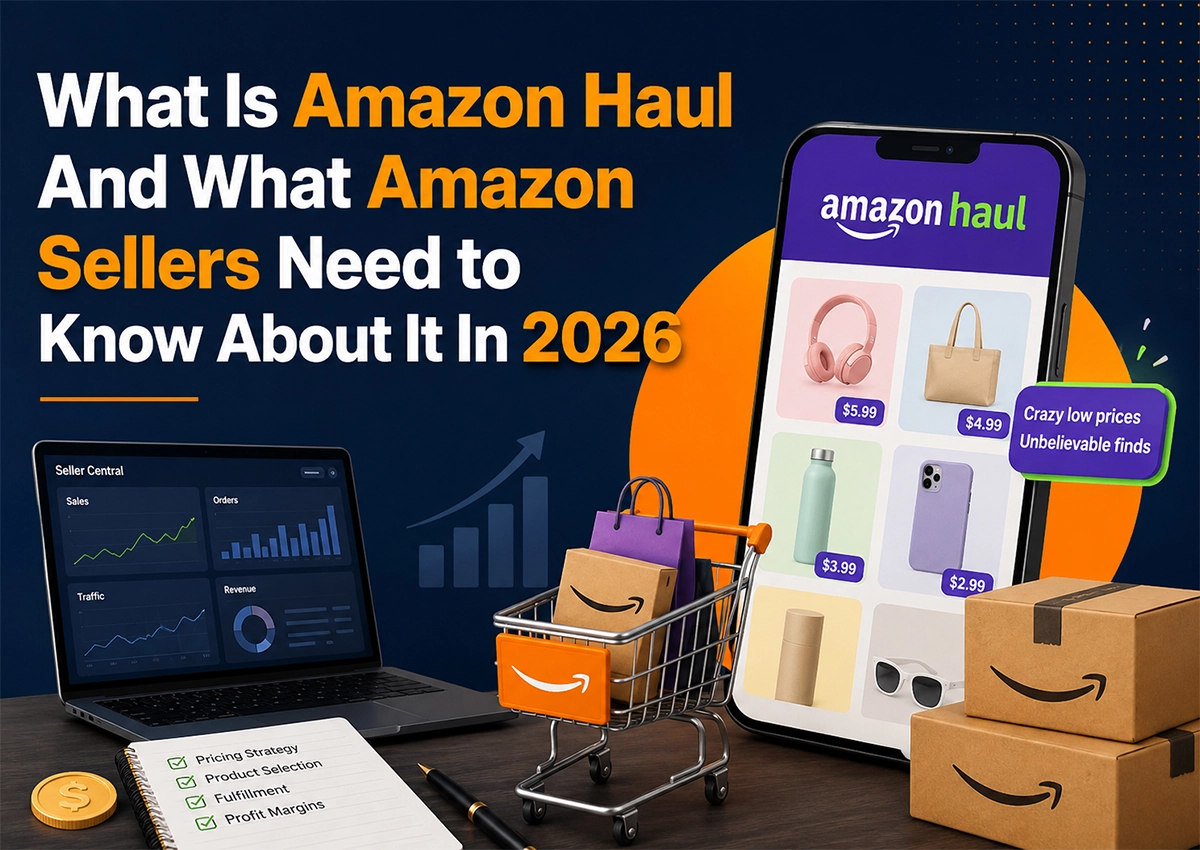
What Is Amazon Haul And What Amazon Sellers Need to Know About It In 2026
What Is Amazon Haul And What Amazon Sellers Need to Know About It In 2026 Budget shopping isn’t new. What’s…
Budget shopping isn’t new. What’s changing is where shoppers are doing it.
If you’ve recently heard people asking what Amazon Haul is, you’re not alone. Amazon quietly introduced a new shopping experience aimed at customers looking for trendy, low-cost products without leaving the Amazon ecosystem.
For shoppers, it’s another way to save money. For sellers, it’s a completely different opportunity.
And honestly, it’s making many brands rethink how they compete against low-cost marketplaces like Temu and Shein.
But jumping in without understanding how Amazon Haul works? Probably not the smartest move.
In this guide, we’ll explain βwhat is Amazon Haulβ, how it compares with the traditional Amazon marketplace, whether Amazon Haul is legit, and what sellers should consider before making it part of their growth strategy in 2026.
Amazon has spent years building the world’s largest online marketplace. Now it’s experimenting with something different.
Amazon Haul focuses on affordable products, mobile-first shopping, and value-conscious buyers. While it still operates under Amazon’s ecosystem, the shopping experience, pricing expectations, and customer behavior are noticeably different.
For sellers, it creates both opportunity and pressure. Lower-priced products can reach a massive audience. At the same time, pricing, logistics, and margins become more important than ever.Β
Understanding where Amazon Haul fits into your overall marketplace strategy will help you decide whether it’s the right channel for your business.
It focuses on affordable products and attracts shoppers looking for low-cost everyday items.
Product selection, pricing expectations, and shopping behavior differ significantly.
Sellers still need optimized listings, competitive pricing, and efficient operations to remain profitable.
Commodity products often perform better than premium or luxury brands.
Brands that evaluate margins, demand, and customer expectations before expanding usually perform better over time.
The simplest way to explain Amazon Haul meaning is this:
It’s a dedicated shopping experience inside Amazon built around affordable products.
Think of it as Amazon creating its own answer to the rapid growth of ultra-budget shopping platforms.
Instead of competing only through Prime delivery or massive product selection, Amazon Haul focuses on one thing: Value.
Customers browsing Amazon Haul expect inexpensive products across categories like home essentials, beauty, fashion accessories, electronics, lifestyle items, pet supplies, and seasonal products.
Most items fall into lower price ranges compared to traditional Amazon listings. The concept is actually pretty simple.
Imagine someone wants a phone stand.
On the regular Amazon marketplace, they might compare products priced between $15 and $40.
Inside Amazon Haul, they’re more likely to browse similar products priced much lower while adding several inexpensive items to the same order.
One mistake we’re already seeing is brands assuming Amazon Haul is simply another category inside Amazon. It isn’t.
Customers entering Amazon Haul behave differently.
They browse and compare.
Adding multiple inexpensive products instead of researching one premium purchase.
The brands that understand that buying behavior early will likely have a stronger advantage as the platform continues to evolve.
Category: Budget E-commerce Marketplace
At first glance, Amazon Haul looks like the regular Amazon app, but when you look closer, youβll notice the difference.
Products are grouped around affordability. Customers browse collections of low-cost items instead of premium brands. Consequently, the experience feels more like discovering deals than searching for a specific product.
Most purchases are impulse-driven. Someone comes in for a phone case. They leave with a desk organizer, reusable straws, and a pet toy. That’s exactly how Amazon designed it.
For sellers, this means product pricing, perceived value, and listing quality matter even more than before.
Many sellers assume Amazon Haul simply replaces the standard marketplace. It doesn’t.
Instead, it serves a different customer segment.
| Factor | Amazon Marketplace | Amazon Haul |
|---|---|---|
| Primary Focus | Wide product selection | Budget-friendly shopping |
| Customer Intent | Planned purchases | Impulse buying |
| Average Pricing | Low to premium | Primarily low-cost |
| Competition | Every price segment | Value-focused products |
| Best For | Most product categories | Affordable, fast-moving items |
Think of it this way. Traditional Amazon is like a large shopping mall, while Amazon Haul feels more like a value outlet where shoppers expect deals every time they browse. Neither is better;Β
they simply solve different shopping needs.
Probably the biggest question online is: “Is Amazon Haul legit?”
Yes. Amazon Haul is an official shopping experience created by Amazon itself. It isn’t a third-party website or separate marketplace pretending to be Amazon.
That’s why searches like these continue growing:
The confusion mostly comes from its newer interface and lower-priced products. Orders, payments, and customer support all operate within Amazon’s ecosystem.
Imagine a shopper searching for kitchen storage bins.
On the regular marketplace, they compare premium brands, customer reviews, and delivery speed.
Inside Amazon Haul, they’re usually asking a different question:
“Can I get something that works well without spending much?” That shift in buying intent changes everything.
We’ve seen many sellers focus only on lower pricing when entering value-driven marketplaces.
That’s rarely enough.
Customers still compare ratings, images, delivery expectations, and product descriptions before clicking Buy Now.
Price attracts attention; trust closes the sale.
Not every product belongs on Amazon Haul. That’s the first thing sellers should understand.
If your brand competes on craftsmanship, premium materials, or luxury positioning, Amazon Haul may not be the right fit.
However, if you sell everyday essentials, trending accessories, home organizers, beauty tools, pet products, or inexpensive lifestyle items, the platform could open up a new audience.
The key is simple: offer value without sacrificing quality.
Take two brands.
One sells handcrafted leather wallets for $80. The other sells minimalist card holders for under $15.
Both products are useful.
But only one naturally fits the buying behavior inside Amazon Haul.
Matching the marketplace to your product matters just as much as matching the product to the customer.
That depends on your business model.
For brands with healthy margins on low-cost products, Amazon Haul can increase visibility and attract high-volume sales.
For others, the pressure to stay competitive on price may outweigh the benefits.
Before expanding, ask yourself:
If the answer is yes, Amazon Haul may be worth testing. If not, your resources may deliver a better return in the traditional Amazon marketplace.
Learn how to optimize your listings, pricing, and strategy for Amazon Haul and the broader Amazon marketplace.
This is another common search. “Any way to avoid Amazon Haul shipping limit?”
In reality, shipping policies are determined by Amazon. Sellers can’t bypass or customize those limits on their own.
Instead of trying to avoid them, focus on what you can control:
Policy changes happen regularly, so staying informed is far more valuable than relying on workarounds.
Launching on Amazon Haul isn’t just about listing cheaper products. Some of the most common mistakes include:
One assumption we hear often is:
“If my product sells on Amazon, it’ll automatically sell on Amazon Haul.”
Not necessarily. The audience is different; the buying journey is shorter.
Success comes from understanding customer intent, not simply lowering your price.
Amazon Haul is still evolving. That’s what makes it interesting.
Amazon is clearly responding to the growing demand for affordable shopping experiences while competing with fast-growing low-cost marketplaces.
Here are the biggest trends we’re watching.
Launching on Amazon Haul isn’t just about listing lower-priced products.
At Krolog, we help brands evaluate whether Amazon Haul aligns with their growth strategy before they invest time and resources. Our team supports sellers with:
The goal isn’t simply to sell more; it’s to grow profitably.
So, what is Amazon Haul?
It’s Amazon’s answer to the growing demand for affordable online shopping.
For shoppers, it offers low-cost products across popular everyday categories. For sellers, it creates another opportunity to reach price-conscious customers.
But it isn’t the right fit for every brand. Before joining Amazon Haul, evaluate your margins, product positioning, fulfillment capabilities, and long-term goals.
The sellers who succeed won’t be the ones with the cheapest products. They’ll be the ones who combine competitive pricing with strong listings, efficient operations, and a clear marketplace strategy.
That’s what creates sustainable growth in 2026.
Amazon Haul is a value-focused shopping experience within Amazon that features affordable products across multiple everyday categories. It targets shoppers looking for budget-friendly deals.
Yes, Amazon Haul is an official Amazon shopping experience. It is operated by Amazon, making it a legitimate platform for both shoppers and eligible sellers.
Amazon Haul is real. Although some shoppers compare it with other discount marketplaces, it remains part of Amazon's ecosystem and follows Amazon's marketplace policies.
The traditional Amazon marketplace includes products across all price ranges. Amazon Haul focuses primarily on lower-priced items designed for value-conscious shoppers.
It depends on your products and margins. Sellers with affordable, high-volume products may benefit the most, while premium brands should carefully evaluate whether the pricing model aligns with their business.
No, shipping policies are set by Amazon. Instead of looking for ways around them, sellers should optimize inventory planning, pricing, and fulfillment efficiency.
Sandeep K., Founder & CEO of Krolog Inc., is an Amazon marketplace consultant with over 10 years of experience helping brands grow across Amazon, Shopify, Walmart, and other ecommerce platforms.Β
His expertise spans Amazon SEO, PPC management, listing optimization, marketplace expansion, and ecommerce growth strategy. Over the years, he has helped businesses improve visibility, increase conversions, and scale sustainably through data-driven decision-making rather than guesswork.
Amazon Haul is another reminder that ecommerce never stands still.
New shopping experiences create new opportunities, but only for brands that adapt quickly. Whether you’re evaluating Amazon Haul, optimizing existing listings, or planning your next marketplace expansion, success comes from having the right strategy behind every decision.
At Krolog, we help brands navigate marketplace changes with data-driven Amazon SEO, listing optimization, PPC management, and growth strategies designed for long-term profitability, not just short-term sales.
Request a free Amazon marketplace audit today and discover where your brand can unlock its next growth opportunity.
What Is Amazon Haul And What Amazon Sellers Need to Know About It In 2026 Budget shopping isn’t new. What’s…
What Is a Good Conversion Rate on Shopify? 2026 Benchmarks for Ecommerce Brands You launched your Shopify store. Traffic came…
Amazon Conversion Rate Optimization Data-Driven Strategies: How to Increase Sales in 2026 Getting traffic isn’t the hard part anymore; converting…
Krolog was born from a simple yet powerful idea: to empower businesses with the tools and strategies needed to thrive in the ever-evolving digital marketplace. Our journey is a testament to the transformative impact of strategic E-commerce solutions.


Copyright Β© 2026 All Right ReservedΒ