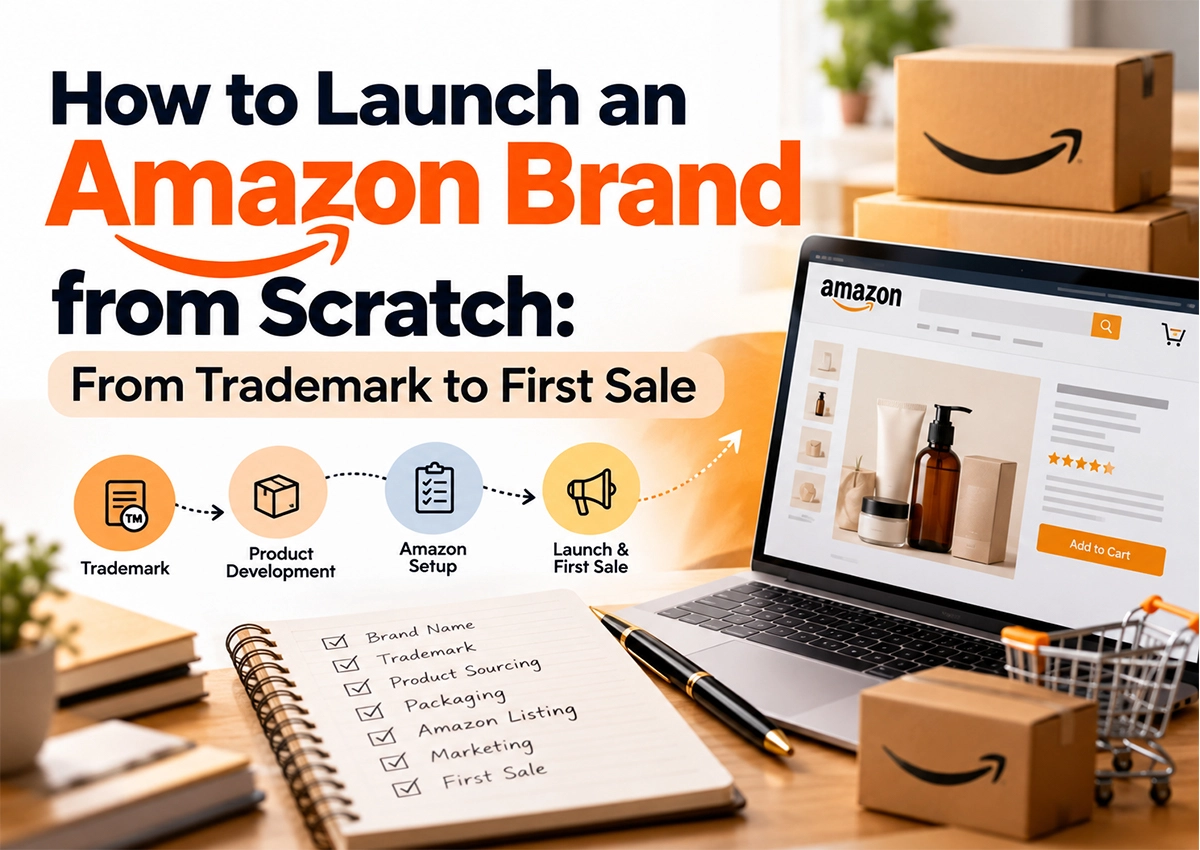
How to Launch an Amazon Brand from Scratch: From Trademark to First Sale
How to Launch an Amazon Brand from Scratch: From Trademark to First Sale Launching an Amazon brand looks simple from…

Launching an Amazon brand looks simple from the outside. Find a product, add a logo, create a listing, and get started.
In reality, there are quite a few things that go into launching a successful Amazon Brand.
You need the right product, reliable Amazon product sourcing, a protectable brand, strong Amazon Brand Registry setup, conversion-focused content, and a launch plan that gets your first customers without burning through your budget.
This guide breaks down how to launch an Amazon brand from scratch, from Amazon trademark registration and product research to your first sale.
Building an Amazon private label business is not just about finding a product and uploading it.
You are building an asset.
That means researching demand, checking competitors, protecting your intellectual property, creating a strong listing, and launching with enough traffic to generate meaningful data.
Accordingly, the first sale should not be your only goal. You want the systems behind that sale to support repeatable growth.
Use Amazon product research, competitor research, demand signals, margins, and customer reviews before committing inventory.
Amazon trademark registration and Brand Registry can help establish Amazon brand ownership and unlock important brand protection tools.
Your images, title, bullets, Amazon product description, keywords, and A+ Content need to work together.
Your first order tells you very little alone. Search terms, clicks, conversion rate, CPC, and customer behavior tell you much more.
The first question most new sellers ask is: how to find products to sell on Amazon?
The better question is: Which product has enough demand, manageable competition, healthy margins, and room for differentiation?
That changes the research process.
Start with:
For example, suppose you find 20 similar kitchen organizers.
Don’t immediately launch number 21.
Read the reviews.
Maybe buyers complain about weak packaging, poor instructions, or difficult installation. That is useful information. Your product can solve that problem.
At Krolog, we often see sellers fall in love with a product before checking the economics. A product can have great demand and still be a terrible business.
Once you have a viable product, move into Amazon product sourcing.
Get multiple supplier quotes. Request samples. Compare materials, packaging, lead times, minimum order quantities, and defect policies.
Then calculate your actual landed cost. Not just the supplier price.
Include:
Otherwise, your β$10 profitβ can disappear surprisingly fast.
A logo doesn’t make a brand protected.
If you want stronger control over your brand on Amazon, consider Amazon trademark registration and understand the relevant trademark requirements for your marketplace.
Then review the Amazon Brand Registry requirements before applying.
Brand Registry can provide access to tools designed to help with brand protection, enhanced content, reporting, and brand-building features.
Another key point: update Store creatives regularly. Amazon shoppers notice fresh visuals, especially during seasonal campaigns.
The key Amazon Brand Registry benefits include stronger control over brand-related product information and access to additional brand tools.
It can also support:
In other words, Brand Registry isn’t just a badge, but an important part of your operating system.
Launch your brand with the right strategyβfrom trademark to your first sale.
If you’re wondering how to create a brand on Amazon, think about the customer experience first.
Your brand name, packaging, product photography, listing copy, A+ Content, and storefront should feel like they belong to the same company.
Getting traffic is only half the job. The listing has to convert it.
Your Amazon listing optimization should cover the title, bullets, images, product description, A+ Content, and search terms.
Start with Amazon keyword research. Find:
Then use those insights naturally.
Your title needs to tell shoppers what the product is quickly without stuffing it
Use the primary Amazon product keywords naturally, communicate the core benefit, and make the product easy to understand.
The same applies to your Amazon product description and bullets. Write for shoppers first.
A shopper cannot physically touch your product. Your images have to do that job.
Strong Amazon product photography should show:
Add infographics where they genuinely help.
Then use Amazon A+ Content to answer the questions shoppers still have.
Common mistake: Spending heavily on inventory and very little on creative. That usually creates an expensive traffic problem later.
So, how do you get your first sale on Amazon? Don’t simply publish the listing and wait.
Build an initial traffic strategy around relevant keywords and audiences.
Amazon PPC for beginners should start with controlled campaigns rather than aggressive spending.
At the same time, continue improving your listing. Your first sale gives you data. Your next 10β20 sales give you patterns.
That distinction matters.
Launch your brand with the right strategyβfrom trademark to your first sale.
Paid traffic can generate early visibility while your listing works toward stronger Amazon organic ranking. But don’t chase sales at any cost. Track:
If a keyword gets plenty of clicks but no orders, investigate.
Don’t automatically increase the bid.
A few mistakes show up again and again.
Amazon is becoming increasingly data- and AI-driven.
Conversational shopping, richer product information, AI-assisted discovery, and changing customer search behavior are making content quality more important.
That means sellers should think beyond exact-match keywords.
Build listings that clearly explain:
That clarity helps both shoppers and increasingly sophisticated search engines understand the product.
Launching an Amazon brand from scratch isn’t one task.
It’s a sequence.
Skip one step, and the cracks usually show later.
At Krolog, we help sellers connect these pieces through Amazon product research, listing optimization, Amazon SEO, PPC, A+ Content, and ongoing account management.
The goal isn’t simply to make your first sale, but to build an Amazon brand that can keep making them.
Start with market and product research. Validate demand, competition, margins, customer pain points, and sourcing options before committing inventory.
Brand Registry has specific eligibility and trademark requirements. Review Amazon's current requirements for your marketplace before beginning enrollment.
There is no fixed timeline. Product demand, listing quality, pricing, reviews, advertising, competition, and launch execution can all affect how quickly a new ASIN generates orders.
Not always, but PPC can help generate initial traffic and collect valuable search-term and conversion data. Start with controlled spending and optimize based on performance.
Trademark your brand where appropriate, enroll in Amazon Brand Registry if eligible, maintain consistent brand information, monitor unauthorized use, and act on potential infringements through the available Amazon tools.
There is no fixed launch budget. Your costs can include product sourcing, samples, Amazon fees, packaging, trademark registration, photography, inventory, and PPC. Start with a realistic contribution-margin calculation rather than choosing a budget based only on competitor spending.
For most new brands, starting with one strong product or a small number of closely related products makes testing easier. It lets you understand demand, conversion, PPC performance, and customer feedback before expanding the catalog.
Avoid making major decisions from only a few days of data. Give campaigns enough time to generate meaningful clicks and conversions, then review search terms, CPC, conversion rate, ACoS, and sales. However, clearly irrelevant or wasteful targets should be addressed sooner.
Both can play different roles. Amazon SEO helps build organic visibility over time, while PPC can generate targeted traffic and valuable search-term data during the launch. The stronger approach is to use PPC insights to continuously improve your listing and organic strategy.
Sandeep K., Founder & CEO, Krolog Inc., brings 10+ years of experience across Amazon SEO, PPC, listing optimization, product strategy, and marketplace growth.
His work focuses on helping brands turn Amazon traffic into sustainable revenue through practical, data-led strategies.
The first sale is important, but the foundation behind it matters more.
From Amazon product research and brand protection to listing optimization, PPC, and ongoing growth, Krolog can help you build the launch strategy around your business goals.
Request a free Amazon account audit today and identify the opportunities your new brand can act on.
How to Launch an Amazon Brand from Scratch: From Trademark to First Sale Launching an Amazon brand looks simple from…

Amazon Store Optimization: A 2026 Checklist for Sellers Your Amazon listing gets the click. Your store decides whether shoppers keep…
Amazon Product Ranking Guide: How to Improve Visibility & Sales in 2026 Getting your product on Amazon is easy. Getting…
Krolog was born from a simple yet powerful idea: to empower businesses with the tools and strategies needed to thrive in the ever-evolving digital marketplace. Our journey is a testament to the transformative impact of strategic E-commerce solutions.


Copyright Β© 2026 All Right ReservedΒ