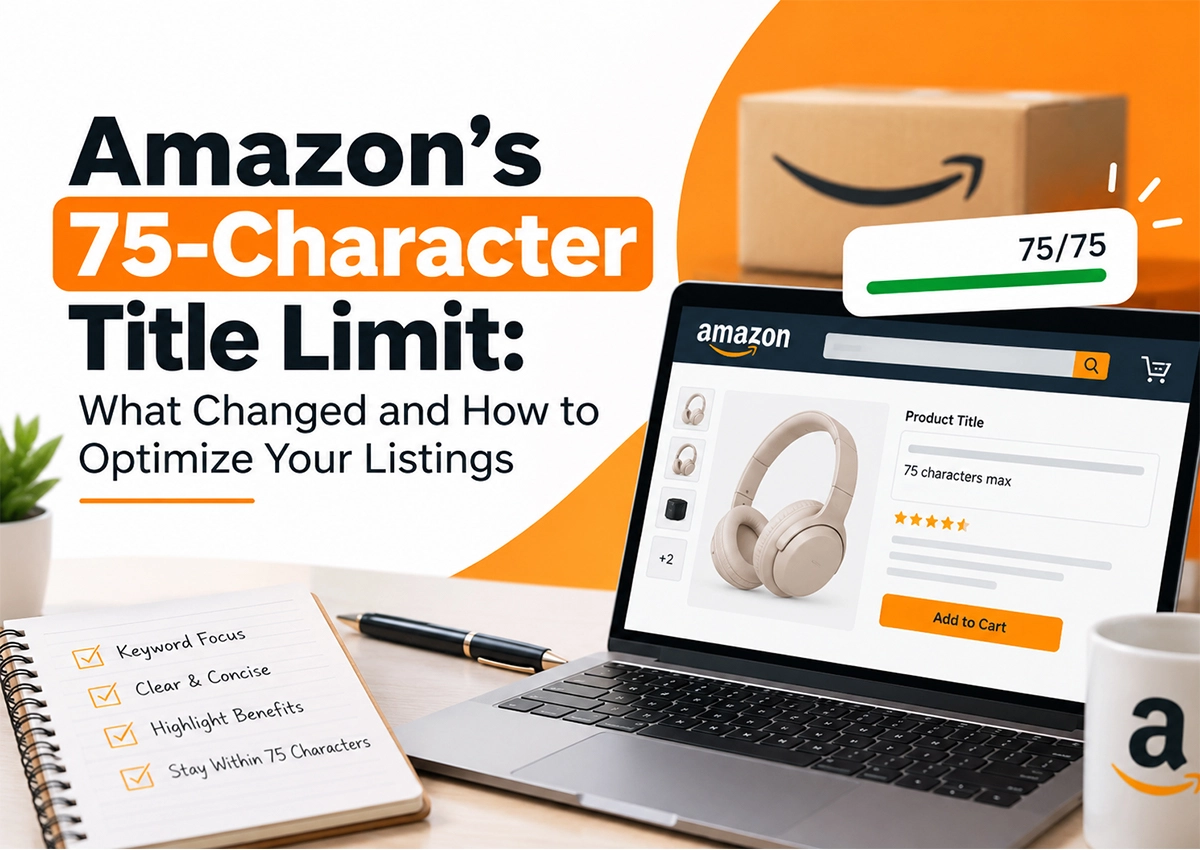

Amazon’s 75-Character Title Limit: What Changed and How to Optimize Your Listings
Amazon’s 75-Character Title Limit: What Changed and How to Optimize Your Listings Amazon quietly changed one of the biggest parts…
Amazon quietly changed one of the biggest parts of every product listing. The Amazon title character limit is now capped at 75 characters for most product titles across several categories.
It looks like a small update from the outside, but it has a huge impact on product rankings and discoverability.
Your Amazon title now has less space to convince shoppers, rank for keywords, and explain what the product actually does. Sellers who relied on long, keyword-heavy titles are already seeing listings suppressed or titles automatically shortened.
This guide breaks down what changed, why it matters, and how Amazon SEO optimization should evolve in 2026. You’ll learn practical Amazon product title best practices, common mistakes to avoid, and a smarter way to approach Amazon keyword optimization without sacrificing rankings or conversions.
The new Amazon product title character limit changes how sellers write and optimize listings. Instead of filling titles with keywords, Amazon now rewards concise, readable titles that match customer intent.
A successful Amazon listing optimisation strategy now combines keyword relevance, product clarity, backend keywords, and AI-ready content. Accordingly, sellers need to rethink both Amazon search optimization and product page optimization if they want to maintain visibility in search results.
Long titles packed with keywords are no longer the safest strategy. Clear, customer-friendly titles matter more.
Keywords haven’t disappeared. They simply need to be placed more strategically across titles, bullets, backend terms, and A+ Content.
Alexa and AI-powered shopping experiences understand context, not just repeated keywords.
Your title works together with bullets, images, reviews, and backend keywords to improve rankings and conversions.
The biggest shift isn’t the number. It’s the strategy behind it.
Amazon now expects most product titles to stay within 75 characters. That means sellers have significantly less room to add features, materials, sizes, colors, and multiple keyword variations in a single line.
For years, many brands followed a simple formula: write the longest title possible and fit every important keyword inside it.
Now, Amazon SEO optimization looks different. Titles need to be short enough to comply with the policy, yet descriptive enough to rank. Both visibility and readability matter.
The catch here is that Amazon isn’t removing keywords altogether. Instead, it’s pushing sellers toward better Amazon keyword optimization across the entire listing, not just the title.
A listing with a clean title, optimized bullets, relevant backend keywords, and helpful A+ Content has a much better chance of performing well than a title stuffed with repeated search terms.
At Krolog, we’ve started reviewing titles differently during every Amazon listing optimisation audit. The first question is no longer “How many keywords fit?” It’s “Would a customer instantly understand this product in one glance?”
That small mindset shift changes the whole listing strategy.
The new Amazon product title character limit sets a maximum of 75 characters for product titles in many categories. Amazon introduced this update to create a more consistent shopping experience and reduce cluttered listings.
Not every category adopted the change at the same time. However, sellers across major categories have received notifications inside Seller Central asking them to update non-compliant titles.
Here’s what the policy focuses on:
| Requirement | What It Means |
|---|---|
| Maximum title length | Aim for 75 characters where the rule applies. |
| Readable formatting | Titles should be easy to scan, both on desktop and mobile. |
| Keyword repetition | Avoid repeating the same keyword multiple times. |
| Promotional language | No unnecessary marketing phrases or exaggerated claims. |
| Special characters | Limit excessive symbols, capitalization, or decorative punctuation. |
This isn’t only about compliance; shorter titles also improve the mobile shopping experience, where customers often see only the first few words before deciding whether to click.
| Old Amazon Title | Optimized Amazon Title |
|---|---|
| Collapsible Silicone Food Storage Containers with Airtight Lids, BPA-Free Reusable Lunch Box Set for Meal Prep, Microwave Safe | Collapsible Silicone Food Containers, BPA-Free Airtight Meal Prep Set |
The second version is shorter and cleaner and still searchable.
More importantly, it leaves room for the rest of the listing to support Amazon listing keyword optimization instead of forcing everything into one field.
This Amazon update is part of a bigger shift in Amazon search optimization. The marketplace is moving toward listings that are easier for customers as well as AI systems to understand.
Several reasons sit behind the change.
More than half of Amazon shopping now happens on mobile devices. Long titles often get cut off after the first few words. As a result, shoppers miss the most important product information. Shorter titles surface the essentials first.
Search pages filled with oversized titles are difficult to scan. Amazon wants listings to look consistent. Accordingly, concise titles help shoppers compare products faster, especially in crowded categories.
Amazon’s AI shopping assistant, Ask Alexa, now understands customer intent across the entire product page, not just exact keywords.
That means Amazon product page optimization matters more than ever. Beyond the title, Ask Alexa evaluates bullet points, descriptions, A+ Content, product attributes, reviews, and images to determine product relevance and surface better shopping recommendations.
For years, sellers repeated phrases like:
All inside one title. Today, Amazon prefers one clear mention in the title and additional supporting context elsewhere in the listing.
One mistake we still see is sellers shortening titles by deleting random words instead of rebuilding the title around customer intent. That’s risky.
A shorter title should still communicate brand, product type, and the primary buying benefit. If those disappear, rankings and conversions usually follow.
This is where most sellers get stuck. The limit got smaller. Your Amazon product title optimization now has to do more with fewer words. Accordingly, every character needs a purpose.
Think of your title as a headline, not a keyword dump. Lead with what customers search for first. Then add the strongest buying attribute.
A simple framework works surprisingly well:
Brand + Product Type + Primary Feature + Size or Variant
For example:
Krolog Glass Meal Prep Containers | Leakproof BPA-Free 3-Pack
Short, clear, and searchable.
Instead of trying to squeeze five different keyword variations into one title, spread them naturally across the listing. That’s how modern Amazon listing keyword optimization works.
Not every keyword deserves title space.
Use the highest-intent phrase in the title. Move secondary terms into bullet points, backend search terms, product attributes, and A+ Content.
That’s a much healthier Amazon search optimization strategy than repeating the same words twice.
Listings that remove duplicate keywords often keep their rankings. Sometimes they even improve. Amazon already understands related terms. You don’t have to force them into every field.
The new rule changes length, not quality. Good titles still answer one question immediately: What am I buying?
Avoid phrases like “Best Seller,” “Premium Quality,” or “Top Rated.” Amazon’s product title guidelines discourage promotional language anyway.
Mobile shoppers may only read the first few words. If the product type appears after character 40, many customers won’t even see it.
Use natural capitalization. Avoid ALL CAPS. Skip decorative symbols unless Amazon specifically allows them for your category.
Repeating “food container” three times doesn’t strengthen Amazon SEO optimization. It wastes valuable space.
Your title is only one ranking signal. Strong Amazon listing SEO also depends on:
Together, these create a much stronger Amazon product page optimization strategy.
Stay compliant with Amazon’s latest title guidelines while making your listings easier to find and convert. Get expert Amazon listing optimization support from Krolog.
The 75-character limit exposed a lot of old habits.
Many sellers simply delete the last 40 characters. That usually removes size, material, or the product benefit customers actually care about.
Keywords matter; keyword stuffing doesn’t.
A title like:
Silicone Food Container Lunch Box Meal Prep Container BPA Free Food Storage Container
reads poorly. Customers and Amazon notice it.
Backend search terms exist for a reason. Use them for alternate spellings, regional terms, abbreviations, and long-tail variations instead of overcrowding the title.
A title may look fine on desktop but feel overwhelming on a phone. Always preview listings on mobile before publishing.
Search behavior changes during peak season, Amazon events, holiday sales, and category trends.
Accordingly, optimizing Amazon listings shouldn’t be a one-time task. Review titles regularly using Search Query Performance, keyword reports, and conversion data.
We’ve seen brands lose clicks after shortening titles because they removed the product’s biggest selling point instead of unnecessary keywords. Small edits can have a big impact. The goal isn’t just to fit inside 75 characters. It’s to make every one of those characters work harder.
The 75-character update isn’t just a title fix but a listing strategy update.
At Krolog, we treat Amazon SEO optimization as a complete product-page optimization process. We don’t shorten titles and call it done. We rebuild listings around how Amazon search works today.
Our team starts with Amazon keyword optimization using search intent, competitor research, and category data. Then we map keywords across titles, bullet points, backend search terms, A+ Content, and product attributes. The result is a listing that’s compliant, readable, and built for both search visibility and conversions.
For brands managing large catalogs, this matters even more. Updating hundreds of listings manually often creates inconsistencies. A structured Amazon listing optimisation strategy helps maintain rankings while keeping every product aligned with Amazon’s latest title guidelines.
One pattern we’ve noticed is simple. Listings with concise titles, stronger bullets, and better keyword distribution usually perform more consistently than listings relying on one keyword-heavy title to do everything.
Amazon search is evolving fast.
Amazon’s AI shopping experience, from Rufus to Ask Alexa, is making AI-powered product discovery more conversational and intent-driven. Instead of relying only on exact keywords, Ask Alexa understands customer questions and evaluates the entire product listing. Accordingly, Amazon listing SEO is becoming more semantic and context-focused.
Here are the trends sellers should prepare for:
In other words, Amazon search optimization is no longer about fitting more keywords into fewer characters. It’s about giving Amazon better context across the entire listing.
The new Amazon title character limit changes one field, but it affects the entire listing strategy.
Winning listings in 2026 aren’t the longest ones. They’re the clearest ones. Strong Amazon product title optimization starts with the primary keyword, highlights the biggest customer benefit, and leaves supporting keywords for the rest of the product page.
If you’re updating existing listings, don’t just trim characters. Rebuild the title around customer intent and review the entire listing for keyword placement, readability, and compliance.
At Krolog, we’ve helped brands improve Amazon listing keyword optimization by combining Amazon SEO, content optimization, and ongoing performance analysis. A compliant title matters, but a complete listing strategy drives long-term growth.
For many product categories, Amazon now recommends or enforces a 75-character Amazon product title character limit. Sellers should check Seller Central because implementation varies by category and marketplace.
Start with Amazon title optimization by keeping the title concise and keyword-focused. Then distribute secondary keywords across bullet points, backend search terms, product descriptions, and A+ Content for stronger Amazon listing SEO.
Use the brand name, primary product keyword, and the most important buying feature. Avoid keyword repetition, promotional phrases, excessive capitalization, and unnecessary symbols. Keep titles readable on mobile.
Not necessarily. A shorter title can improve readability and click-through rate while maintaining rankings if Amazon keyword optimization is handled across the rest of the listing.
Amazon indexes information from multiple parts of a listing. Backend keywords, bullet points, attributes, A+ Content, and customer-facing copy all contribute to Amazon search optimization and product discoverability.
Yes, backend search terms are the right place for synonyms, alternate spellings, abbreviations, and long-tail phrases that don't naturally fit in the title. This supports Amazon listing keyword optimization without making the title look cluttered.
It can. Updating an Amazon title may temporarily impact indexing while Amazon processes the changes. However, titles that follow Amazon product title best practices and improve customer clarity often perform better over time.
The latest Amazon title guidelines recommend concise, readable titles that avoid keyword repetition, promotional claims, excessive capitalization, and unnecessary special characters. Titles should clearly describe the product and follow category-specific requirements.
Amazon listing optimisation includes the title, bullet points, backend keywords, product descriptions, A+ Content, images, attributes, and reviews. All of these signals work together to improve discoverability and conversions.
Ask Alexa evaluates the entire product listing to understand customer intent. As a result, Amazon search optimization now relies more on complete, well-structured product information than on repeating exact-match keywords.
Optimizing Amazon listings should be an ongoing process. Review titles, keywords, and product content during major catalog updates, peak season Amazon campaigns, algorithm changes, or whenever search and conversion performance starts to decline.
Sandeep K, Founder & CEO of Krolog, is an Amazon marketplace consultant with over 10 years of experience in Amazon SEO, PPC, listing optimization, catalog management, and marketplace growth. He has worked with brands across multiple categories to improve rankings, conversions, and long-term profitability.
The new title policy is only one part of Amazon SEO. If your listings need Amazon SEO optimization, Amazon product title optimization, keyword research, A+ Content, or a complete listing audit, Krolog can help identify ranking gaps and optimize your catalog for Amazon’s latest search experience.
Amazon’s 75-Character Title Limit: What Changed and How to Optimize Your Listings Amazon quietly changed one of the biggest parts…
How to Build a Shopify Email List That Converts: From 0 to 5,000 Subscribers E-commerce traffic is expensive, but email…
How to Optimize Your Amazon Listing for Alexa for Shopping in 2026 Shoppers aren’t typing “collapsible silicone food container” anymore.…
Krolog was born from a simple yet powerful idea: to empower businesses with the tools and strategies needed to thrive in the ever-evolving digital marketplace. Our journey is a testament to the transformative impact of strategic E-commerce solutions.


Copyright © 2026 All Right Reserved