Nav Preview
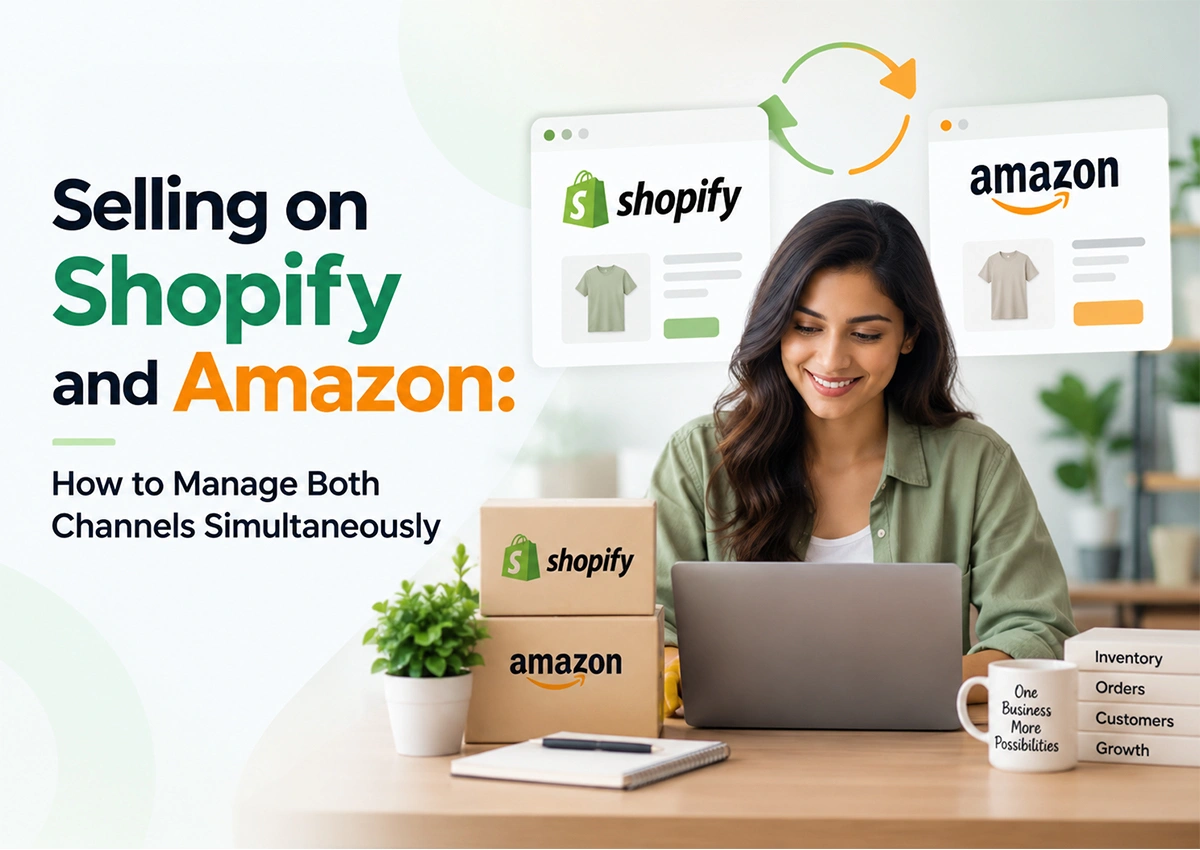
  • Selling on Shopify and Amazon: How to Manage Both Channels Simultaneously in 2026

    Selling on Shopify and Amazon sounds like the perfect growth strategy.

    More reach; More customers; More sales.

    But after the first few weeks, reality hits. An order comes in on Shopify; the same product sells on Amazon minutes later. Inventory doesn’t sync; one customer gets a cancellation email, and another receives the wrong shipment.

    It happens more often than sellers expect.

    The good news? You don’t have to choose between marketplaces. Selling on Shopify and Amazon together can become one of the smartest ways to grow an ecommerce business, provided that inventory, fulfillment, and orders work from one connected system.

    This guide explains how to manage Shopify and Amazon simultaneously, avoid inventory headaches, choose the right fulfillment model, and build a scalable multichannel ecommerce strategy in 2026.

    Amazon Product Video
    Amazon Advertising Video
    Amazon Sponsored Brand Video

    Amazon ACoS Strategies

    PPC Performance

    Higher ROAS

    Selling on Shopify and Amazon simultaneously in 2026

    Summary

    Selling on Shopify and Amazon isn’t about running two separate businesses. It’s about managing one brand across two sales channels.

    A successful setup combines Shopify inventory management, Amazon inventory management, centralized order processing, synchronized stock updates, and a reliable fulfillment strategy. Accordingly, brands reduce overselling, improve delivery speed, and keep inventory accurate across every platform.

    Whether you’re launching on Shopify for Amazon expansion or already selling on both channels, this guide covers practical workflows, common mistakes, fulfillment options, and expert recommendations from Krolog.

    Key Takeaways

    Selling on Shopify and Amazon Works Better Together

    Both platforms serve different customer journeys. Running both helps brands diversify revenue instead of relying on one marketplace.

    Centralized Inventory Prevents Costly Errors

    A centralized inventory management system keeps stock levels updated across Shopify, Amazon, and other channels in real time.

    Fulfillment Strategy Decides Customer Experience

    Choosing between Amazon FBA, Amazon MCF, or a third-party warehouse directly affects shipping speed, margins, and scalability.

    Multichannel Selling Needs Automation

    Manual inventory updates eventually create overselling, delayed orders, and unhappy customers.

    Why Selling on Shopify and Amazon Makes More Sense Than Choosing One Platform

    This question pops up almost every week. “Should I sell on Shopify or Amazon?”

    Wrong question. A better question is: Why not both?

    Amazon gives you built-in traffic. Millions of shoppers already search there every day. Shopify gives you ownership. Your website, customer data, email list, and brand experience.

    Different strengths; different goals.

    Consequently, smart ecommerce brands don’t replace one with the other. They build a system where Shopify and Amazon support each other instead of competing.

    Expert Observation

    We’ve seen brands generate their first sales on Amazon because of marketplace visibility. Later, they used Shopify to increase repeat purchases through email marketing, subscriptions, bundles, and loyalty programs.

    Marketplace for acquisition; Website for retention. That’s usually the healthier long-term play.

    How Does Selling on Shopify and Amazon Simultaneously Actually Work?

    Think of Shopify as your headquarters; Amazon becomes another storefront connected to it.

    • Products sync across channels.Β 
    • Inventory updates automatically.Β 
    • Orders flow into one dashboard.Β 
    • Fulfillment follows predefined rules.

    A typical Shopify Amazon integration looks like this:

    • Products sync from Shopify to Amazon.
    • Inventory updates whenever stock changes.
    • Orders from both channels appear in one workflow.
    • Shipping and fulfillment happen through FBA, Amazon MCF, or a warehouse partner.

    Simple in theory, but can get messy without automation. That’s where multichannel ecommerce platforms make a huge difference.

    What Does Shopify Amazon Integration Actually Sync?

    Many sellers assume Shopify Amazon integration only imports products. In reality, it does much more. A proper integration connects operational data across both platforms.

    1. Product Catalog Sync

    Create products once. Push titles, SKUs, pricing, images, and variants to Amazon afterward.

    This reduces duplicate product management and keeps listings consistent.

    2. Shopify Inventory Management Across Channels

    Inventory becomes the source of truth. If five units sell on Amazon, Shopify stock updates immediately. Likewise, Shopify orders reduce Amazon inventory availability. This prevents overselling during promotions or peak season Amazon traffic spikes.

    3. Ecommerce Order Management From One Dashboard

    Orders from Shopify and Amazon enter one centralized workflow. Instead of checking multiple dashboards throughout the day, sellers manage fulfillment, cancellations, returns, and shipping updates together.

    • Less clicking
    • Fewer mistakes
    • Better customer experience.

    Why Shopify Inventory Management Becomes Critical During Peak Season Amazon Sales

    Peak season changes everything.

    • Prime events
    • Black Friday
    • Cyber Monday
    • Holiday sales

    Traffic increases overnight and inventory disappears faster than expected.

    Without accurate Shopify inventory management, sellers often continue accepting orders after products are already sold out elsewhere.

    We’ve seen brands lose Buy Box eligibility simply because inventory couldn’t sync quickly enough.

    A better workflow includes:

    • Real-time stock synchronization.
    • Safety stock buffers.
    • Automatic inventory updates.
    • SKU-level inventory tracking.

    Accordingly, inventory stays accurate even when order volume doubles.

    Expert Observation

    One mistake sellers make every holiday season is manually adjusting stock after sales begin.

    That’s already too late. Inventory automation should be configured before campaigns launch, not during them.

    Grow on Amazon & Shopify

    Managing two sales channels can be challenging. Krolog helps sellers build, optimize, and scale Amazon and Shopify stores with a unified growth strategy.

    How Ecommerce Inventory Management Keeps Shopify and Amazon in Sync

    Inventory problems rarely start with inventory; they start with disconnected systems.

    A customer buys one product on Shopify. Five minutes later, someone purchases the last unit on Amazon. If both channels don’t talk to each other, you’ve just sold one product twice.

    That’s exactly why ecommerce inventory management becomes the backbone of multichannel selling.

    Instead of managing stock separately on Shopify and Amazon, sellers maintain one centralized inventory that updates every connected channel in real time. As a result, stock levels stay accurate whether sales happen on your website, Amazon, Walmart, or even social commerce channels.

    What Should Centralized Inventory Management Include?

    A reliable centralized inventory management setup should do more than count stock; it should automatically manage inventory movement across channels.

    Core features include:

    • Real-time stock synchronization.
    • SKU mapping across Shopify and Amazon.
    • Inventory alerts for low stock.
    • Bundle and variant inventory tracking.
    • Safety stock allocation during peak season Amazon sales.
    • Warehouse-level inventory visibility.

    Think of it as one inventory brain powering multiple storefronts.

    Expert Observation

    We often see at Krolog that brands keep separate inventory pools for Shopify and Amazon. It feels safer initially. However, it usually creates dead stock on one channel and overselling on another. One inventory pool almost always performs better.

    Why Ecommerce Order Management Is Just as Important as Inventory

    Inventory gets all the attention. Orders create operational chaos.

    Without ecommerce order management, sellers jump between Shopify Admin, Amazon Seller Central, shipping software, warehouse portals, and spreadsheets. Eventually, something gets missed.

    A centralized order management workflow changes that.

    Orders from both Shopify and Amazon appear in one place.Β 

    • Shipping labels generate automatically.Β 
    • Tracking updates sync back to customers. Returns follow the same workflow.

    Less manual work; better accuracy.

    What Does Multichannel Order Management Actually Do?

    A proper multichannel order management system helps sellers:

    • Import Amazon and Shopify orders automatically.
    • Route orders to FBA, Amazon MCF, or a warehouse.
    • Sync shipping confirmations.
    • Process returns from one dashboard.
    • Track fulfillment performance across channels.

    Accordingly, customer communication also becomes much easier because every order follows one lifecycle.

    Practical Example

    Imagine you receive:

    • 22 Amazon orders.
    • 15 Shopify orders.
    • 8 Walmart orders.

    Instead of opening three dashboards, every order appears inside one fulfillment queue.

    That’s the difference between selling on multiple channels and managing multichannel ecommerce professionally.

    Choosing Between Amazon FBA, Amazon MCF, and 3PL Changes Everything

    This is where many brands get stuck. Should Shopify orders ship through Amazon?

    Or should Amazon orders ship from your own warehouse? The answer depends on your business model.

    When Amazon FBA Makes Sense

    Amazon FBA works well if Amazon generates most of your revenue.

    • Amazon stores inventory.Β 
    • Packs products.Β 
    • Handles shipping.Β 
    • Even customer service for marketplace orders.

    Great convenience butΒ  less operational control.

    When Amazon MCF Shopify Becomes a Smart Option

    Amazon MCF Shopify allows sellers to use Amazon’s fulfillment network for Shopify orders too.

    One inventory; two sales channels.

    Customers buying on Shopify still receive fast fulfillment without maintaining separate warehouse stock. It’s especially useful during peak season Amazon campaigns when order volume suddenly increases.

    When a 3PL Is Better

    Growing brands often outgrow FBA-only operations. A dedicated warehouse or multichannel fulfillment partner can ship Shopify, Amazon, Walmart, TikTok Shop, and wholesale orders from one inventory location.

    More flexibility; more branding options; better international expansion.

    Expert Observation

    We usually recommend hybrid fulfillment once brands begin scaling. Amazon FBA handles marketplace speed, while a warehouse or 3PL manages branded ecommerce orders, subscriptions, bundles, and B2B shipments.

    Grow on Amazon & Shopify

    Managing two sales channels can be challenging. Krolog helps sellers build, optimize, and scale Amazon and Shopify stores with a unified growth strategy.

    How to Connect Shopify to Amazon Without Creating Inventory Issues

    Many sellers ask, how do I connect Shopify to Amazon properly? The setup matters more than the software.

    A healthy Shopify Amazon integration usually follows these steps:

    Step 1: Connect Shopify to Amazon Seller Central

    • Authorize both platforms.
    • Import your catalog carefully.
    • Avoid duplicate listings during the first sync.

    Step 2: Map SKUs Correctly

    SKU mapping sounds boring, but it’s important.

    One incorrect SKU can sync the wrong inventory across both channels. Double-check every product variation before publishing.

    Step 3: Enable Inventory Synchronization

    Turn on automatic stock syncing. Real-time inventory updates reduce overselling and manual adjustments.

    Step 4: Configure Fulfillment Rules

    Decide which orders go to FBA, Amazon MCF, or your warehouse. Automation works only when routing rules are clear.

    Step 5: Test Everything

    • Place sample orders.
    • Test Shopify.
    • Test Amazon.
    • Test cancellations and returns.

    A small test today prevents expensive mistakes later.

    Can You Sell on Amazon Through Shopify Without Managing Two Stores?

    Yes certain workflows are designed to support this setup.

    Shopify becomes the operational center, while Amazon remains the marketplace customers shop on.

    • Create products once in Shopify, then publish them directly to Amazon.
    • Inventory syncs automatically.
    • Orders flow into one backend.
    • Fulfillment follows predefined rules.

    Sellers still manage Amazon Seller Central for advertising, listings, and marketplace compliance. However, day-to-day operations become much more centralized.

    This is one of the biggest reasons brands invest in Shopify for Amazon expansion instead of treating each platform separately.

    Why Multichannel Selling Needs One Marketing Strategy Too

    Operations matter, but marketing matters just as much.

    Many brands run Shopify promotions and Amazon PPC campaigns independently. Different messaging; different pricing; different offers.

    Customers notice that.

    A stronger multichannel marketing strategy keeps campaigns aligned across every customer touchpoint. For example:

    • Launch products on Amazon for discovery.
    • Retarget Amazon visitors through Shopify email campaigns.
    • Promote bundles exclusively on Shopify.
    • Use content marketing to drive branded traffic away from paid acquisition over time.

    That’s how multichannel selling becomes profitable instead of fragmented.

    Expert Observation

    The brands growing fastest in 2026 aren’t choosing Shopify or Amazon. They’re building one customer journey across both. Amazon captures demand; Shopify builds customer lifetime value.

    Common Multichannel Selling Mistakes That Cost Brands Money

    Selling on Shopify and Amazon looks simple from the outside.

    Most operational problems start after growth begins. We’ve seen the same mistakes repeat across brands, especially during launches and peak season Amazon campaigns.

    1. Keeping Separate Inventory for Every Channel

    This creates a stock imbalance. Shopify shows inventory available. Amazon shows something different. Eventually, one channel oversells while the other sits with unsold stock.

    2. Managing Orders Manually

    Manual exports and spreadsheets work for 10 orders. Not for 100.

    As order volume grows, delays, duplicate shipments, and missed tracking updates become common. Accordingly, automation becomes less of a luxury and more of a requirement.

    3. Ignoring Fulfillment Costs

    Fast shipping doesn’t always mean profitable shipping. Many sellers underestimate storage fees, fulfillment charges, packaging costs, and return handling until margins start shrinking. Above all, fulfillment should be planned around profitability, not just speed.

    4. Running Different Pricing Across Channels

    Customers compare prices quickly. Large pricing gaps between Shopify and Amazon often reduce trust and hurt conversions. If pricing changes, then update both channels simultaneously.

    5. Waiting Until Peak Season to Automate

    This is probably the biggest mistake: Automation should be ready before traffic arrives, not afterward.

    Expert Observation

    Operations break under pressure, not during normal sales weeks. Brands that prepare inventory, fulfillment, and order workflows before seasonal campaigns usually scale much smoother.

    How Krolog Helps Brands Manage Shopify and Amazon Together

    Managing Shopify and Amazon isn’t just about connecting two platforms; it’s about building one operational system.

    At Krolog, we help brands create a complete Shopify Amazon integration that supports inventory, fulfillment, advertising, and long-term marketplace growth. Whether you’re launching Shopify for Amazon expansion or already managing multiple marketplaces, the focus stays on creating one connected workflow.

    Our team helps sellers:

    • Connect Shopify to Amazon without duplicate listings.
    • Build centralized inventory management across channels.
    • Set up ecommerce order management and multichannel order management workflows.
    • Configure Amazon FBA, Amazon MCF Shopify, and warehouse fulfillment rules.
    • Optimize multichannel ecommerce operations across Amazon, Shopify, and Walmart.

    The goal is simple: less manual work; better inventory visibility; faster fulfillment; sustainable growth.

    Why Selling on Shopify and Amazon Is a Smarter Long-Term Strategy

    You don’t have to choose between Shopify and Amazon anymore.

    Amazon brings demand; Shopify builds ownership. Together, they create a stronger ecommerce business.

    The brands growing fastest in 2026 aren’t managing channels separately. They’re investing in multichannel inventory management, connected fulfillment, and automation that keeps operations running smoothly across every sales channel.

    If you’re planning to scale beyond one marketplace, now is the right time to build a system that grows with your business instead of slowing it down.

    Selling on Shopify and Amazon works best when inventory, orders, fulfillment, and marketing all speak to each other. That’s what makes multichannel selling profitable in the long run.

    Frequently Asked Questions

    About the Author

    Sandeep K. is the Founder and CEO of Krolog Inc., with over 10 years of experience in Amazon SEO, PPC, inventory planning, fulfillment strategy, and marketplace growth. He has helped ecommerce brands scale across Amazon, Shopify, Walmart, and other global marketplaces through data-driven marketplace strategies.

    Need Help Selling on Shopify and Amazon Together?

    Running multiple sales channels shouldn’t create more operational work.

    Whether you’re planning to connect Shopify to Amazon, improve Shopify inventory management, implement Amazon MCF Shopify, or build a complete multichannel ecommerce strategy, Krolog helps brands create scalable systems designed for long-term growth.

    Request a free ecommerce growth audit and discover opportunities to streamline inventory, fulfillment, order management, and marketplace performance.

    Related Article

    Selling on Shopify and Amazon: How to Manage Both Channels Simultaneously in 2026

    Selling on Shopify and Amazon: How to Manage Both Channels Simultaneously in 2026

    Selling on Shopify and Amazon: How to Manage Both Channels Simultaneously in 2026 Selling on Shopify and Amazon sounds like…

    Why Amazon Seller Support Takes So Long to Resolve Issues (And What to Do Instead)

    Why Amazon Seller Support Takes So Long to Resolve Issues (And What to Do Instead)

    Why Amazon Seller Support Takes So Long to Resolve Issues (And What to Do Instead) You opened a case, uploaded…

    Amazon Brings Ads to ChatGPT in New Partnership With OpenAI

    Amazon Brings Ads to ChatGPT in New Partnership With OpenAI

    Amazon Brings Ads to ChatGPT in New Partnership With OpenAI Introduction Amazon is taking its advertising business beyond its own…

    Scroll to Top