Nav Preview
  • Shopify vs WooCommerce for Amazon Sellers: The Complete 2026 Comparison Guide

    Most Amazon sellers eventually hit the same question. “What happens if Amazon changes the rules tomorrow?”

    • Maybe fees go up.Β 
    • Maybe account health becomes an issue.Β 
    • Maybe ad costs keep rising.

    That’s usually when sellers start thinking about building their own ecommerce website.

    And then the debate begins between Shopify vs WooCommerce.

    In this guide, we’ll break down the real differences between the Shopify ecommerce platform and WooCommerce. We’ll explore setup costs, SEO, Amazon integrations, scalability, and what actually works for brands trying to grow beyond Amazon in 2026.

    Shopify Development
    WooCommerce
    Shopify Amazon Integration

    Amazon ACoS Strategies

    PPC Performance

    Higher ROAS

    Shopify vs WooCommerce for Amazon sellers comparison guide showing the best ecommerce platform for scaling beyond Amazon in 2026

    Summary

    Amazon is still the largest marketplace in the world. However, relying entirely on one platform creates risk.

    As a result, more sellers are investing in ecommerce website development to build direct customer relationships and reduce dependence on Amazon.

    Both Shopify and WooCommerce offer strong capabilities, both are popular, and both can help Amazon sellers build an independent sales channel. Yet the right choice depends on far more than design templates or monthly fees, asthey serve different business models.

    Shopify prioritizes simplicity and speed, while WooCommerce prioritizes flexibility and ownership.

    The best option depends on your technical skills, growth plans, and long-term brand strategy.

    Key Takeaways

    Shopify Wins for Simplicity

    Most Amazon sellers can launch faster using Shopify development services without worrying about hosting or technical maintenance.

    WooCommerce Offers More Control

    WooCommerce gives sellers complete ownership over their website, plugins, and customization.

    Integration Matters

    Strong Shopify Amazon integration and WooCommerce Amazon integration can streamline inventory management and order synchronization.

    Total Cost Isn't Always Obvious

    A lower monthly fee doesn’t always mean lower overall cost. Development, hosting, plugins, and maintenance all impact long-term expenses.

    Why Amazon Sellers Are Building Independent Stores in 2026?

    Five years ago, most brands were comfortable relying solely on Amazon. Not anymore.

    At Krolog, we’ve worked with brands that were doing six figures a month on Amazon; sales looked healthy, reviews looked great.

    Then, one listing issue happened and revenue dropped overnight.Β 

    That’s when many sellers realize something important. Amazon is a marketplace, not your business. Your brand exists there. But you don’t own the customer relationship. Consequently, sellers are investing heavily in ecommerce website development. A website gives brands:

    • Direct customer ownership.
    • Email marketing opportunities.
    • Better margins.
    • Greater pricing control.
    • Long-term business value.

    Above all, it creates stability, and that’s becoming more valuable every year.

    Shopify vs WooCommerce: Understanding the Core Difference

    At first glance, both platforms seem similar.

    • You build a store.
    • You add products.
    • You start selling.

    Simple! But under the hood, they’re very different.

    Shopify Ecommerce Platform

    Shopify is a fully hosted solution. You pay a monthly fee and everything is managed for you.

    • Hosting
    • Security
    • Updates
    • Performance

    Most sellers can launch quickly without technical expertise.

    This is why many businesses work with a Shopify agency or Shopify experts to accelerate setup.

    WooCommerce

    WooCommerce operates differently. It’s a WordPress plugin, where you own the site, manage hosting, control customization, and decide which plugins to install.

    Because of this flexibility, many brands invest in professional WooCommerce development services to build custom solutions.

    Should Amazon Sellers Build a Shopify or WooCommerce Store in 2026?

    This is probably the most common question we hear at Krolog.

    The answer? It depends on where your business is today.

    Imagine two Amazon sellers.

    Seller A launches private-label products and wants a professional website running within two weeks.

    Seller B manages a large catalog and needs custom functionality, advanced content marketing, and full control over every element.

    Seller A usually succeeds faster with Shopify, Seller B on the other hand, often benefits more from WooCommerce.

    Neither choice is wrong. The mistake is choosing a platform because someone on YouTube recommended it.

    Your business model should drive the decision. Not trends.

    Which Platform Is Easier to Set Up If You're Already Running an Amazon Store?

    This one isn’t rocketscience.Β 

    Shopify wins as most sellers can launch a functional website in days.

    • Themes are simple.
    • Apps are plentiful.
    • Checkout is optimized.
    • Support is readily available.

    As a matter of fact, we’ve seen brands launch complete Shopify store development projects in less than two weeks.

    WooCommerce requires more effort.

    You need:

    • Hosting
    • WordPress setup
    • Plugin management
    • Security configuration
    • Performance optimization

    Although WooCommerce offers greater flexibility, the learning curve is steeper.

    If speed matters, Shopify usually gets the edge.

    What's the Real Cost Difference Between Shopify and WooCommerce for an Amazon Seller?

    This is where things become interesting. Many sellers assume WooCommerce is cheaper because it’s technically free. That’s not always true.

    Shopify Costs

    Typically include:

    • Monthly subscription
    • Premium theme (optional)
    • Shopify apps
    • Transaction fees depending on the payment setup.

    Costs at Shopify areΒ 

    • Predictable.
    • Simple.
    • Easy to budget.

    WooCommerce Costs

    Typically include:

    • Hosting
    • Domain
    • Premium plugins
    • Developer support
    • Security tools
    • Maintenance

    Initially, it may appear cheaper. Over time, however, costs can increase depending on customization needs.

    Expert Observation

    One mistake sellers make is comparing only monthly platform fees. The real comparison should include total ownership costs over 12 months.

    That’s where surprises often happen.

    Shopify vs WooCommerce Comparison: Feature Snapshot

    Feature Shopify WooCommerce
    Ease of Setup Excellent Moderate
    Customization Good Excellent
    Hosting Included Yes No
    SEO Flexibility Very Good Excellent
    Maintenance Minimal User Managed
    Scalability Excellent Excellent
    Learning Curve Low Medium to High
    Best For Fast Growth Brands Custom Ecommerce Businesses

    Ready to Build Beyond Amazon?

    Create a scalable Shopify store that gives you full control over customers, sales, and long-term growth.

    Is WooCommerce or Shopify Better for SEO if You're Already Selling on Amazon?

    Many Amazon sellers think SEO only matters inside Amazon.

    Not true anymore.

    If you’re building a brand,Β 

    • Google matters too.Β 
    • AI search matters.Β 
    • Voice search matters.Β 
    • Your own website becomes another acquisition channel.

    This is where the Shopify vs WooCommerce comparison gets interesting.

    Shopify handles most SEO basics automatically. Clean URLs, mobile optimization, SSL certificates, XML sitemaps; they’re already there. Consequently, sellers can focus more on content than on technical setup.

    WooCommerce, however, offers deeper SEO control.

    Since it’s built on WordPress, you can optimize nearly everything.Β 

    • Meta tags.Β 
    • Schema markup.Β 
    • Site architecture.Β 
    • Blog content.Β 
    • Internal linking.Β 
    • Even page speed, if done correctly.

    That flexibility comes with responsibility.

    We’ve seen sellers install twenty plugins chasing “better SEO.” Eventually, the site slowed down, rankings dropped, and conversions suffered.

    Expert Observation

    At Krolog, we’ve found that Shopify performs exceptionally well for brands that prioritize speed and ease of management. WooCommerce shines when businesses invest in long-term content marketing and technical optimization. Both work; execution decides the winner.

    Can You Run Amazon FBA and a Shopify or WooCommerce Store at the Same Time?

    Absolutely. In fact, many successful brands already do.

    Amazon handles fulfillment and your website handles branding.

    Customers don’t even notice the difference.

    Orders flow directly into Amazon FBA while your own website captures valuable first-party customer data.

    Accordingly, you’re building an asset rather than relying entirely on marketplace traffic.

    Some advantages include:

    • Better customer retention
    • Email marketing opportunities
    • Higher lifetime value
    • Greater pricing flexibility
    • Reduced dependence on Amazon alone

    This hybrid model has quickly become one of the smartest growth strategies for 2026.

    Which Platform Syncs Inventory and Orders Better with Amazon?

    Inventory synchronization sounds simple, until it breaks.

    Imagine selling your last unit on Amazon while your website still shows it as available.

    • Now you’re dealing with overselling.
    • Refunds.
    • Negative customer experiences.

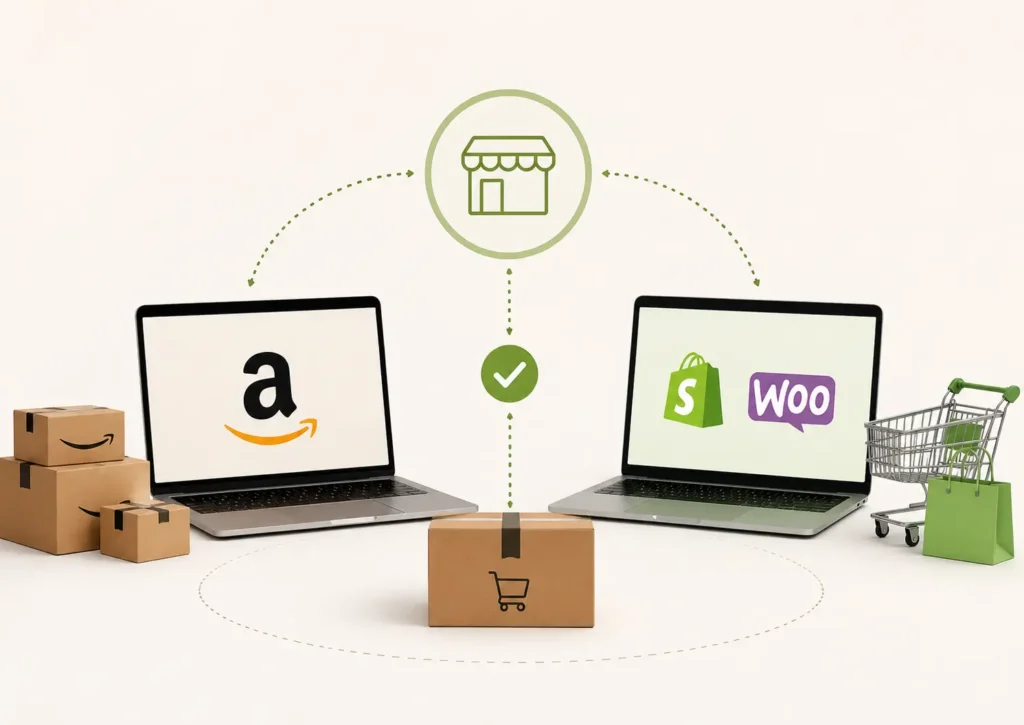
    Both Shopify Amazon integration and WooCommerce Amazon integration solve this problem, but differently.

    Shopify

    Shopify’s ecosystem makes integrations straightforward. Popular connectors automatically sync:

    • Inventory
    • Pricing
    • Orders
    • Product catalog
    • Shipping status

    Setup usually takes minutes rather than days.

    WooCommerce

    WooCommerce also supports Amazon integrations.

    However, plugin quality varies significantly. Some are excellent, others may require ongoing maintenance.

    Consequently, businesses using WooCommerce often rely on experienced WooCommerce development services to ensure stable integrations.

    Do You Need Third-Party Tools to Connect Amazon with Shopify or WooCommerce?

    Short answer? Yes.

    Neither platform natively manages every Amazon workflow. Most sellers use specialized connectors for:

    • Inventory synchronization
    • Order routing
    • FBA fulfillment
    • Pricing updates
    • Multi-channel reporting

    Fortunately, both ecosystems offer reliable solutions. The real question isn’t whether you need a connector. It’s whether the connector fits your business scale.

    Growing brands should prioritize stability over price. Downtime costs more than subscription fees.

    Best Platform for Amazon Sellers Building a Brand Website in 2026

    If someone asked me today, “Which platform should I choose?”

    I’d ask three questions first.

    • Do you want speed?
    • Do you want customization?
    • Do you have technical resources?

    If speed matters most, go with Shopify.

    While If flexibility is more important,Β  WooCommerce is hard to beat.

    Here’s a simplified breakdown.

    Business Goal Recommended Platform
    Fast Website Launch Shopify
    Complete Customization WooCommerce
    Beginner-Friendly Setup Shopify
    Advanced SEO & Blogging WooCommerce
    Minimal Maintenance Shopify
    Enterprise Custom Development WooCommerce

    Common Mistakes Amazon Sellers Make When Building Their First Website

    Launching a website isn’t the hard part. Growing it is.

    Some mistakes which appear again and again include:

    Treating the Website Like Another Amazon Listing: Your website should tell your brand story. Not just display products.

    1. Ignoring Mobile Experience: Over half of ecommerce traffic now comes from mobile devices. A slow mobile experience costs conversions.

    2. Choosing Based Only on Monthly Cost: Platform fees rarely represent total ownership costs.

    • Support.
    • Maintenance.
    • Apps.
    • Development.

    They all matter.

    3. Skipping SEO from Day One: Whether you choose Shopify or WooCommerce E-commerce SEO should never become an afterthought. Organic traffic compounds over time.

    Emerging Trends for Ecommerce in 2026

    The ecommerce landscape is changing quickly. Some trends every Amazon seller should watch include:

    1. AI-Powered Shopping: Customers increasingly discover products through AI assistants instead of traditional search.

    2. First-Party Customer Data: Brands are investing heavily in owned audiences through email, SMS, and loyalty programs.

    3. Omnichannel Selling: Amazon remains important. But websites, marketplaces, and social commerce now work together.

    4. Faster Store Experiences: Google continues rewarding websites that load almost instantly. Performance is no longer optional.

    Why Many Amazon Brands Partner with Krolog

    Building a website is one thing. Building a profitable ecommerce ecosystem is another.

    At Krolog, we help Amazon sellers create websites that don’t simply look good, but actually support business growth.

    Our expertise includes:

    Whether you’re launching your first brand website or migrating from another platform, we help create a scalable ecommerce foundation that grows alongside your Amazon business.

    Ready to Build Beyond Amazon?

    Create a scalable Shopify store that gives you full control over customers, sales, and long-term growth.

    Final Verdict

    There isn’t a single winner in the Shopify vs WooCommerce comparison. There never was.

    If your priority is speed, simplicity, and minimal maintenance, Shopify is usually the smarter investment.

    If your business requires complete customization, advanced SEO capabilities, and full ownership of your ecommerce infrastructure, WooCommerce offers unmatched flexibility.

    The important thing isn’t choosing the “best” platform. It’s choosing the platform that supports your next stage of growth.

    At Krolog, we’ve helped Amazon sellers build scalable ecommerce ecosystems that combine marketplace success with independent brand growth. Because at the end of the day, Amazon should be one sales channel, not your entire business.

    Ready to build beyond Amazon?

    Whether you need Shopify development services, WooCommerce development services, seamless Shopify Amazon integration, or a complete ecommerce website development strategy, Krolog can help you build a store that’s designed to grow with your brand.

    Frequently Asked Questions

    About the Author

    Sandeep K., Founder & CEO of Krolog Inc., is an ecommerce growth consultant with over 10 years of experience helping brands scale across Amazon, Shopify, WooCommerce, Walmart Marketplace, and other ecommerce channels.

    His expertise spans Amazon SEO, PPC management, marketplace strategy, ecommerce website development, Shopify migrations, WooCommerce implementations, conversion optimization, and omnichannel growth planning.
    Having worked with brands across multiple industries, he focuses on building sustainable ecommerce ecosystems that reduce marketplace dependency while driving long-term profitability.

    Ready to Build a Brand Beyond Amazon?

    Selling on Amazon is a great way to grow. Building your own ecommerce store ensures that growth stays yours.

    Whether you’re choosing between Shopify vs WooCommerce, planning a complete ecommerce website development project, or looking for seamless Shopify Amazon integration or WooCommerce Amazon integration, the right strategy can help you diversify revenue, own your customer relationships, and future-proof your business.

    At Krolog, we help Amazon sellers design, build, migrate, and optimize high-converting ecommerce stores that work alongside their marketplace business, and not compete with it.

    Book a free ecommerce strategy consultation today and discover which platform fits your business goals, budget, and long-term growth plans.

    Related Article

    Shopify vs WooCommerce for Amazon Sellers: The Complete 2026 Comparison Guide

    Shopify vs WooCommerce for Amazon Sellers: The Complete 2026 Comparison Guide

    Shopify vs WooCommerce for Amazon Sellers: The Complete 2026 Comparison Guide Most Amazon sellers eventually hit the same question. “What…

    Amazon Search Algorithm Explained: How It Works & How to Rank Higher in 2026

    Amazon Search Algorithm Explained: How It Works & How to Rank Higher in 2026

    Amazon Search Algorithm Explained: How It Works & How to Rank Higher in 2026 Most Amazon sellers spend months tweaking…

    Amazon Account Suspended? Here’s How to Get It Reinstated Faster in 2026

    Amazon Account Suspended? Here’s How to Get It Reinstated Faster in 2026

    Amazon Account Suspended? Here’s How to Get It Reinstated Faster in 2026 Imagine this scenario, where you are an Amazon…

    Scroll to Top