Nav Preview
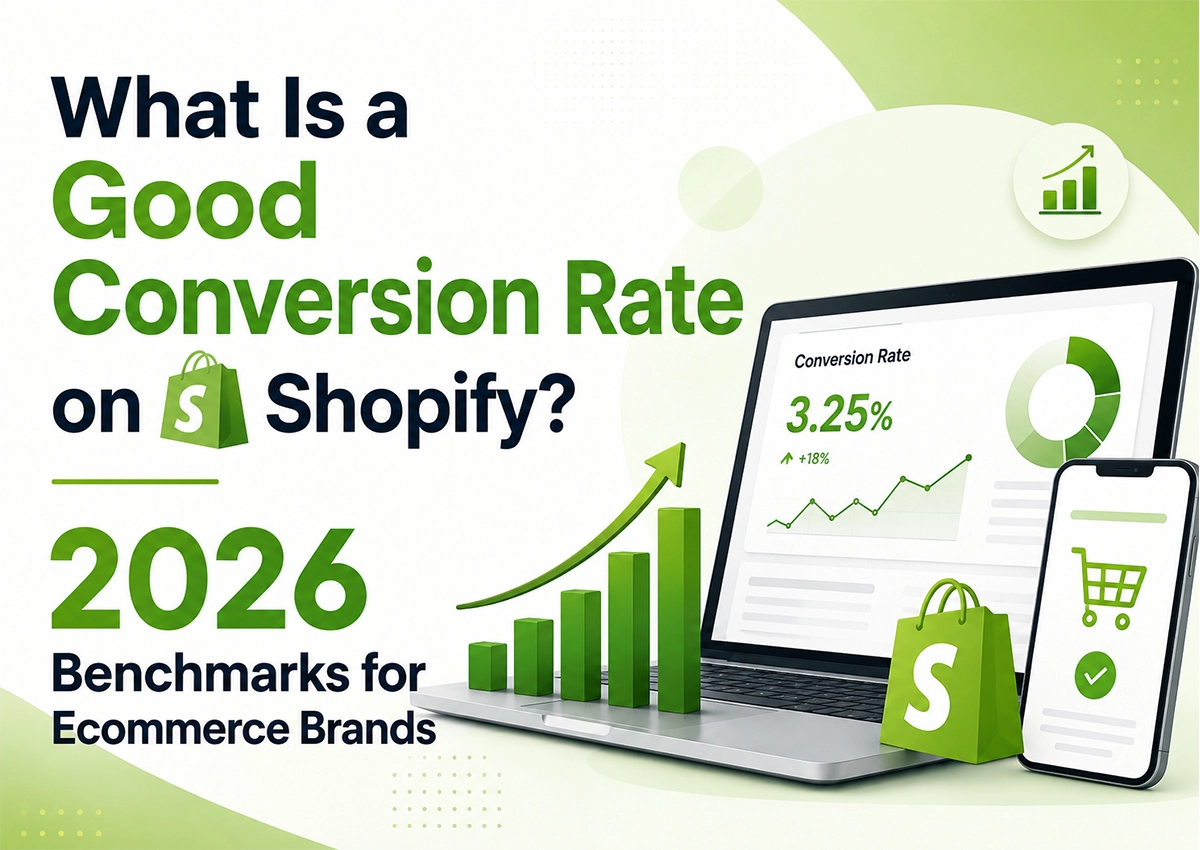
  • What Is a Good Conversion Rate on Shopify? 2026 Benchmarks for Ecommerce Brands

    You launched your Shopify store.

    Traffic came in; sales didn’t.

    It happens more often than you’d think.

    Many brands assume more visitors mean more revenue. Not always.Β 

    The real difference is conversion. So, what is a good conversion rate on Shopify in 2026?

    This guide covers the latest Shopify conversion benchmarks, what impacts conversions, and practical Shopify conversion rate optimization strategies to help you turn more visitors into customers.Β 

    Whether you’re launching a new store or scaling an existing one, you’ll learn how to improve performance using data, not guesswork.

    Shopify Conversion Rate
    Shopify Conversion Rate Optimization
    Ecommerce Benchmarks 2026

    Amazon ACoS Strategies

    PPC Performance

    Higher ROAS

    What Is a Good Conversion Rate on Shopify? 2026 Ecommerce Conversion Rate Benchmarks and Optimization Guide

    Summary

    A strong Shopify conversion rate isn’t about hitting one universal number. It depends on your industry, traffic quality, pricing, customer trust, and overall shopping experience.

    In 2026, successful ecommerce brands are moving beyond simple design improvements. They’re investing in Shopify conversion optimization, faster websites, better product pages, AI-driven personalization, and automated customer journeys that remove friction from the buying process.

    The brands seeing consistent growth don’t chase more traffic first. They make better use of the traffic they already have.

    Key Takeaways

    A Higher Conversion Rate Means Better ROI

    More visitors don’t always mean more revenue. Improving your Shopify conversion rate helps you generate more sales without increasing your marketing budget.

    Benchmarks Are Only the Starting Point

    Knowing the average Shopify conversion rate gives you context. However, your biggest competitor should be your own store’s previous performance.

    Product Pages Win or Lose the Sale

    Strong Shopify product page optimization often delivers bigger gains than simply increasing ad spend.

    Data Should Drive Every Improvement

    Guessing rarely works. Track visitor behavior, test changes, measure results, and repeat.
    That’s how sustainable Shopify conversion rate optimization works.

    What Is a Good Conversion Rate on Shopify?

    Ask ten ecommerce founders this question; you’ll probably hear ten different answers.

    Some will say 2%; others aim for 5%. A few claim anything below 8% is underperforming.

    The truth sits somewhere in the middle.

    A good Shopify conversion rate isn’t just a percentage. It’s a reflection of how efficiently your store turns visitors into customers. Generally speaking:

    • Below 1% usually signals room for improvement.
    • Between 2% and 3% is considered healthy for many Shopify stores.
    • 3% to 5% often indicates a well-optimized ecommerce business.
    • Above 5% is typically achieved by brands with strong customer trust, optimized product pages, loyal audiences, and effective retention strategies.

    But numbers alone don’t tell the full story.Β 

    Imagine two skincare brands.

    Brand A gets thousands of visitors through broad social media ads; traffic is high; intent isn’t.

    Brand B attracts fewer visitors through targeted search campaigns and email marketing. Those shoppers already know what they’re looking for.

    Both stores receive traffic; only one consistently converts.

    That’s why comparing your store to generic benchmarks without considering traffic quality can lead to the wrong conclusions.

    Expert Observation

    One mistake we see regularly at Krolog is brands obsessing over visitor numbers while ignoring conversion efficiency.

    We’ve worked with stores that doubled revenue without increasing traffic at all. How?

    • By improving product pages.
    • Simplifying checkout.
    • Building trust through reviews.
    • And removing the small friction points shoppers experience before clicking “Buy Now.”

    More traffic is exciting; better conversions are usually more profitable.

    Why Shopify Conversion Rate Matters More in 2026

    Five years ago, brands could solve almost every sales problem the same way.

    • Run more ads.
    • Increase the budget.
    • Drive more traffic.

    That playbook doesn’t work as well anymore.

    • Customer acquisition costs have climbed.Β 
    • Competition is tougher.Β 
    • Buyers compare products across multiple stores before making a decision.Β 

    As a result, every visitor has become more valuable.

    Imagine spending $5,000 on paid ads.

    Store A converts at 1%. Store B converts at 3%. Same traffic; same ad spend.

    Three times the orders.

    That’s the power of Shopify conversion optimization.

    Accordingly, improving conversions doesn’t just increase revenue. It lowers customer acquisition costs, improves ROAS, and makes every marketing channel work harder.

    Expert Observation

    Many merchants think growth starts with more traffic. From our experience, growth usually starts with fixing what’s already broken.

    Your next sale may not need another ad campaign. It may just need a better buying experience.

    What Is the Average Shopify Conversion Rate?

    There’s no official number published by Shopify because every store is different.

    • Different industries
    • Different price points
    • Different traffic sources.

    Still, years of ecommerce performance data provide useful benchmarks.

    Here’s what most stores look like.

    Performance Level Shopify Conversion Rate
    Needs Improvement Below 1%
    Average 1%–2%
    Good 2%–3%
    Excellent 3%–5%
    Top Performing Stores Above 5%

    These numbers aren’t goals; they’re simple reference points.

    If your store converts at 1.8%, don’t panic. Instead, ask better questions.

    • Where are visitors dropping off?
    • Which products convert best?
    • Does mobile perform worse than desktop?
    • Is checkout creating friction?

    Those answers usually matter more than the benchmark itself.

    Average Ecommerce Conversion Rate by Industry

    Not every industry converts the same way. Someone buying a $25 vitamin supplement behaves very differently from someone purchasing a $2,000 office chair.

    Higher prices usually mean longer buying journeys; lower-priced essentials often convert faster.

    Here’s a general comparison.

    Industry Average Ecommerce Conversion Rate
    Health & Supplements 3%–5%
    Beauty & Skincare 2.5%–4%
    Fashion & Apparel 1.5%–3%
    Home & Kitchen 2%–4%
    Pet Supplies 2.5%–4.5%
    Electronics 1%–2%
    Luxury Products 0.8%–2%
    B2B Ecommerce 1%–2.5%

    This is why comparing your supplement brand to a luxury furniture retailer rarely makes sense.

    • Different shoppers
    • Different purchase intent
    • Different buying behavior

    Practical Example

    A wellness brand selling collagen supplements noticed its conversion rate sitting around 2.1%.

    At first, the team thought the performance was average.

    After comparing against health supplement benchmarks, they realized competitors were converting much higher.

    The issue wasn’t pricing; it wasn’t traffic either.

    The product pages lacked social proof, subscription options, and trust badges.

    After improving those areas, conversions increased without spending more on advertising.

    Sometimes the biggest opportunity is already sitting inside your existing store.

    Common Mistake

    Many merchants focus only on the average Shopify conversion rate. That’s backwards.

    A store converting at 2% today and 3% next month is making real progress.

    Meanwhile, another store stuck at 4% for a year may actually be losing momentum if competitors continue improving.

    Benchmarks provide direction; continuous improvement drives growth.

    How to Find Your Shopify Conversion Rate?

    You can’t improve what you don’t measure. Yet many store owners only track sales.

    They rarely monitor the metric behind those sales.

    Your Shopify conversion rate tells you how many visitors actually become customers. It shows whether your traffic is qualified and whether your store is doing its job.

    The formula is simple.

    Shopify Conversion Rate = (Orders Γ· Total Sessions) Γ— 100

    For example:

    • Total Store Sessions: 12,000
    • Orders: 360

    Your conversion rate would be 3%.

    That single number can reveal a lot. A sudden drop may indicate checkout issues. A steady increase often means your recent optimizations are working.

    Accordingly, review your conversion rate weekly, not just monthly. Smaller trends are easier to fix before they become expensive problems.

    Where Can You Find Your Shopify Conversion Rate?

    Thankfully, Shopify makes this fairly easy. Inside your Shopify Admin, head to:

    • Analytics
    • Next ReportsΒ 
    • And then, Sessions by Conversion

    Here, you’ll see:

    • Total store sessions
    • Converted sessions
    • Added-to-cart rate
    • Reached checkout rate
    • Overall purchase conversion rate

    Don’t stop at one number. Break it down further. Compare:

    • Mobile vs desktop
    • Organic vs paid traffic
    • Email vs social media
    • New vs returning customers

    Sometimes one channel converts twice as well as another. That’s where smarter budget decisions begin.

    Expert Observation

    One pattern we’ve noticed at Krolog is brands celebrating traffic spikes without checking conversion quality.

    We’ve seen stores increase traffic by 40%. Sales barely moved.

    Why? Most of the visitors weren’t ready to buy. Traffic quality almost always beats traffic quantity.

    What Actually Affects Your Shopify Conversion Rate?

    Many founders assume pricing is the biggest factor.

    It’s important, but rarely the only reason.

    Customers make buying decisions based on dozens of small signals. Each one either builds confidence or creates doubt. The strongest conversion drivers usually include:

    1. Traffic Quality

    Not every visitor has buying intent. Someone searching for “best protein powder for muscle recovery” is much closer to purchasing than someone casually browsing Instagram.

    Better targeting leads to better conversions.

    2. Website Speed

    Every extra second matters. Slow-loading pages frustrate shoppers and may leave before seeing the product.

    • Compress images.
    • Reduce unnecessary apps.
    • Keep your theme lightweight.

    Fast stores generally convert better.

    3. Product Trust

    Visitors ask themselves one question. “Can I trust this brand?” Trust comes from:

    • Verified reviews
    • High-quality product photography
    • Transparent shipping policies
    • Clear return information
    • Secure payment options

    Miss any of these, and hesitation starts creeping in.

    4. Pricing & Offers

    Customers rarely compare just the price. They compare value.

    Sometimes a product priced slightly higher converts better because the offer feels stronger.

    • Bundles
    • Free shipping thresholds
    • Subscriptions.
    • Limited-time offers

    Each can influence purchase decisions when used thoughtfully.

    5. Mobile Experience

    More than half of ecommerce traffic now comes from smartphones. Yet many stores are still designed desktop first.

    • Buttons become too small.
    • Images crop incorrectly.
    • Checkout feels clunky.

    A frustrating mobile experience quietly destroys conversions.

    Turn More Shopify Visitors Into Paying Customers

    Learn how to improve your Shopify conversion rate with data-driven optimization, UX improvements, and CRO strategies.

    Shopify Product Page Optimization: Where Most Sales Are Won

    Think about your own shopping habits. You rarely buy from the homepage; you buy from the product page. That’s where questions get answered; or ignored.

    Strong Shopify product page optimization isn’t about adding more content; it’s about removing doubt.

    High-converting product pages usually include:

    • Benefit-driven headlines
    • Professional lifestyle images
    • Short product videos
    • Clear pricing
    • Social proof
    • FAQs
    • Delivery estimates
    • Easy-to-find CTAs

    Everything should move the customer one step closer to purchasing.

    Practical Example

    An outdoor gear brand had healthy traffic. Its conversion rate stayed below 1.7%. After reviewing the store, the issue became obvious.Β 

    • The products looked great, but the pages didn’t.
    • The descriptions focused on specifications instead of customer benefits.
    • Product videos were missing.
    • Reviews sat at the bottom of the page where hardly anyone saw them.

    After reorganizing the layout, adding user-generated photos, improving copy, and making the “Add to Cart” button more prominent, conversions improved steadily over the following weeks.

    No increase in ad spend; no major redesign.

    Just better Shopify conversion optimization where it mattered most.

    Shopify Conversion Rate Optimization: Strategies That Actually Work

    There’s no magic button. No app that suddenly doubles your sales overnight.

    The brands with consistently high Shopify conversion rate optimization results usually improve dozens of small things. Each improvement alone may feel minor, but together, they create a much better shopping experience.

    That’s what makes a difference.

    1. Start With Your Product Pages

    Most visitors don’t land on your homepage. They land on a product page.

    That’s where they decide whether to trust you or leave.

    Good Shopify product page optimization focuses less on features and more on outcomes.

    Instead of saying: “Made with premium cotton.”

    Say: “Soft enough for everyday wear. Durable enough to last for years.”

    Customers buy solutions, not specifications.

    A few improvements that consistently increase conversions:

    • Lead with customer benefits.
    • Keep titles clear and keyword-focused.
    • Use high-resolution lifestyle images.
    • Add short product demonstration videos.
    • Display reviews near the Add to Cart button.
    • Answer common objections before customers ask.

    Small changes; big difference.

    2. Simplify the Buying Journey

    Every additional click creates friction; every unnecessary form field creates doubt.

    Your checkout should feel effortless. Ask yourself:

    • Can customers check out as guests?
    • Are payment options clearly visible?
    • Is shipping information easy to find?
    • Does checkout work smoothly on mobile?

    If customers have to think too much, they usually don’t buy.

    Expert Observation

    Merchants often redesign entire stores when all they really needed was a simpler checkout.

    We’ve seen stores improve conversions simply by removing distractions and shortening the purchase flow.

    Sometimes less really does sell more.

    Marketing Strategy Shopify: Don't Chase Everyone

    Traffic isn’t equal; neither are customers.

    Many brands spend heavily bringing people to the store. Very few spend enough time bringing the right people.

    A smart marketing strategy starts before visitors ever reach your website. Focus on attracting shoppers with genuine buying intent. That means:

    • Target long-tail keywords instead of only broad terms.
    • Build SEO content that answers customer questions.
    • Segment email campaigns based on customer behavior.
    • Retarget abandoned carts quickly.
    • Invest in repeat customers, not only first-time buyers.

    More visitors help; better visitors pay.

    Shopify Ecommerce Automation Creates Better Experiences

    Automation isn’t just about saving time anymore. It’s about creating consistency.

    The highest-performing Shopify brands automate repetitive tasks so they can focus on growth.

    Useful Shopify ecommerce automation includes:

    • Welcome email sequences.
    • Abandoned cart reminders.
    • Back-in-stock notifications.
    • Post-purchase review requests.
    • Product recommendation emails.
    • Loyalty reward campaigns.

    When customers feel remembered and the brand is responsive, sales increase naturally.

    Practical Example

    A growing apparel brand noticed nearly 70% of carts were abandoned.

    Instead of increasing ad spend, they built a simple three-email recovery sequence.

    • The first email reminded shoppers.
    • The second answered common objections.
    • The third included a limited-time incentive.

    Within weeks, abandoned cart recovery became one of the store’s highest-converting revenue channels.

    No complicated funnel; just better timing.

    Common Shopify Conversion Rate Optimization Mistakes

    Even experienced brands make these mistakes. Some seem harmless.

    Over time, they quietly reduce sales.

    1. Focusing Only on Traffic: Traffic looks impressive, but it’s the revenue that pays the bills.

    Don’t confuse the two.

    2. Ignoring Mobile Users: Most shoppers browse on their phones. If your mobile experience feels awkward, conversions suffer immediately.

    3. Weak Product Photography: Blurry images, generic supplier photos, inconsistent branding. Customers notice. Professional visuals build confidence before a single word is read.

    4. Too Many Apps: Apps add functionality, but they also slow websites. Install only what genuinely improves the customer experience. Everything else becomes unnecessary weight.

    5. Never Testing Anything: Some merchants redesign their stores every year; others never change anything. Neither approach works. High-performing stores test continuously.

    • Headlines
    • Images
    • Pricing
    • CTAs

    Small experiments often uncover the biggest opportunities.

    Shopify Benchmarks Worth Tracking

    Most merchants watch revenue; good merchants watch conversion rate; and great ones watch everything connected to it.

    Besides your Shopify average conversion rate, monitor these KPIs consistently.

    Metric Healthy Benchmark
    Shopify Conversion Rate 2%–3%+
    Add-to-Cart Rate 8%–12%
    Checkout Completion Rate 40%–60%
    Cart Abandonment Rate Below 70%
    Returning Customer Rate 25%–35%
    Average Order Value Increasing month over month

    These numbers work together. A low conversion rate doesn’t always mean your product page is weak.

    • Sometimes checkout is the problem.
    • Sometimes traffic quality.
    • Sometimes pricing.

    Looking at one metric in isolation rarely tells the full story.

    How Krolog Improves Shopify Conversion Rates

    Every Shopify store has opportunities. Finding them requires data, not assumptions.

    Our approach starts with understanding customer behavior before making recommendations.

    Typically, we evaluate:

    • Traffic sources and visitor intent
    • Product page performance
    • User behavior through heatmaps and analytics
    • Mobile usability
    • Checkout friction
    • Site speed
    • Customer trust signals
    • Email and automation workflows

    Only then do we recommend changes.

    Sometimes the biggest improvement comes from rewriting product copy; other times it’s simplifying navigation, or improving page speed.

    Every store tells a different story; the strategy should too.

    Expert Observation

    One assumption we hear a lot is: “We just need more traffic.”

    Not always.

    We’ve worked with brands that increased revenue significantly without growing traffic at all.

    • They improved product messaging.
    • Strengthened trust.
    • Optimized checkout.
    • And made buying easier.

    That’s often where sustainable growth begins.

    Our Evaluation Methodology

    When we review a Shopify store, we don’t rely on guesswork or generic checklists.

    We evaluate performance using measurable ecommerce metrics that directly influence sales.

    Our framework includes:

    • Overall Shopify conversion rate
    • Product page engagement
    • Mobile responsiveness
    • Store speed and Core Web Vitals
    • Checkout completion rates
    • Customer trust indicators
    • Navigation and user experience
    • Returning customer behavior
    • Email automation performance
    • Revenue per visitor

    Every recommendation is backed by data, because successful conversion optimization on Shopify isn’t about changing everything; it’s about improving the things that matter most.

    Frequently Asked Questions

    About the Author

    Sandeep K., Founder & CEO of Krolog Inc., has over 10 years of experience helping ecommerce brands grow through Shopify development, Amazon marketplace consulting, SEO, CRO, and performance marketing.Β 

    His team has helped businesses improve user experience, increase conversion rates, and build scalable ecommerce ecosystems across multiple industries.

    Turn More Visitors Into Customers with Krolog

    Getting traffic is only half the battle. Converting that traffic into paying customers is where real growth happens.

    At Krolog, we combine Shopify conversion rate optimization, store development, UX improvements, SEO, automation, and data-driven CRO strategies to help ecommerce brands increase revenue without relying solely on bigger advertising budgets.

    Whether you’re launching a new store or trying to improve an existing one, we’ll help you uncover hidden conversion opportunities and build a Shopify store that sells better.

    Request a free Shopify store audit today and discover exactly what’s preventing your visitors from becoming customers.

    Related Article

    What Is a Good Conversion Rate on Shopify? 2026 Benchmarks for Ecommerce Brands

    What Is a Good Conversion Rate on Shopify? 2026 Benchmarks for Ecommerce Brands

    What Is a Good Conversion Rate on Shopify? 2026 Benchmarks for Ecommerce Brands You launched your Shopify store. Traffic came…

    Amazon Conversion Rate Optimization Data-Driven Strategies: How to Increase Sales in 2026

    Amazon Conversion Rate Optimization Data-Driven Strategies: How to Increase Sales in 2026

    Amazon Conversion Rate Optimization Data-Driven Strategies: How to Increase Sales in 2026 Getting traffic isn’t the hard part anymore; converting…

    Can You Merge Amazon Accounts? A Step-by-Step Guide for 2026

    Can You Merge Amazon Accounts? A Step-by-Step Guide for 2026

    Can You Merge Amazon Accounts? A Step-by-Step Guide for 2026 Can you merge Amazon accounts? Not exactly. That’s where most…

    Scroll to Top