• Amazon Seller Central vs Amazon FBA: Key Differences Explained

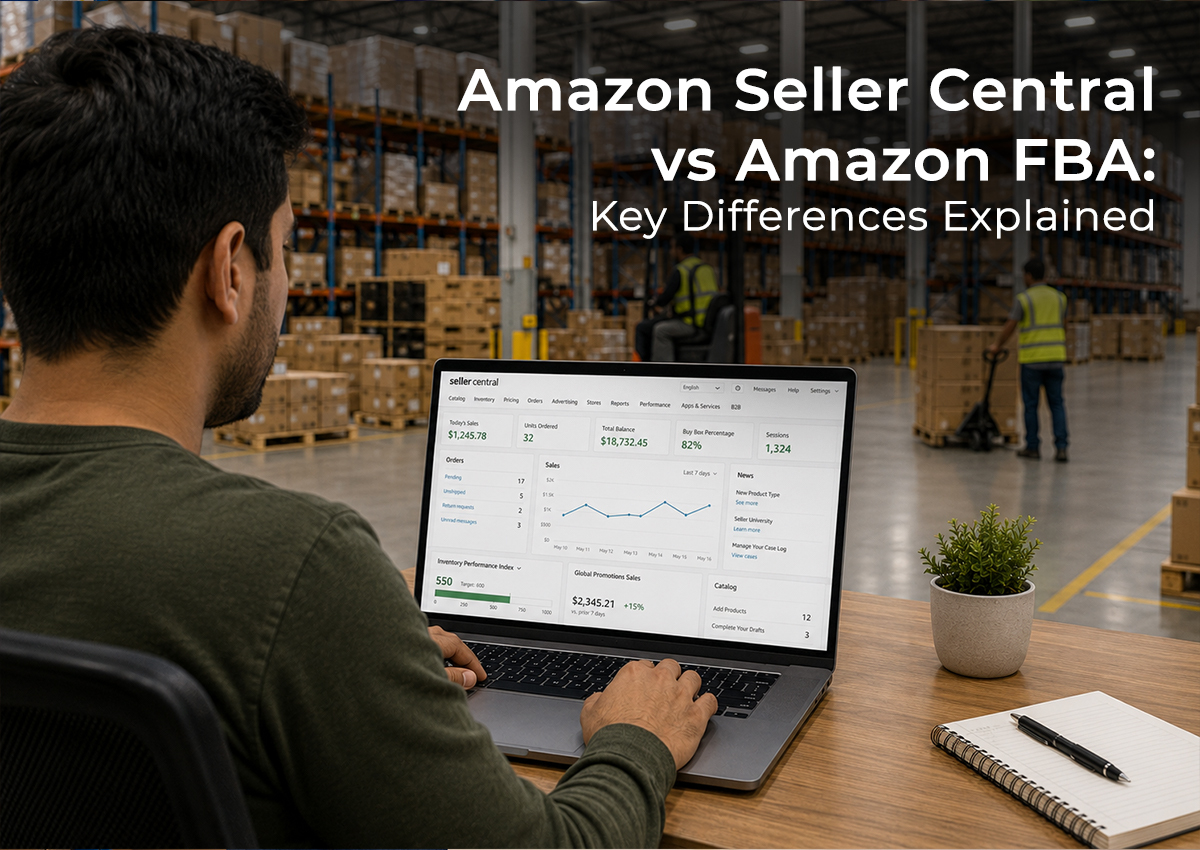
    Amazon Seller Central vs Amazon FBA comparison showing seller dashboard and warehouse fulfillment operations

    Introduction

    At the present time, Amazon continues to dominate global eCommerce. Consequently, thousands of businesses are entering the marketplace every day to scale sales and reach wider audiences.

    However, many new sellers still confuse Amazon Seller Central with Amazon FBA. Although both systems work together, they serve completely different purposes.

    ย 

    Understanding Amazon Seller Central and Amazon FBA

    As a matter of fact, understanding the difference between these two models is critical before launching or scaling your business on Amazon.
    To clarify:

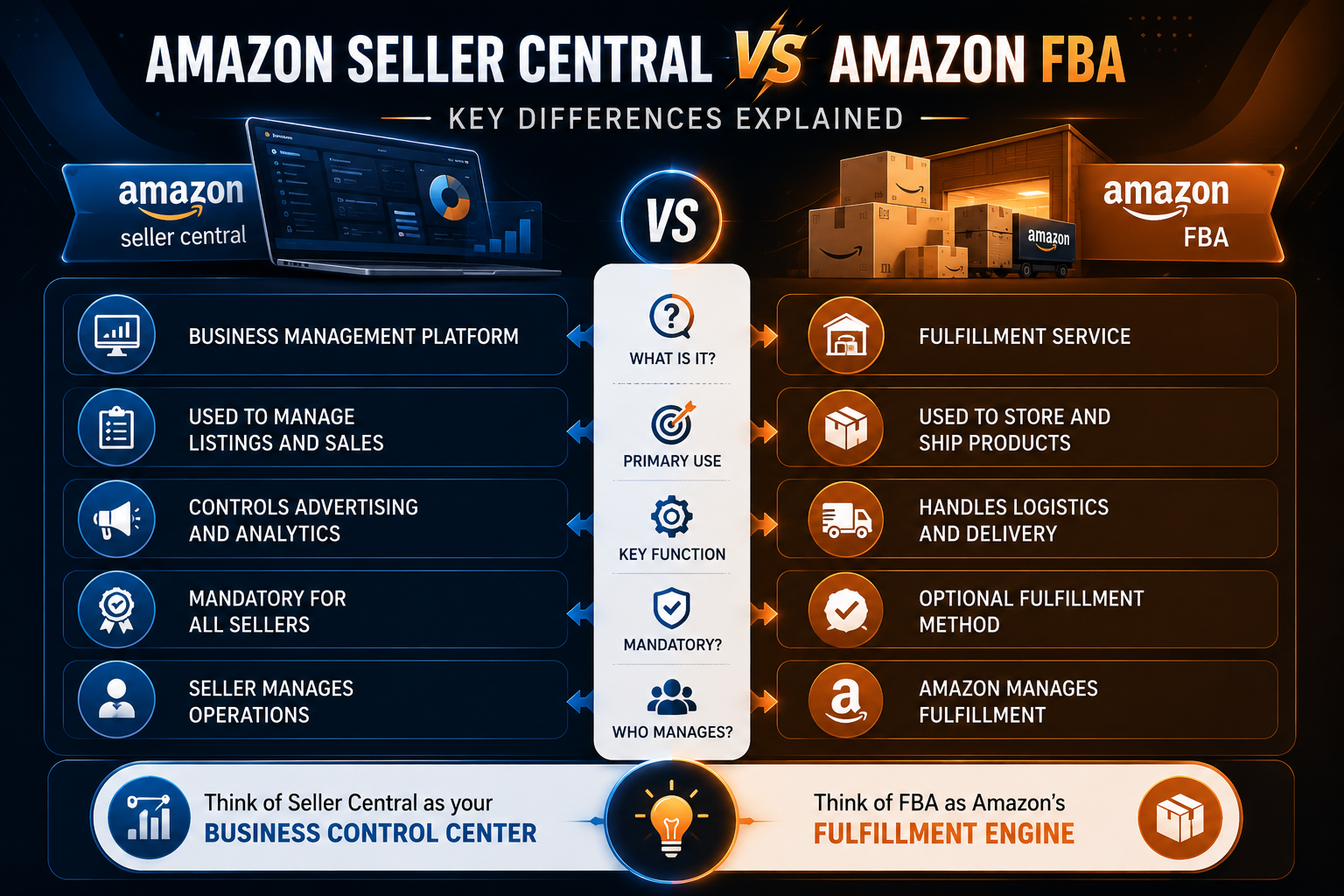
    • Amazon Seller Central is the platform sellers use to manage their business.
    • Amazon FBA is a fulfillment service offered by Amazon.

    In other words, Seller Central acts as the control center, whereas FBA handles storage, shipping, and customer service.

    Therefore, understanding how Amazon FBA works and how Seller Central operates helps sellers build a more profitable and scalable Amazon business.

    ย 

    What Is Amazon Seller Central?

    To begin with, Amazon Seller Central is the dashboard sellers use to manage every aspect of their Amazon business.

    Through this platform, sellers can:

    • List products.
    • Manage inventory.
    • Run PPC campaigns.
    • Track sales performance.
    • Monitor customer feedback.
    • Handle pricing and promotions.

    At this point, it is important to realize that every seller must complete an Amazon Seller Central account setup before selling products on Amazon.

    Without Seller Central, sellers cannot:

    • Upload products
    • Manage orders
    • Access analytics
    • Control advertising campaigns

    Accordingly, Seller Central serves as the operational backbone of an Amazon business.

    ย 

    What Is Amazon FBA?

    Secondly, let us understand the Amazon FBA meaning in simple terms.
    FBA stands for โ€œFulfillment by Amazon.โ€

    Under this model, sellers send inventory to Amazon warehouses. Afterward, Amazon stores, packs, ships, and handles customer support for those products.

    So, when people ask, โ€œWho is an Amazon FBA seller?โ€ the answer is straightforward:
    It refers to a seller leveraging Amazonโ€™s logistics infrastructure instead of managing shipping independently.

    ย 

    How Amazon FBA Works

    To explain further, here is a simplified breakdown of how Amazon FBA works:

    Step 1: Product Sourcing

    Firstly, sellers source or manufacture products.

    Step 2: Amazon Seller Central Account Setup

    Secondly, sellers create and configure their Seller Central account.

    Step 3: Inventory Shipment

    After that, inventory gets shipped to Amazon fulfillment centers.

    Step 4: Product Listings Go Live

    Amazon displays the products on the marketplace.

    Step 5: Customer Places an Order

    Whenever a customer purchases the product, Amazon processes the order automatically.

    Step 6: Amazon Handles Fulfillment

    Amazon packs, ships, and delivers the order.

    Step 7: Customer Service & Returns

    Amazon also manages returns and customer service for FBA orders.

    In essence, FBA allows sellers to focus more on growth, marketing, and product expansion instead of logistics.

    Amazon Seller Central vs Amazon FBA comparison infographic showing key differences between seller management and fulfillment services

    Types of Sellers on Amazon

    At the same time, sellers can choose different fulfillment models inside Seller Central.

    1. FBM (Fulfilled by Merchant)

    Under FBM:

    • Sellers store their own inventory.
    • Sellers pack and ship orders.
    • Sellers manage returns.

    This model gives sellers more operational control.
    However, it increases the workload and is not an efficient approach to scale.

    2. FBA (Fulfillment by Amazon)

    Under FBA:

    • Amazon stores inventory.
    • Amazon handles shipping.
    • Amazon manages returns.
    • Amazon supports customer service.

    Consequently, many businesses choose FBA for scalability and operational efficiency.

    Amazon FBA Benefits

    Above all, the biggest reason sellers choose FBA is convenience and scalability.

    Here are some major Amazon FBA benefits businesses should know:

    1. Faster Shipping: Amazon Prime eligibility improves delivery speed significantly.
      As a result, customers trust FBA products more.
    2. Higher Conversion Rates: Prime badges often increase click-through and conversion rates. Consequently, sellers frequently experience higher sales volume.
    3. Reduced Operational Burden: Amazon manages warehousing, packing, and logistics. Therefore, sellers can focus on growth activities.
    4. Better Customer Experience: Amazon handles customer service professionally and efficiently. This improves buyer satisfaction.
    5. Easier Scaling: As order volume grows, sellers do not need to expand internal logistics teams immediately. Accordingly, FBA supports faster scaling.

    Challenges of Amazon FBA

    Although FBA offers multiple advantages, sellers should also understand its limitations.

    1. Storage Fees: Amazon charges monthly inventory storage fees. Especially during peak season, Amazon costs may increase significantly.
    2. Long-Term Inventory Costs: Slow-moving inventory can lead to additional penalties. Therefore, inventory planning becomes critical.
    3. Reduced Packaging Control: Amazon controls fulfillment packaging. As a result, brand customization options may become limited.
    4. Increased Competition: Since many sellers use FBA, competition becomes more intense. Consequently, optimization strategies become essential.

    When Should You Use Amazon FBA?

    FBA works best for businesses that:

    • Want to scale quickly.
    • Sell lightweight products.
    • Need Prime eligibility.
    • Prefer operational simplicity.
    • Lack of warehousing infrastructure.

    On the other hand, FBM may work better for:

    • Oversized products.
    • Customized items.
    • Low-margin products.
    • Businesses with strong logistics systems.

    Therefore, sellers must evaluate profitability carefully before choosing fulfillment methods.

    Why Seller Central Optimization Matters

    Even though FBA handles logistics, success still depends heavily on Seller Central optimization.
    Without proper optimization:

    • Listings may not rank.
    • PPC costs may rise.
    • Conversion rates may drop.
    • Organic visibility may decline.

    Accordingly, successful sellers continuously optimize:

    In other words, FBA alone cannot guarantee success.

    Common Mistakes New Amazon Sellers Make

    1. Ignoring Account Setup Optimization: Many sellers rush through the Amazon Seller Central account setup without understanding compliance and structure.
      As a result, account performance suffers later.
    2. Choosing FBA Without Profit Analysis: Some businesses underestimate FBA fees. Consequently, margins shrink unexpectedly.
    3. Poor Inventory Forecasting: Sending excessive inventory to FBA warehouses often increases storage costs. Therefore, forecasting remains essential.
    4. Weak Listing Optimization: Even great products fail without optimized listings. Accordingly, SEO and conversion optimization remain critical growth drivers.

    How Krolog Helps Amazon Sellers Scale Efficiently

    At Krolog, we help businesses simplify Amazon growth through data-driven marketplace strategies.

    Our Amazon services include:

    Whether you are launching your first product or scaling an existing catalog, Krolog helps businesses improve visibility, profitability, and operational efficiency.
    Most importantly, we build strategies tailored to your business goals instead of applying generic solutions.

    Seller Central + FBA: The Winning Combination

    The most successful Amazon businesses understand one important fact:
    Seller Central and FBA work best together.

    Seller Central gives sellers control over:

    • Listings
    • Ads
    • Analytics
    • Pricing
    • Performance tracking

    Meanwhile, FBA simplifies:

    • Fulfillment
    • Shipping
    • Customer service
    • Returns management

    Together, they create a scalable Amazon ecosystem capable of supporting long-term growth.

    The Bigger Picture: Building a Sustainable Amazon Business

    All things considered, choosing between Seller Central services and Amazon FBA is not really an either-or decision.

    Instead, it is about understanding how both systems function together.

    Seller Central manages the business side.
    FBA manages the logistics side.

    Therefore, businesses that understand both systems thoroughly position themselves for stronger growth, better customer experience, and higher profitability.

    Final Takeaway: Scale Smarter on Amazon

    In conclusion, understanding Amazon FBA meaning, how Amazon FBA works, and the role of Seller Central is essential for every Amazon seller.
    Without a doubt, businesses that optimize both operational strategy and fulfillment infrastructure gain a significant competitive advantage.

    Whether you are learning what an FBA seller on Amazon is for the first time or planning to scale aggressively in peak season, success on Amazon depends on:

    With the right strategy and expert support from Krolog, sellers can build scalable, sustainable, and profitable Amazon businesses in todayโ€™s competitive marketplace.

    Related Article

    Amazon Seller Central vs Amazon FBA: Key Differences Explained

    Amazon Seller Central vs Amazon FBA: Key Differences Explained

    Amazon Seller Central vs Amazon FBA: Key Differences Explained Introduction At the present time, Amazon continues to dominate global eCommerce.…

    From Supply Chain to Sales Engine: How Toner Pros Scaled with Shopify

    From Supply Chain to Sales Engine: How Toner Pros Scaled with Shopify

    How Krolog Transformed Growth for an Arts and Crafts eCommerce Brand Services Used Shopify Store Development Services Shopify Design Services…

    From Handmade Store to Scalable Brand: How Cantoocity Grew with Shopify

    From Handmade Store to Scalable Brand: How Cantoocity Grew with Shopify

    How Krolog Transformed Growth for an Arts and Crafts eCommerce Brand Services Used Shopify Store Development Services Shopify Design Services…

    Ready to Scale Your Amazon Brand?

    If youโ€™re looking for expert-led Amazon advertising strategies, a performance-focused Amazon PPC strategy, and real growth, get in touch with us at Krolog, where Amazon experts will help you build a winning Amazon advertising system tailored to your business.

    Scroll to Top