Amazon Backend Keywords Guide (2026): How to Use Hidden Keywords for Better Rankings
Amazon Backend Keywords Guide (2026): How to Use Hidden Keywords for Better Rankings You could have the best product on…
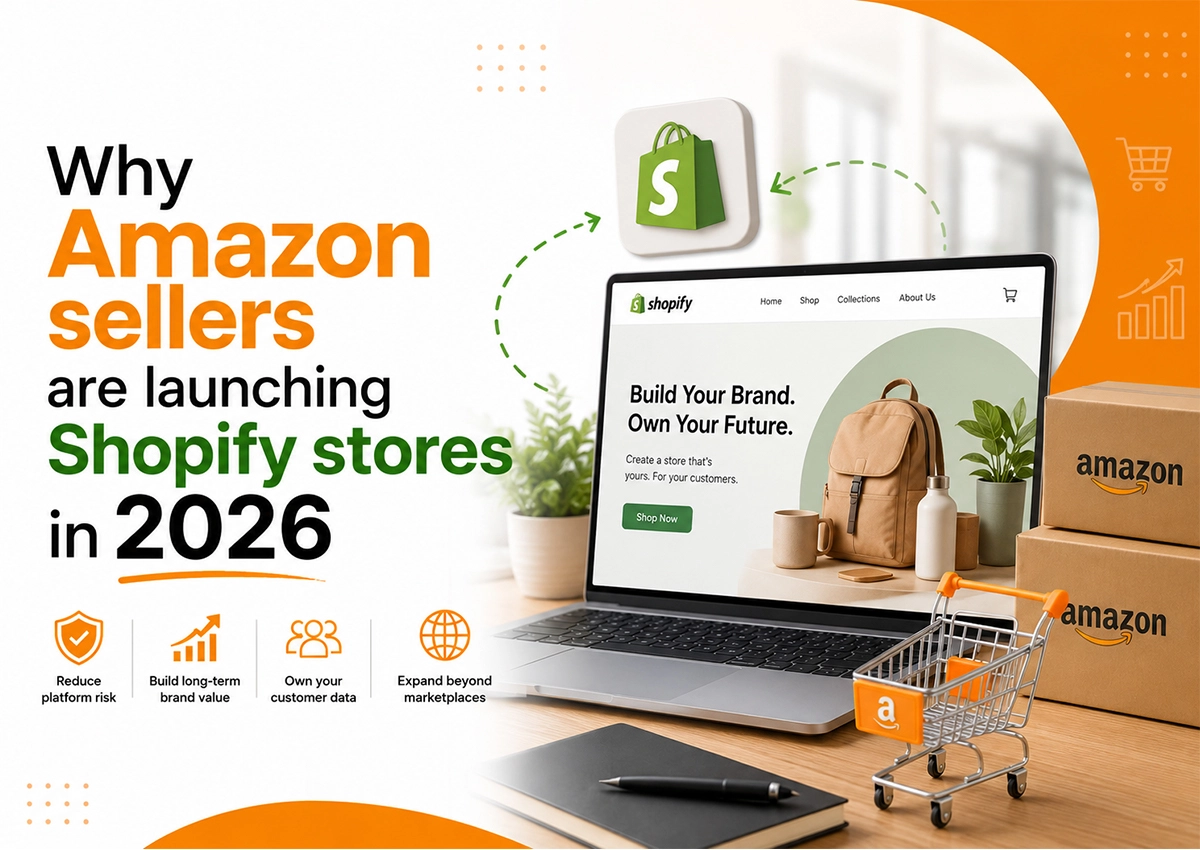
Discover why thousands of Amazon sellers are expanding into Shopify ecommerce in 2026. Learn how Shopify Plus, multi-channel ecommerce, Amazon FBA integration, and independent brand ownership are helping sellers build a more profitable and future-ready business.
Amazon is still one of the strongest marketplaces for acquiring customers. But sellers donβt own the business completely on Amazon.Β
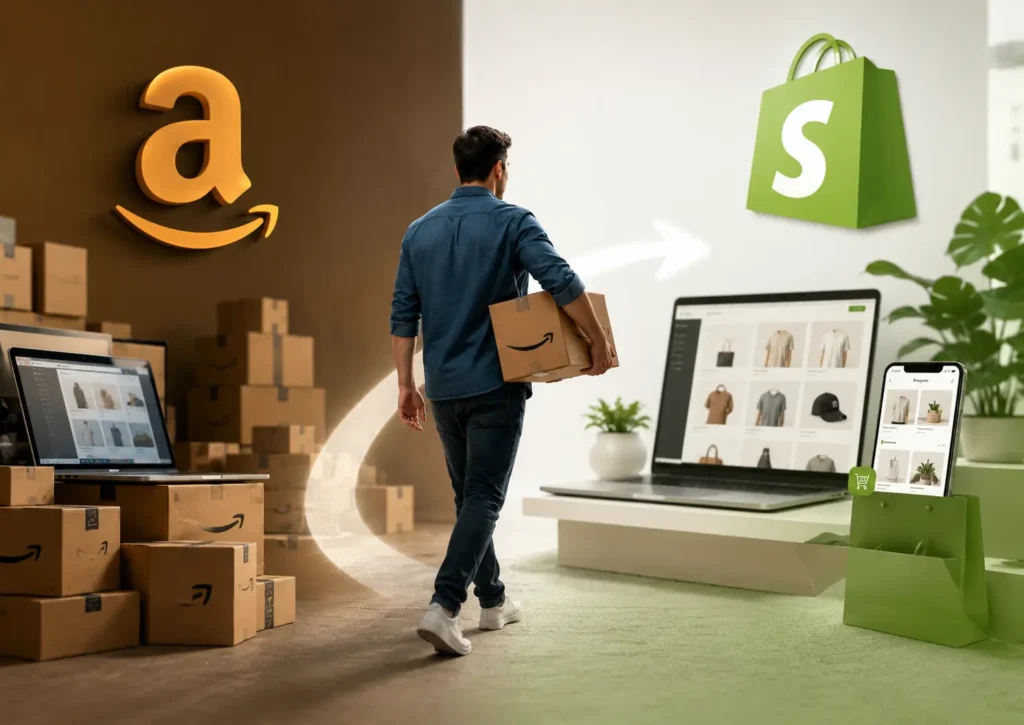
That’s exactly why thousands of sellers are investing in Shopify ecommerce. They’re building their own storefront while continuing to sell on Amazon.Β
The result?Β
Successful brands now treat Amazon as one sales channel, not their entire business.
A Shopify store lets brands collect emails, build loyalty programs, and create repeat buyers.
Many sellers now connect Amazon FBA directly with Shopify to simplify fulfilment.
Brands selling across Amazon and Shopify generally recover faster from marketplace changes.
Category: Ecommerce Platform
Related Entities:
Shopify ecommerce isn’t simply another website builder. It’s your own digital storefront.
Think about how most Amazon businesses begin.
Everything looks great until you realise the customer isn’t really yours. Amazon owns the buying experience.
Amazon owns the customer data, decides how your products appear, and if policies change tomorrow, your business changes too.
That’s where Shopify enters the picture.
Instead of competing with Amazon, Shopify gives sellers a place they completely control.
Everything. And that’s exactly why Shopify ecommerce is becoming one of the fastest-growing investments for Amazon sellers in 2026.
Ten years ago, selling on Amazon alone made perfect sense.
But things have changed over the years. Growing brands are noticing patterns where fees continue to increase, PPC costs keep rising, and competition becomes tougher every quarter.
Today, smart sellers aren’t abandoning Amazon but reducing dependency and diversifying revenue streams.
An arts and crafts brand we recently analysed generated nearly 90% of its revenue from Amazon.
The numbers are great, but thereβs almost zero customer data, no email lists, no SMS subscribers, and no loyalty program.
A single policy update could have affected the majority of their revenue.
Post their Shopify launch, Amazon remained their biggest acquisition channel, while Shopify became their retention channel. The brand witnessed:
Now that’s what we call a much healthier business.
At Krolog, we’ve seen this shift accelerate over the last two years. More brands now ask how Amazon and Shopify can work together, and not which platform they should choose.
Amazon continues to deliver incredible reach.
That’s definitely hard to beat. But sellers also face growing operational costs.
While individually, they don’t look alarming, together, they may completely change the math, as each one chips away at profitability.
Many brands now compare Amazon FBA vs Shopify differently than they did five years ago.
Shopify isn’t necessarily cheaper. It comes with its own hosting, apps, payment processing, and marketing costs. But sellers control where that money goes. That’s where the key difference lies. Instead of paying for marketplace dependency, they’re investing in owned growth.
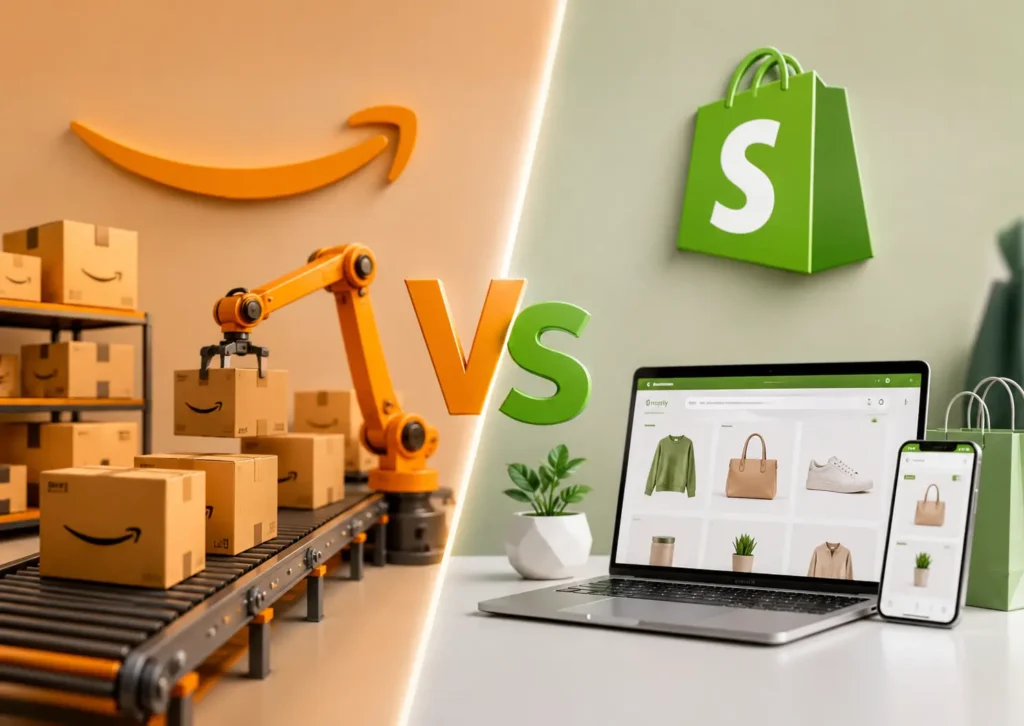
One question appears in almost every ecommerce discussion. Shopify vs Amazon?
Honestly, it’s the wrong question. The best-performing brands rarely choose one. They combine both.
Both generate sales. Only one builds long-term equity. That’s why conversations around selling on Shopify vs Amazon are changing. It’s no longer about replacing one platform. It’s about creating a connected ecosystem where each channel strengthens the other. The businesses growing fastest in 2026 understand that and are planning for the next five years, and not just the next Prime Day.
Launching a Shopify store sounds like a massive project. It really isn’t, at least not if you plan it right.
A lot of sellers make the mistake of thinking they need hundreds of products, expensive custom development, and months of work before going live. Truth is, you don’t. Start small.
Pick your best-selling products, build a clean storefront, keep navigation simple, and then connect your existing fulfillment system. That’s enough to get moving.
A practical roadmap looks something like this:
Step 1: Audit your Amazon catalog. Identify products with strong reviews and consistent demand.
Step 2: Build your Shopify store. Focus on speed, mobile experience, and trust signals before adding fancy features.
Step 3: Configure payments, shipping, taxes, and customer emails.
Step 4: Connect Amazon FBA if you plan to use Multi-Channel Fulfillment.
Step 5: Install only the apps you genuinely need. Too many apps slow stores down.
Step 6: Launch marketing. Email, Meta Ads, Google Shopping, influencer campaigns. Everything becomes easier when you own the customer journey.
One thing we’ve noticed at Krolog? Brands that keep their first Shopify launch simple usually scale faster than those trying to build the “perfect” website from day one.
Here’s something many sellers don’t realise. Launching Shopify doesn’t mean renting another warehouse. You can continue using your existing Amazon inventory.
Amazon Multi-Channel Fulfillment (MCF) allows eligible sellers to fulfill Shopify orders directly using Amazon’s logistics network. That’s a huge advantage.
It creates a much smoother transition into multi-channel ecommerce. The basic workflow looks like this:
Simple.Β
That said, there are a few things to monitor:
Many growing brands forget to separate marketplace inventory from DTC inventory planning. Everything works well until one channel suddenly sells out and affects the other. Proper forecasting prevents this.
This comparison comes up almost every week. The answer?
It depends on your objective.
| Comparison Factor | Amazon FBA | Shopify |
|---|---|---|
| Customer Traffic | Very High | You generate it |
| Customer Relations | Limited | Complete |
| Brand Control | Moderate | Full |
| Advertising Flexibility | Amazon Ads | Google, Meta, TikTok & more |
| Marketplace Fees | Higher | Lower platform dependency |
| Customer Lifetime Value | Limited | Much Higher |
| Data Access | Restricted | Complete |
| Long-Term Brand Equity | Moderate | Excellent |
Looking at Amazon FBA vs Shopify as competitors misses the bigger picture. Amazon is incredible for acquisition. Shopify excels at retention. The strongest brands combine both.
Some sellers wait too long, and some rush into it. Neither approach works.
Generally speaking, it’s time to consider Shopify if:
A good rule of thumb? If Amazon already validates your products, Shopify becomes much easier to scale. You aren’t guessing anymore but building on proven demand.
Launching a Shopify store sounds exciting, and it is. But weβve seen brands rush into it because everyone else was doing it. That doesn’t end well.Β
One client came to us after building their own Shopify store over a weekend. It looked good. But pages loaded slowly, checkout abandoned often, and analytics weren’t even configured properly.Β
Within eight weeks, after redesigning the store, improving speed, refining collections, and integrating Amazon fulfillment correctly, conversion rates nearly doubled.
Sometimes growth isn’t about working harder. It’s about building smarter.
Ad Spend Γ· Total Revenue
Many experienced advertisers increasingly prioritize TACoS because it reflects long-term brand growth.
Turn your ideas into a powerful online store.
Ecommerce in 2026 looks very different from even two years ago.Β
That’s exactly why more brands are investing in Shopify ecommerce. Not because Amazon is losing relevance, but because the ability to create customer relationships is becoming a competitive advantage.
The biggest shift isn’t where customers shop. It’s how they shop.
People discover products on TikTok, compare them on Amazon, and finally purchase from a brand’s Shopify website after seeing a retargeting ad. The buying journey is no longer linear.
Brands that understand this consistently outperform those relying on a single sales channel.
When advising Amazon brands on Shopify expansion, we evaluate opportunities using practical business metrics, not assumptions.
Our framework includes:
At Krolog, we follow the same methodology while helping brands launch or optimize Shopify stores. Instead of simply building a website, the focus stays on creating a scalable ecommerce ecosystem that complements Amazon and does not compete with it.
No. For most businesses, the better strategy is to use both platforms together. Amazon provides marketplace traffic, while Shopify allows you greater control over customer relationships and branding.
Profit margins vary by category. However, many brands improve profitability because Shopify eliminates marketplace referral fees and allows better control over pricing, customer retention, and upselling.
Sales stop immediately. That's one reason sellers are building Shopify stores, to reduce dependency on a single platform and maintain business continuity.
At Krolog, besides Shopify Development services, we also offer Amazon Full Account Management and Amazon Account Reinstatement services to get your Amazon account up and running again.
Β
Yes. Amazon Multi-Channel Fulfillment (MCF) lets you use existing FBA inventory for Shopify orders, simplifying inventory management.
Amazon drives marketplace sales, while Shopify supports direct-to-consumer growth. Together, they create a stronger multi-channel ecommerce strategy with diversified revenue streams.
Generally, once Amazon sales become stable and the business has enough resources to invest in branding, marketing, and customer acquisition, launching Shopify becomes a logical next step.
Most brands can launch within a few weeks, but building consistent traffic and profitability typically takes several months, depending on marketing strategy, niche, and execution.
Yes. While Shopify won't replace Amazon overnight, it helps diversify revenue, build customer loyalty, and reduce risks associated with relying solely on one marketplace.
Amazon remains one of the most powerful ecommerce marketplaces in the world. That hasn’t changed.
What has changed is how successful brands approach growth.
Instead of asking “Amazon or Shopify?”, smart businesses now ask “How can both platforms work together?”
Amazon drives discovery; Shopify builds relationships. Amazon generates marketplace sales; Shopify improves margins, captures customer data, and creates long-term brand value.
The future belongs to brands that diversify, not because Amazon is failing, but because customers expect to shop across multiple channels.
If you’re serious about preparing your online business for future ecommerce growth, building a Shopify store alongside Amazon is no longer a luxury. It’s becoming a strategic necessity.
Sandeep K. Founder and CEO of Krolog Inc. is a professional Amazon and eCommerce consultant specializing in marketplace growth, inventory forecasting, profitability optimization, and performance-driven strategies for brands worldwide.
Request a shopify store:
Amazon Backend Keywords Guide (2026): How to Use Hidden Keywords for Better Rankings You could have the best product on…
How to Expand From Amazon to Shopify: The 2026 Checklist If you’re relying entirely on Amazon for sales, you’re also…
Why Amazon Sellers Are Launching Shopify Stores in 2026 Discover why thousands of Amazon sellers are expanding into Shopify ecommerce…
Krolog was born from a simple yet powerful idea: to empower businesses with the tools and strategies needed to thrive in the ever-evolving digital marketplace. Our journey is a testament to the transformative impact of strategic E-commerce solutions.


Copyright Β© 2026 All Right ReservedΒ