Amazon Backend Keywords Guide (2026): How to Use Hidden Keywords for Better Rankings
Amazon Backend Keywords Guide (2026): How to Use Hidden Keywords for Better Rankings You could have the best product on…
If you’re relying entirely on Amazon for sales, you’re also relying entirely on Amazon’s rules.
That’s exactly why more sellers are launching Shopify stores in 2026. Not to leave Amazon, but to build a business they actually own.
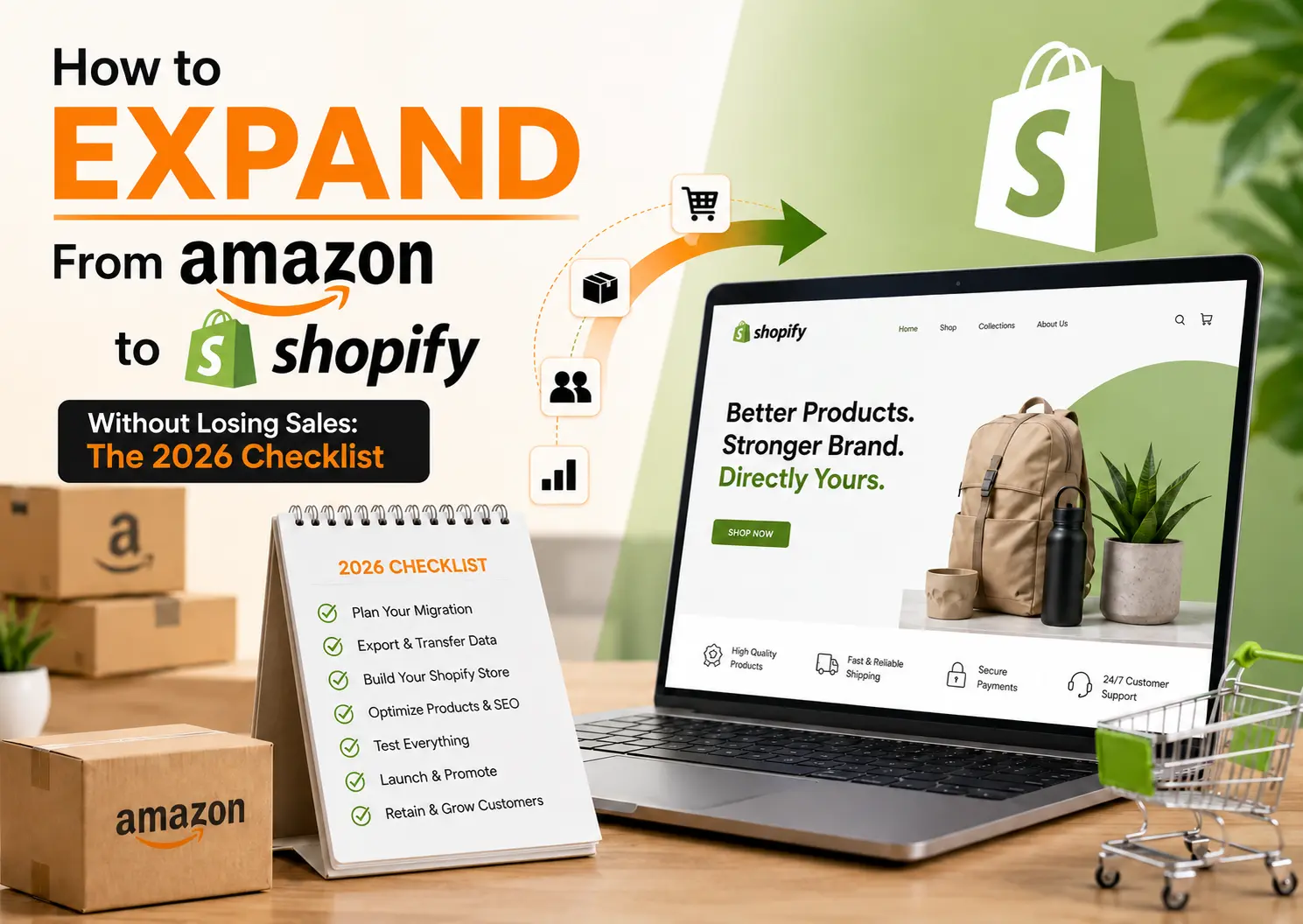
This guide walks you through the complete Amazon-to-Shopify expansion processβfrom importing your Amazon catalog into Shopify and configuring Shopify Marketplace Connect to launching your branded store without disrupting your Amazon sales.
Whether you’re expanding on Shopify as a second sales channel or building a long-term DTC strategy, this checklist will help you expand confidently while keeping Amazon as a powerful acquisition engine.
Expanding from Amazon to Shopify allows brands to diversify revenue without sacrificing marketplace sales. Rather than replacing Amazon, successful sellers use Shopify to own customer relationships, improve margins, and build long-term brand equity while continuing to benefit from Amazon’s reach.Β
A structured Shopify expansion checklist, proper product import strategy, optimized redirects, and integrated inventory management ensure you can launch without sacrificing sales or customer experience.
Many brands continue selling on Amazon while growing their Shopify store.
A structured Shopify launch checklist prevents common expansion mistakes.
Unlike Amazon, Shopify gives you direct access to customer data, email marketing, and repeat purchase opportunities.
Tools like Shopify Marketplace Connect help manage inventory across multiple sales channels.
The goal isn’t to replace Amazon, but to build a stronger multichannel ecommerce business.
Expanding from Amazon to Shopify means adding your own ecommerce store while continuing to sell on Amazon. Rather than replacing one platform with another, you’re building an additional sales channel that gives you greater control over branding, customer relationships, and long-term growth.Β
In some cases, this may involve migrating existing ecommerce assets, but for most Amazon sellers, expansion, not migration, is the primary objective.Β
Category : Shopify Expansion
Category Type : Ecommerce Platform Expansion
Related Entities : Shopify Marketplace Connect, Amazon Seller Central, Shopify Plus, Amazon FBA, Multi-channel Ecommerce SEO
Common Synonyms : Amazon to Shopify expansion, Shopify product import, ecommerce platform expansion
Key Metrics : Revenue Diversification, Conversion Rate, Repeat Customers, Customer Lifetime Value
A few years ago, selling exclusively on Amazon made sense. Today? Not so much.
Many brands have realized that depending on a single marketplace creates unnecessary risk.
One policy update, account suspension, or an inventory issue, and sales can stop overnight.
That’s why selling on Amazon vs Shopify is no longer viewed as an either-or decision.
It’s becoming a “both” strategy.
Amazon still generates discovery and high-intent traffic. Shopify creates direct customer relationships, stronger branding, and better long-term profitability.
The smartest ecommerce businesses aren’t replacing Amazon. They’re building an ecosystem around it.
One misconception I still hear is:
“Expanding to Shopify means abandoning Amazon.”
Actually, the opposite is happening.
The fastest-growing ecommerce brands continue using Amazon for customer acquisition while leveraging Shopify for repeat purchases, subscriptions, bundled offers, loyalty programs, and higher-margin sales. That’s a much more resilient business model.
Instead of debating Shopify vs Amazon, many brands are asking a different question:
“How can both platforms work together?”
The answer lies in multichannel ecommerce.
Amazon delivers reach; Shopify delivers ownership. Together, they create a balanced growth strategy. Some of the biggest advantages include:
If one channel slows down, the other continues generating sales.
Amazon limits customer communication. Shopify gives you access to:
Your Shopify store reflects your brand, not Amazon’s marketplace layout. That means complete control over:
While Amazon remains an excellent acquisition channel, Shopify often improves lifetime customer value because repeat purchases don’t always require marketplace fees or aggressive advertising.
Modern integrations like Shopify Marketplace Connect allow businesses to manage inventory across Amazon and Shopify without creating duplicate workflows.
That’s becoming increasingly important as brands expand into Walmart Marketplace, TikTok Shop, and other ecommerce channels.
If you ask successful ecommerce brands whether they prefer Shopify vs Amazon, most won’t choose one. They’ll choose both.
Amazon remains one of the largest product discovery platforms in the world. Millions of shoppers begin their buying journey there because they trust the marketplace and appreciate fast shipping.
Shopify, however, gives brands something Amazon never can: ownership.
You own the website, customer relationship, marketing data and control the shopping experience.
Instead of thinking about selling on Amazon vs Shopify, think about the role each platform plays.
| Amazon | Shopify |
|---|---|
| Customer discovery | Brand building |
| Marketplace trust | Customer ownership |
| High buying intent | Higher lifetime value |
| Fast acquisition | Repeat purchases |
| Built-in traffic | Complete marketing control |
One of the smartest strategies we’re seeing in 2026 is using Amazon as the acquisition engine while Shopify becomes the retention engine.
Amazon finds new customers. Shopify keeps them coming back.
Absolutely. In fact, this has become the preferred growth strategy for many established brands.
Running both platforms together allows businesses to diversify revenue without sacrificing Amazon’s marketplace exposure. Some advantages include:
With integrations like Shopify Marketplace Connect, managing inventory across channels has become far simpler than it was just a few years ago.
Turn your ideas into a powerful online store.
One of the first steps during expansion is importing your catalog. Fortunately, Amazon-to-Shopify product import doesn’t require rebuilding everything manually.
Most sellers export product information, including:
This data can then be imported into Shopify using CSV files. However, don’t treat expansion as a copy-paste exercise. It’s also an opportunity to improve your listings.
Many brands use expansion to:
Think of expansion as rebuilding your storefront, and not simply replicating it.
Inventory management used to be one of the biggest barriers to multi-channel selling.
That’s changing. Shopify Marketplace Connect allows businesses to synchronize products, pricing, and inventory across multiple marketplaces. A few benefits include:
Instead of maintaining separate inventories, businesses can manage operations from a single dashboard. For growing brands, that’s a significant operational advantage.
Before launching your Shopify store, make sure every critical component is in place.
Launching without testing often leads to avoidable revenue loss.
Expansion becomes much easier when broken into clear phases.
Shopify redirects become important if you’re moving an existing website or consolidating multiple ecommerce properties into Shopify.
Without redirects:
If you’re expanding directly from Amazon, redirects may not be required. However, they become essential when you’re also migrating an existing ecommerce website to Shopify.Β
In 2026, successful brands combine automation with experienced management.
Companies like Krolog increasingly integrate both approaches to improve efficiency and profitability.
Expansion costs vary depending on store complexity.
| Business Size | Estimated Investment |
|---|---|
| Small Store | $1,500β$4,000 |
| Growing Brand | $4,000β$10,000 |
| Enterprise | $10,000β$30,000+ |
Pricing usually depends on:
Hiring experienced expansion specialists often costs more initially, but usually prevents expensive fixes later.
Consider a home organization brand selling exclusively through Amazon. Sales were strong, but repeat purchases remained low because customer communication was limited. After launching Shopify:
Amazon continued driving new customers, while Shopify increased lifetime value. That combination produced stronger overall profitability.
Turn your ideas into a powerful online store.
The ecommerce landscape is changing faster than ever. Sellers that adapt early are building more resilient businesses, while those relying on a single marketplace are finding growth increasingly difficult.
AI-driven recommendations, personalized product suggestions, and conversational shopping assistants are reshaping how customers discover products. Shopify merchants can leverage these tools to create richer shopping experiences and improve conversions.
Rather than debating selling on Amazon vs Shopify, successful brands are integrating both platforms. Amazon remains a customer acquisition channel, while Shopify becomes the hub for brand building and customer retention.
Owning first-party customer data enables businesses to create personalized email campaigns, loyalty programs, subscription models, and remarketing strategies, advantages that marketplace-only sellers simply don’t have.
Growing brands are investing in faster, more flexible storefronts that offer unique shopping experiences and better performance across devices.
More businesses are expanding beyond Amazon into Shopify, Walmart Marketplace, TikTok Shop, and other ecommerce channels to reduce dependency on a single revenue source.
Our recommendations are based on practical ecommerce implementation rather than theory. We evaluate expansion strategies using criteria that directly influence business performance.
Yes. In fact, many successful brands operate on both platforms. Amazon helps attract new customers, while Shopify enables stronger branding, customer retention, and higher lifetime value.
For most growing businesses, yes. Shopify provides greater control over branding, customer data, marketing, and profitability while reducing dependence on a single marketplace.
Expansion costs typically range from $1,500 to $30,000+, depending on catalog size, store complexity, custom development, and third-party integrations.
No. Most businesses continue selling on Amazon while growing their Shopify store as part of a multi-channel ecommerce strategy.
You can export product information from Amazon Seller Central and perform an Amazon-to-Shopify product import using CSV files.
Not if the processes are handled correctly. Using proper Shopify redirects, optimizing metadata, and maintaining site structure help preserve existing search visibility.
Most projects take 2β8 weeks, while larger enterprise expansions with custom functionality may require several months.
If your business has a large catalog, custom workflows, or multiple marketplace integrations, working with an experienced expansion partner significantly reduces risk and downtime.
Yes. Shopify supports wholesale pricing, B2B portals, custom catalogs, bulk ordering, and integrations through Shopify Plus and third-party applications.
Expanding from Amazon to Shopify isn’t about choosing one platform over another. It’s about creating a stronger multichannel business where Amazon drives discovery, and Shopify builds customer relationships. The brands growing fastest in 2026 aren’t leaving Amazon; they’re leveraging both to maximize visibility, ownership, and long-term profitability.
With proper planning, a structured Shopify expansion checklist, optimized product imports, inventory synchronization through Shopify Marketplace Connect, and a carefully executed launch strategy, businesses can transition without sacrificing sales.
For brands looking to simplify the process, Krolog’s Shopify expansion and development experts help manage everything from expansion planning and store development to SEO optimization and post-launch growth, ensuring a smooth transition with minimal business disruption.
Sandeep K. Founder and CEO of Krolog Inc.has over 10 years of experience helping ecommerce brands scale through Amazon marketplace management, Shopify development, SEO, conversion optimization, and multi-channel growth strategies.
Planning an expansion doesn’t have to be complicated.
Request a Shopify Expansion Audit to identify risks, SEO opportunities, technical improvements, and a roadmap for launching your Shopify store without disrupting existing sales
Amazon Backend Keywords Guide (2026): How to Use Hidden Keywords for Better Rankings You could have the best product on…
How to Expand From Amazon to Shopify: The 2026 Checklist If you’re relying entirely on Amazon for sales, you’re also…
Why Amazon Sellers Are Launching Shopify Stores in 2026 Discover why thousands of Amazon sellers are expanding into Shopify ecommerce…
Krolog was born from a simple yet powerful idea: to empower businesses with the tools and strategies needed to thrive in the ever-evolving digital marketplace. Our journey is a testament to the transformative impact of strategic E-commerce solutions.


Copyright Β© 2026 All Right ReservedΒ