
Nav Preview

Amazon Backend Keywords: Where to Put Them and What to Never Include

Your product listing looks good. The title is optimized, bullet points are clear, and images are doing their job. But are you using the available backend keyword space properly?

Amazon backend keywords help sellers include relevant search terms without adding more text to the visible listing. Think synonyms, alternate product names, and relevant search phrases customers might use.

Sounds simple. Yet many sellers waste this space repeating keywords or adding irrelevant search terms.ย 

Here’s how to get it right, where to add them, and what to leave out.

Amazon Product Video
Amazon Advertising Video
Amazon Sponsored Brand Video

Amazon ACoS Strategies

PPC Performance

Higher ROAS

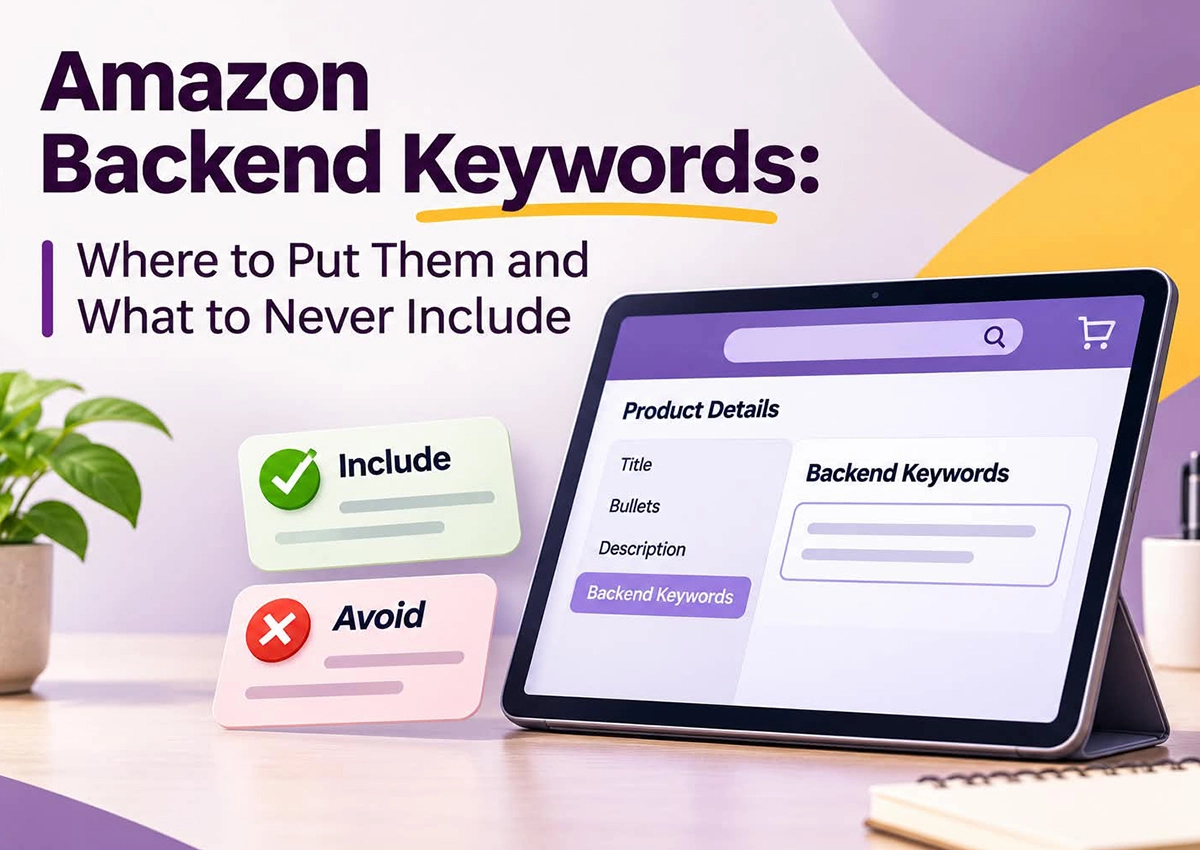
Amazon backend keywords guide showing a tablet with the Backend Keywords field and Include and Avoid checklist cards

Summary

Amazon backend keywords are hidden search terms entered through the Generic Keywords field in Seller Central. They help Amazon match products with relevant customer searches. Sellers should prioritize relevant synonyms, alternate terminology, and useful search variations while following Amazon’s byte limit and prohibited-term guidelines.

Key Takeaways

Use Hidden Space Wisely

Add relevant terms missing from visible listing content.

Watch the Limit

Keep backend search terms below 250 bytes where the applicable marketplace limit is 250 bytes.

Avoid Repetition

Don’t waste space repeating existing listing keywords.

Stay Relevant

Every term should describe the product or its legitimate use.

Review Regularly

ย Update keywords as customer search behavior changes.

What Are Amazon Backend Keywords and Why Do They Matter?

Amazon backend keywords are search terms that sellers add to the Generic Keywords field in Seller Central. Customers cannot see them on the product detail page, but Amazon can use them for search matching.

For example, imagine you’re selling a bamboo cutting board.

Your product title already includes “bamboo cutting board.” Instead of repeating those words, you could consider relevant alternatives such as:

  • chopping surface
  • food preparation board
  • kitchen prep accessory
  • butcher block

The idea isn’t to fill every available byte. It’s to cover useful search variations without duplicating existing information.

Where Do You Add Amazon Backend Keywords in Seller Central?

Finding the field is easy. Choosing the right terms takes more work.

  1. Open Amazon Seller Central.
  2. Go to Manage All Inventory.
  3. Find the product and select Edit.
  4. Open the Product Details tab.
  5. Locate the Generic Keyword field.
  6. Add relevant search terms and save your changes.

Amazon may display different attributes depending on the product category and marketplace. Don’t confuse Generic Keywords with fields such as Intended Use or Target Audience. Those attributes have separate purposes.

What Is the Amazon Backend Keywords Limit?

For Amazon’s US Generic Keywords field, the limit is less than 250 bytes. This is a byte limit, not always a character limit. If the field exceeds the limit, Amazon Search may ignore the entire entry.ย 

A few rules worth following:

  • Use lowercase letters.
  • Separate words with spaces.
  • Avoid punctuation.
  • Don’t repeat words.
  • Use either singular or plural forms.
  • Skip unnecessary articles and prepositions.

Marketplace and category requirements can differ. Check the applicable Seller Central guidance before uploading.

What Should You Never Include in Amazon Backend Keywords?

This is where sellers often get careless. More keywords don’t automatically mean more visibility.

Avoid including:

  • Brand names: Your brand or competing brand names.
  • ASINs and product identifiers: These don’t belong in generic search terms.
  • Subjective claims: Words such as “best,” “amazing,” or “cheapest.”
  • Temporary claims: “New,” “on sale,” or “limited time.”
  • Irrelevant terms: Popular keywords that don’t describe your product.
  • Repeated words: Repetition wastes valuable space.
  • Common misspellings: Amazon already accounts for many spelling corrections.

These restrictions come directly from Amazon’s search-term guidance. Violations can affect indexing and may create listing or account risks.ย 

Optimize Your Amazon Listings for Better Visibility

Not sure which backend keywords to use or what to avoid? Get expert Amazon SEO support to optimize your listing keywords, improve discoverability, and reach more relevant shoppers.

How Do You Find the Right Amazon Backend Keywords?

Start with Amazon keyword research, not guesswork.

Use an Amazon keyword research tool such as Helium 10 or Jungle Scout to identify search variations and competitor keyword opportunities. Amazon Brand Analytics can also help eligible brand-registered sellers understand customer search behavior.

For each ASIN, build a list of:

  • Relevant synonyms.
  • Alternative product names.
  • Common abbreviations.
  • Product-specific use cases.
  • Search terms competitors rank for that are genuinely relevant.

An Amazon backend keyword extractor can help collect keyword ideas, but don’t copy everything it generates. Review relevance first.

Expert observation

At Krolog, we often find sellers chasing high-volume keywords without checking whether those terms actually describe the product. Relevance should come first; Search volume comes next.

How Krolog Approaches Amazon Keyword Optimization

Keyword placement works best when it’s part of a wider listing strategy.

For example, Krolog worked with Mini Scrapper on optimising their Amazon presence. Within one month, the brand recorded a 45% increase in sales, while ACoS improved from 75% to 47%.

This was a broader listing optimization effort along with back-end search term integration. It demonstrates why keyword research, listing content, back-end search terms, and performance improvements need to work together.

Through its Amazon Listing Optimization Services, Krolog helps brands refine keyword placement, improve listing relevance, and build stronger product pages.

Common Amazon Backend Keyword Mistakes

  • Copying competitor keywords without checking relevance.
  • Repeating title and bullet-point keywords.
  • Treating backend fields as a place for keyword stuffing.
  • Ignoring marketplace-specific limits.
  • Updating keywords without monitoring search performance.

Small mistakes that can cause valuable listing space wastage.

Final Verdict

Amazon backend keywords aren’t a dumping ground for every search phrase you can find. They’re a limited space, so use it carefully.

Prioritize relevant synonyms, alternative product names, and customer search variations. Avoid repetition and prohibited terms. Most importantly, treat backend keywords as one part of your overall Amazon SEO strategy.

At Krolog, we combine keyword research with Amazon listing optimization and Amazon SEO services to help brands improve discoverability and build listings that convert.

Frequently Asked Questions

About the Author

Sandeep K., Founder and CEO of Krolog Inc., has over 10 years of experience in Amazon SEO, PPC, keyword strategy, and marketplace growth. He helps brands improve product visibility, strengthen listing performance, and build sustainable Amazon strategies.

Need Help With Amazon Listing Optimization?

A few relevant keywords can make a difference, but only when they’re part of a well-planned listing strategy.

Krolog’s Amazon experts can help you identify keyword gaps, optimize backend search terms, and improve your product listings.

Related Article

Amazon Backend Keywords: Where to Put Them and What to Never Include

Amazon Backend Keywords: Where to Put Them and What to Never Include

Amazon Backend Keywords: Where to Put Them and What to Never Include Your product listing looks good. The title is…

Amazon Account Deactivated vs. Suspended: Why the Difference Changes Your Appeal

Amazon Account Deactivated vs. Suspended: Why the Difference Changes Your Appeal

Amazon Account Deactivated vs. Suspended: Why the Difference Changes Your Appeal You log in to Seller Central, expecting another day…

Shopify App Development: Costs, Process, and When Your Store Actually Needs a Custom App

Shopify App Development: Costs, Process, and When Your Store Actually Needs a Custom App

Shopify App Development: Costs, Process, and When Your Store Actually Needs a Custom App Your Shopify store is growing. Orders…

Scroll to Top