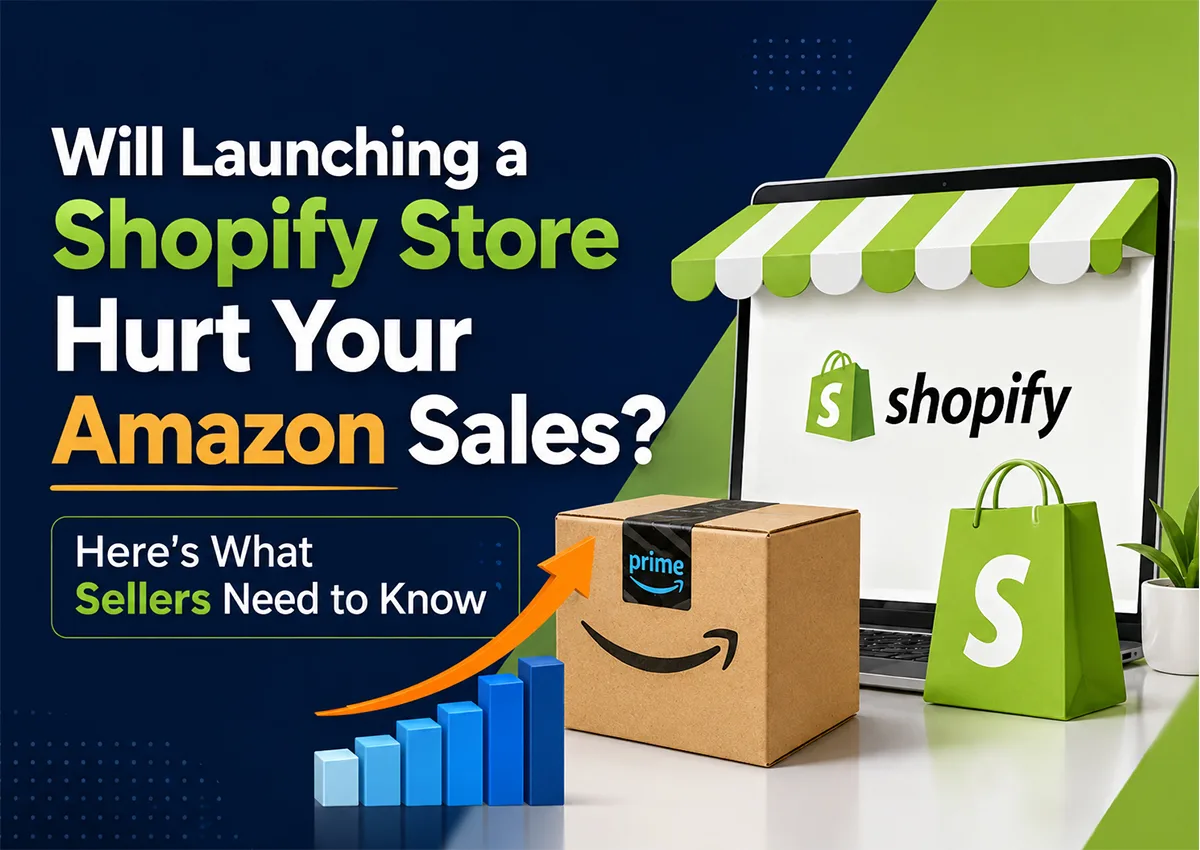
Will Launching a Shopify Store Hurt Your Amazon Sales? Here’s What Sellers Need to Know
Will Launching a Shopify Store Hurt Your Amazon Sales? Here’s What Sellers Need to Know Think launching a Shopify store…
Think launching a Shopify store will hurt your Amazon sales?
Not really!
After helping ecommerce brands grow for over a decade, we’ve found that sellers who expand beyond Amazon often build stronger, more resilient businesses. The real question isn’t Shopify vs Amazon. It’s how both platforms work together.
Amazon brings customers in. A Shopify ecommerce store helps you build lasting relationships, increase repeat purchases, and support a smarter multi-channel ecommerce strategy.
In this guide, you’ll learn whether launching a Shopify store affects Amazon sales, when it makes sense, the common mistakes to avoid, and how successful brands use Amazon and Shopify together to drive sustainable growth.
Many Amazon sellers delay launching a Shopify store because they worry it will reduce Amazon sales. It’s a fair concern. But it’s often based on assumption rather than data.
A Shopify store doesn’t compete with Amazon unless you make it compete. Instead, it gives your brand another place to convert customers, build loyalty, collect first-party data, and grow outside marketplace limitations.
Today’s fastest-growing brands don’t rely on one channel. They build an omnichannel ecommerce strategy where Amazon drives discovery while Shopify strengthens customer relationships and lifetime value.
Done right, both platforms complement each other.
Amazon remains one of the best acquisition channels available. Shopify simply gives customers another way to buy directly from your brand.
Brands combining Amazon and Shopify are often more resilient because they diversify traffic, revenue, and customer acquisition.
Amazon owns the customer relationship. Shopify gives you access to emails, purchase history, loyalty programs, and remarketing opportunities.
The debate shouldn’t be Shopify vs Amazon. It should be how each platform supports different stages of your customer’s journey.
Category: Ecommerce Growth Strategy
Related Entities:
A few years ago, one of our clients asked us something interesting.
“If we build a Shopify store, won’t customers stop buying from Amazon?”
It sounded logical. Why give people another place to shop?
But after launching their Shopify site, something unexpected happened.
Suddenly, the business wasn’t depending on Amazon alone.
We’ve seen similar stories again and again. That’s because shoppers don’t think in platforms.
They think in convenience.
Some buyers trust Amazon’s fast shipping, while others prefer buying directly from a brand they already know. Many will use both, which is why launching a Shopify store rarely steals sales from Amazon. More often, it expands your overall reach.
The real risk isn’t opening another sales channel; it’s opening one without a strategy.
Amazon and Shopify solve different problems. One helps people discover your products. The other helps them remember your brand.
Think about it.
A customer may first find your product on Amazon. A month later, they Google your brand name instead of searching Amazon again. If your Shopify store is ready, you’ve just gained a direct customer without losing the first sale.
That’s how smart brands think in 2026. Not channel versus channel, rather, channel plus channel.
At Krolog, we’ve noticed that sellers who hesitate to diversify usually stay dependent on Amazon’s algorithm. Meanwhile, brands that embrace multi-channel ecommerce often build steadier revenue because they’re no longer relying on one traffic source.
The internet loves debating Shopify vs Amazon. Honestly, it’s the wrong debate.
Amazon is a marketplace; Shopify is your own storefront.
One gives you instant exposure; the other gives you complete ownership
| Amazon | Shopify |
|---|---|
| Massive customer base | Complete brand control |
| High buyer trust | Own customer relationships |
| Marketplace rules | Full pricing flexibility |
| Limited customer data | Access to customer data and email marketing |
| Fast customer acquisition | Better repeat purchase opportunities |
Another question we hear almost every week.
Amazon FBA vs Shopify.
The answer depends on what you’re trying to achieve. If your goal is quick visibility, Amazon FBA is hard to beat. But if you aim to build a long-term brand, Shopify is essential.
Successful businesses don’t replace Amazon with Shopify. They use Amazon to acquire customers and Shopify to build loyalty.
Imagine you’re selling premium coffee accessories.
Your Amazon listing ranks well; sales are steady.
One customer buys a grinder. Three months later, they want matching storage jars.
On Amazon, they’ll probably search again. Maybe they’ll find your competitor first.
With a Shopify store?Β
That’s the power of Amazon and Shopify working together.
One mistake we see often is sellers waiting too long to build their Shopify store. They think they’ll launch it after reaching a certain revenue milestone.
By then, they’ve already missed months or even years of collecting first-party customer data, growing email lists, and building repeat business.
Launching early doesn’t hurt Amazon; launching without a strategy does.
Build a Shopify store that complements your Amazon business and creates new growth opportunities.
The biggest misconception? That every sale has to come from Amazon.
The fastest-growing brands in 2026 don’t think in channels. They think in ecosystems.
Amazon brings new customers through search; Shopify keeps them coming back.
One fuels discovery, the other builds loyalty.
That’s what a successful omnichannel ecommerce strategy looks like.
Selling on one platform feels comfortable. Until something changes.
Suddenly, growth slows.
With multi-channel ecommerce, you’re not blindly relying on one channel.
Your customers can find you through:
More touchpoints; more opportunities; less dependence on one platform.
Here’s something many new sellers don’t realize. Amazon owns the customer relationship, not you.
Your Shopify ecommerce store changes that. Now you can:
Over time, that’s often where the biggest profits come from.
We’ve seen these mistakes again and again:Β
One thing we’ve learned at Krolog. The brands that scale the fastest don’t ask, “Should I sell on Amazon or Shopify?”
They ask,
“How can both platforms make each other stronger?”
That’s the difference. Amazon generates demand; Shopify captures brand value.
When each platform plays its role, your business becomes much harder to disrupt.
The biggest mistake? Thinking you need a perfect website before you launch.
You don’t; start simple.
That’s enough to begin.Β
If you’re wondering how to build a Shopify site, focus on customer experience before fancy design. Speed, trust, and usability will always outperform flashy animations.
When you create a Shopify store, don’t copy your Amazon listings word for word.
Give shoppers a reason to buy direct. Think about:
Your Shopify store should feel like your brand’s home, not another marketplace listing.
A store without traffic is just another website. After launching, start driving qualified visitors through:
Wondering how to promote your Shopify store for free?
These channels compound over time and often deliver the highest ROI.
Build a Shopify store that complements your Amazon business and creates new growth opportunities.
The ecommerce landscape is changing fast. Here’s what we’re seeing:
The brands winning in 2026 aren’t choosing between marketplaces. They’re building connected experiences across every channel customers use.
At Krolog, we’ve helped brands expand from Amazon into Shopify without sacrificing marketplace performance.
The pattern is usually the same.
It’s not about replacing Amazon; it’s about building a business that can grow with or without it.
So, βWill launching a Shopify store hurt your Amazon sales?β In most cases, no.
It actually strengthens your business.
Amazon is still one of the best places to acquire customers. Millions of shoppers already trust it. Walking away from that traffic wouldn’t make much sense.
But relying on Amazon alone? That’s becoming riskier every year.
A Shopify ecommerce store gives you something Amazon never can: ownership.
The smartest brands don’t see Shopify vs Amazon as a battle. They understand each platform has a different job. Amazon drives discovery; Shopify builds loyalty.Β
Together, they create a sustainable multi-channel ecommerce business that’s far more resilient.
At Krolog, we’ve seen brands unlock stronger growth simply by connecting both ecosystems with the right strategy.Β
It isn’t about selling on more channels. It’s about making every channel work together.
If you’re thinking beyond your next sale, launching a Shopify store might be one of the smartest investments you make in 2026.
In most cases, launching a Shopify store expands your overall reach instead of harming Amazon sales. Customers simply gain another trusted way to buy from your brand.
Amazon is often the better starting point because it provides immediate access to millions of shoppers. Shopify becomes valuable as your brand grows and you want greater control over customer relationships and marketing.
Absolutely. Many successful brands use Amazon and Shopify together as part of a broader omnichannel ecommerce strategy, leveraging Amazon for acquisition and Shopify for retention.
They serve different purposes. Amazon FBA can generate faster sales through marketplace traffic, while Shopify often delivers higher long-term profitability through repeat purchases and lower customer acquisition costs.
Start with a simple storefront, migrate your product catalog, set up payments and shipping, and then focus on SEO, email marketing, and brand-building. The goal isn't to replace Amazon; it's to complement it.
Invest in content marketing, SEO, email newsletters, Pinterest, social media, and customer referrals. Organic traffic takes time, but it compounds and reduces reliance on paid ads.
Yes, even small sellers benefit from multi-channel ecommerce because it diversifies revenue, reduces platform dependency, and creates more opportunities to engage customers.
Yes, Shopify can integrate with Amazon FBA, allowing Amazon to store, pack, and ship orders placed through your Shopify store. This lets sellers leverage Amazon's fulfillment network while maintaining an independent storefront. It's an effective way to combine the operational efficiency of FBA with the branding and customer ownership benefits of Shopify.
Yes, but it depends on the integration you use. Shopify can sync inventory with Amazon through native integrations, third-party apps, or inventory management tools. Proper synchronization helps prevent overselling, keeps stock levels accurate across channels, and simplifies multi-channel ecommerce management.
Not necessarily. Many brands keep Shopify prices similar to Amazon for consistency, while others offer exclusive bundles, loyalty discounts, or subscriber benefits on their Shopify store. The key is maintaining a pricing strategy that protects your brand, remains competitive, and complies with Amazon's pricing policies where applicable.
Sandeep K., Founder & CEO of Krolog, has spent more than 10 years helping brands scale across Amazon, Shopify, Walmart, and other ecommerce marketplaces.Β
His expertise spans Amazon SEO, PPC, Shopify development, conversion optimization, inventory planning, and omnichannel growth strategies. Through Krolog, he has helped businesses build profitable, scalable ecommerce brands across North America and beyond.
Amazon can launch your brand; Shopify can help you own it.
Whether you’re planning your first Shopify store, improving an existing one, or building a complete omnichannel ecommerce strategy, Krolog helps sellers connect every piece of the puzzle, Β from Amazon optimization and Shopify development to SEO, paid advertising, and long-term brand growth.
Request a free ecommerce growth consultation today and discover how Amazon and Shopify can work together to grow your business.
Will Launching a Shopify Store Hurt Your Amazon Sales? Here’s What Sellers Need to Know Think launching a Shopify store…
Top 5 Amazon FBA Consulting Services in the USA and Canada for 2026 Hiring the right Amazon FBA consulting services…
Types of Amazon Account Suspensions in 2026: Causes and How to Get Reinstated Amazon Account Suspension can bring your entire…
Krolog was born from a simple yet powerful idea: to empower businesses with the tools and strategies needed to thrive in the ever-evolving digital marketplace. Our journey is a testament to the transformative impact of strategic E-commerce solutions.


Copyright Β© 2026 All Right ReservedΒ