
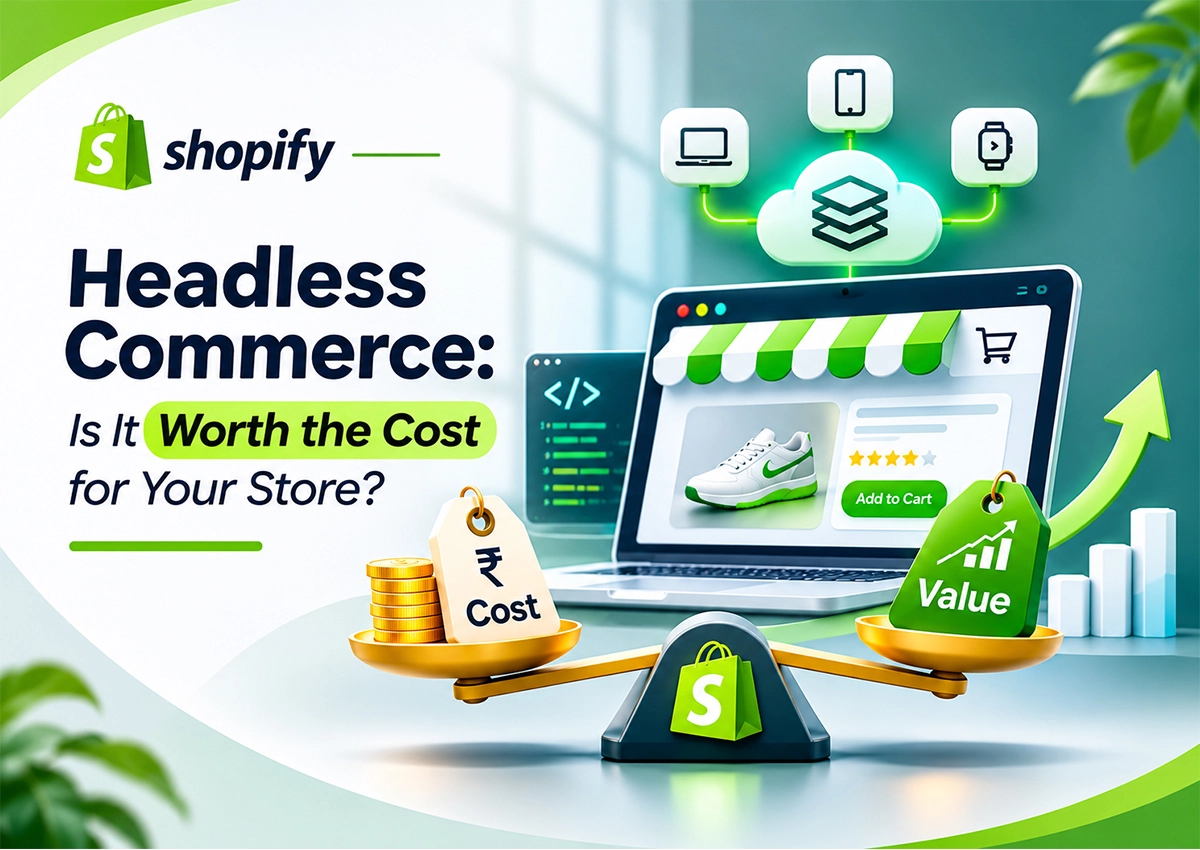
Shopify Headless Commerce: Is It Worth the Cost for Your Store?
Shopify Headless Commerce: Is It Worth the Cost for Your Store? Your Shopify store looks and works well, but the…

Your Shopify store looks and works well, but the shopping experience may still feel limiting to customers as your business grows. Custom product pages, faster interactions, and a storefront that works across multiple channels can give your business a competitive edge.
That’s where Shopify Headless Commerce comes in. It separates your storefront from Shopify’s backend, giving developers more control over the customer experience. But it also adds development costs and technical complexity.
So, is headless Shopify worth the investment? Let’s look at what it changes, what it costs, and when it makes business sense.
Shopify headless commerce separates the frontend from Shopify’s backend. Brands can build custom shopping experiences using tools such as Shopify Hydrogen and the Storefront API. It offers flexibility and integration opportunities, but requires a larger development and maintenance investment than a standard Shopify theme.
Build custom storefront experiences.
Budget for development, integrations, and maintenance.
Shopify’s October 2026 release made Hydrogen framework-agnostic.
A well-optimised Shopify theme may still be enough for many businesses.
Think of your store as two separate systems. The frontend is what customers see. The backend manages products, orders, inventory, and checkout.
Traditional Shopify themes connect these layers within Shopify’s storefront architecture. With headless ecommerce, developers build a separate frontend and connect it to Shopify through APIs.
The Shopify Storefront API provides access to products, collections, search, and cart functionality. This gives brands more control over design and customer journeys.
Shopify Hydrogen helps developers build custom storefronts. It is not a ready-made Hydrogen Shopify theme.
The October 2026 Hydrogen update made the toolkit framework-agnostic, allowing developers to add Shopify commerce capabilities to existing JavaScript frameworks, including React Router and Next.js. Oxygen hosting remains free.
This means brands have more flexibility when planning Shopify Hydrogen development.
Benefits include:
But there’s another side.
Headless development requires experienced developers, API integrations, testing, and ongoing maintenance. A poorly planned build can become expensive without improving conversions.
There isn’t one fixed price for Shopify headless pricing. Your investment depends on:
Your regular Shopify subscription may still apply. Development is an additional investment.
Get a project-specific estimate before committing.
Get expert guidance on Shopify headless development and the right approach for your store.
It can be worth it if your business needs a highly customised storefront, complex integrations, or experiences beyond standard themes.
However, smaller stores may get better value from Shopify theme customisation and performance optimisation.
Don’t choose headless because it’s trending. Choose it when your current storefront creates measurable business limitations.
Krolog helps brands with Shopify development, custom storefronts, migration, integrations, SEO, and performance optimisation.
Krolog worked with Cantoocity, a Canadian arts and crafts brand, on its Shopify store development and migration. The migration was completed in four weeks. The project focused on building a responsive storefront and improving the shopping experience.
This was a Shopify development and migration project, not a headless implementation. It demonstrates why planning, execution, and technical fit matter before choosing a more complex architecture.
It is a Shopify store with a separate frontend connected to Shopify's backend through APIs.
The core concept is separating the customer-facing storefront from backend commerce functions.
It offers design flexibility, custom experiences, API integrations, and support for multiple digital channels.
Hydrogen is an open-source toolkit. Development, hosting choices, integrations, and maintenance may still involve costs. Shopify's Oxygen hosting is free.
It can support performance-focused storefronts, but speed depends on implementation, hosting, code quality, and optimisation.
Usually, a standard Shopify theme is more cost-effective for smaller stores with straightforward requirements.
Yes, Shopify Plus merchants can use headless architecture when they need greater customisation and integration flexibility.
Hire experienced developers when your project requires custom storefront architecture, API integrations, or advanced functionality.
Review its Shopify portfolio, API experience, technical capabilities, project process, and ongoing support options.
A custom storefront should solve a real business problem, not just add another layer of technology.
Krolog helps businesses evaluate their requirements, choose the right Shopify architecture, and build ecommerce experiences designed for growth.
Shopify Headless Commerce: Is It Worth the Cost for Your Store? Your Shopify store looks and works well, but the…
Amazon Backend Keywords: Where to Put Them and What to Never Include Your product listing looks good. The title is…
Amazon Account Deactivated vs. Suspended: Why the Difference Changes Your Appeal You log in to Seller Central, expecting another day…
Krolog was born from a simple yet powerful idea: to empower businesses with the tools and strategies needed to thrive in the ever-evolving digital marketplace. Our journey is a testament to the transformative impact of strategic E-commerce solutions.


Copyright © 2026 All Right Reserved