Nav Preview
  • What Happens After You Hire a Shopify Agency? A 4-Step Process Explained

    Most brands think the hard part is deciding to hire a Shopify agency. It isn’t.

    The real work starts after the contract is signed.

    We’ve seen it a lot many times. A business invests in Shopify website development, expects a polished store within a few weeks, and then wonders why the agency keeps asking questions instead of writing code.

    There’s a reason.

    A successful Shopify website design isn’t built from a template; it’s built from strategy. Every decision, from navigation to checkout, affects conversions later.

    That’s why experienced agencies follow a process instead of jumping straight into development.

    In this guide, we’ll walk through the four stages that happen after you hire a Shopify agency, explain what each phase looks like, highlight common mistakes, and share what separates a good Shopify partner from one that simply delivers a website.

    Amazon PPC Case Study
    Amazon PPC Management
    Amazon Advertising Strategy

    Amazon ACoS Strategies

    PPC Performance

    Higher ROAS

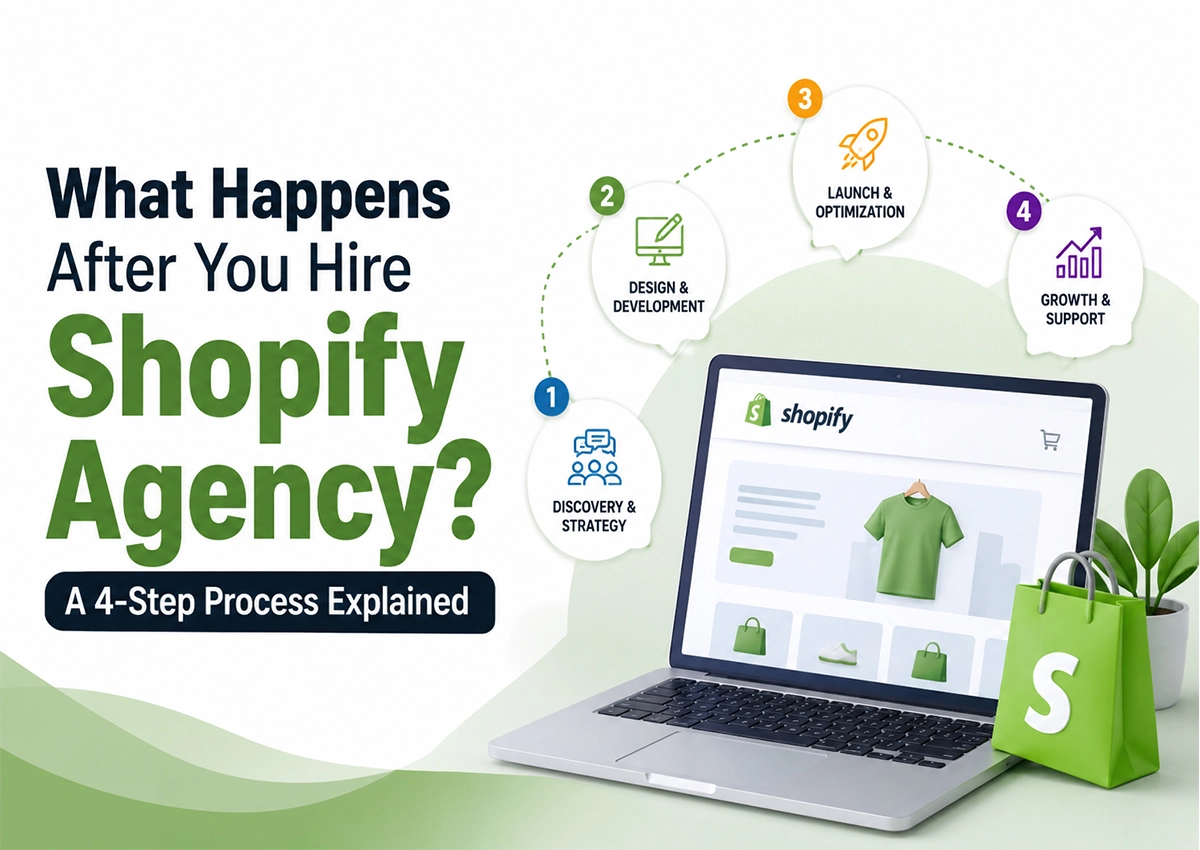
    Illustration showing the 4-step Shopify agency process including discovery, design and development, launch and optimization, and ongoing growth and support for Shopify store owners.

    Summary

    Hiring a Shopify agency isn’t just about getting a new website. It’s about building an online store that’s fast, scalable, and designed to convert.

    The best agencies begin with research, move into strategy and design, then build, test, launch, and continuously optimize your store. Following a structured process helps reduce delays, avoid expensive rework, and create a better shopping experience from day one.

    Key Takeaways

    Every Great Store Starts With Strategy

    Successful Shopify website development begins long before the first page is designed.

    Design Should Drive Sales

    A clean Shopify website design should guide visitors toward purchasing, not just look attractive.

    Development Isn't the Finish Line

    Launch day is only the beginning. Ongoing Shopify store maintenance keeps your store secure, updated, and optimized.

    The Right Agency Saves Time

    An experienced Shopify partner prevents costly mistakes, improves efficiency, and helps brands scale faster.

    Entity Overview

    Category: Shopify Development Services

    Related Entities:

    • Shopify
    • Shopify Plus
    • Shopify App Store
    • Shopify Themes
    • Shopify Payments
    • Google Analytics 4
    • Meta Pixel
    • Klaviyo
    • Google Merchant Center

    Step 1: Discovery & Business Strategy

    Every successful project starts with questions. Not designs and code.

    A reliable agency won’t rush into Shopify store development. Instead, they’ll spend time understanding your products, customers, competitors, and growth goals. That early research often saves weeks of revisions later.

    At this stage, the agency typically reviews:

    • Business goals and revenue targets.
    • Existing website performance.
    • Product catalog and collections.
    • Customer journey.
    • Competitor websites.
    • Required integrations.
    • Design preferences.
    • SEO and migration needs.

    It may feel slow, but skipping discovery usually creates bigger problems halfway through the project.

    Practical Example

    A home décor brand approached us wanting a complete redesign. Their first request was a premium theme.

    After reviewing customer behavior, we found the real issue wasn’t the theme. Visitors struggled to find products because navigation was cluttered.

    We simplified the store structure before touching the design. Conversions improved because shoppers could finally find what they needed.

    Sometimes the biggest win isn’t visual; it’s structural.

    What Happens During Shopify Store Setup?

    Once discovery is complete, the technical foundation begins. This usually includes:

    • Shopify account configuration
    • Domain connection
    • Store settings
    • Payment gateways
    • Shipping rules
    • Tax setup
    • Basic security settings

    Think of it as preparing the store before customers arrive. Miss one important setting here, and fixing it later becomes much harder.

    Expert Observation

    One mistake we see quite often? Businesses focus almost entirely on design.

    Design matters, of course, but we’ve seen beautifully designed stores struggle because the strategy behind them was weak.

    The stores that grow aren’t always the flashiest. They’re the ones built around customer behavior, clear navigation, and long-term business goals.

    Step 2: Shopify Website Design & UX Strategy

    This is where ideas start looking real. Wireframes become pages, and pages become a shopping experience.

    A good Shopify website design isn’t built around trends; it’s built around customers. Every button, banner, and product page should make buying feel effortless. At this stage, the agency usually works on:

    • Store architecture
    • Homepage layout
    • Collection and product pages
    • Mobile-first design
    • Brand colors and typography
    • Navigation and search
    • Checkout experience

    The goal isn’t to impress visitors; it is to make them buy.

    Practical Example

    A skincare brand wanted animations on almost every section.

    They looked amazing, but they also slowed the site.

    We pulled down unnecessary effects, simplified the layout, and made the “Add to Cart” button more visible. 

    Bounce rates dropped; sales climbed.

    Sometimes less really is more.

    Why Shopify Theme Customization Matters?

    Most premium themes are solid. Very few are perfect.

    That’s why Shopify theme customization matters. Instead of forcing your business to fit a template, the theme is adjusted to fit your brand, products, and customers. Common customizations include:

    • Custom product templates
    • Mega menus
    • Trust badges
    • Advanced product filters
    • Wishlist and review integrations
    • Custom landing pages

    The objective is simple. Make the store feel uniquely yours without sacrificing speed.

    Step 3: Shopify Custom Development & Quality Testing

    Now the developers take over. This is where design becomes a working store. Depending on your business, Shopify custom development may include:

    • Custom sections and templates
    • Third-party app integrations
    • ERP or CRM connections
    • Subscription functionality
    • Custom checkout experiences (where supported)
    • Performance optimization
    • SEO implementation

    After development comes testing.

    • Every page
    • Every form
    • Every button
    • Every checkout flow


    The best agencies don’t launch and hope for the best. They test until they’re confident customers won’t run into issues.

    Common Mistakes During Development

    We’ve seen these delay projects more times than we can count.

    • Changing requirements halfway through development.
    • Installing too many apps that slow the store.
    • Ignoring mobile optimization.
    • Prioritizing aesthetics over conversions.
    • Skipping QA because the launch deadline feels urgent.

    Each one seems small. Together, they can cost sales before the store even goes live.

    Expert Observation

    Many brands think custom development means adding more features; not always.

    In our experience at Krolog, the best-performing stores often have fewer apps, cleaner code, and faster load times. 

    Customers don’t notice complex development; they notice when everything simply works.

    Step 4: Launch, Optimization & Ongoing Support

    Launch day feels exciting; it should. But it isn’t the finish line; it’s actually the starting point.

    A good agency doesn’t disappear after publishing your store. They monitor performance, fix unexpected issues, and keep improving the experience as real customers start shopping.

    After launch, most Shopify agency services include:

    • Performance monitoring
    • Bug fixes
    • Speed optimization
    • SEO checks
    • Analytics verification
    • Conversion tracking
    • Security updates
    • Shopify store maintenance

    The first few weeks often reveal insights you simply can’t predict during development.

    Ready to Build a Shopify Store That Grows Your Business?

    From planning and design to development, launch, and ongoing support, our Shopify experts help you build a store that’s optimized for growth from day one.

    Why Shopify Store Maintenance Matters?

    Think of your store like a retail shop. You wouldn’t open it once and never clean, restock, or rearrange products.

    An online store is no different.

    • Apps update
    • Themes evolve
    • Customer behavior changes.
    • Search engines introduce new ranking signals.

    Regular Shopify store maintenance keeps everything running smoothly while protecting your investment.

    Don't Stop at Launch. Start Optimizing.

    Launching a store gets visitors. Optimization turns them into customers.

    That’s where Shopify conversion rate optimisation comes in. Small improvements can create surprisingly big results:

    • Faster page speeds
    • Better product images
    • Clearer CTAs
    • Simpler navigation
    • Streamlined checkout
    • Stronger product descriptions
    • Trust badges and reviews

    Rarely does one massive change double conversions. Usually, it’s ten small improvements working together.

    Practical Example

    A fashion brand came to us a month after launch. Traffic looked healthy, but sales didn’t.

    The problem wasn’t marketing.

    Customers kept abandoning checkout because shipping costs appeared too late.

    We made shipping estimates visible earlier, simplified checkout, and reduced unnecessary form fields.

    Within weeks, completed orders increased without spending an extra dollar on ads. Sometimes the issue isn’t attracting people. It’s removing friction.

    When Does a Shopify Website Redesign Make Sense?

    Not every store needs rebuilding. Sometimes it just needs refining. A Shopify website redesign becomes worthwhile when:

    • Your brand has evolved.
    • Mobile conversions are declining.
    • The store loads slowly.
    • Navigation feels confusing.
    • The current design no longer reflects your business.
    • You’re migrating to a more scalable setup.

    Redesigns should solve problems. Not simply introduce a new look.

    Expert Observation

    One thing we’ve learned after building and optimizing Shopify stores for years?

    The highest-performing stores are never “finished;” they evolve.

    Owners test, learn, and improve. The brands that keep growing don’t treat launch as the end of the project. They treat it as the beginning of continuous optimization.

    How Much Does It Cost to Hire a Shopify Agency?

    One of the first questions every business asks is:

    “How much is this going to cost?”

    The honest answer? It depends on what you’re building.

    A simple Shopify store setup costs far less than a fully customized ecommerce store with integrations, migrations, and advanced functionality.

    Here’s a general benchmark.

    Project Type Typical Investment
    Basic Shopify Store Setup $1,000–$3,000
    Custom Shopify Website Development $3,000–$10,000+
    Shopify Plus Projects $10,000–$50,000+
    Ongoing Shopify Store Maintenance $200–$2,000/month

    The cheapest proposal isn’t always the best value. Poor development often leads to expensive fixes later.

    How Long Does Shopify Website Development Take?

    Every project moves at a different pace. However, most timelines look something like this.

    Project Stage Typical Timeline
    Discovery & Planning 1–2 weeks
    Shopify Website Design 2–3 weeks
    Development & Testing 2–5 weeks
    Launch & Final QA 1 week

    A standard project usually takes 4 to 8 weeks. Larger stores with custom functionality naturally take longer.

    What Questions Should You Ask Before You Hire a Shopify Agency?

    Choosing an agency shouldn’t be based on price alone. Ask the right questions first.

    • Have you built stores similar to mine?
    • Do you provide Shopify custom development or only theme edits?
    • Will the store be optimized for SEO and conversions?
    • How do you handle post-launch support?
    • What does your Shopify agency services package include?
    • Who owns the code and store after launch?
    • What is your development process?
    • Can you share real client results or case studies?

    The answers usually tell you everything you need to know.

    Why Businesses Choose Krolog?

    We’ve seen businesses come to us after working with agencies that delivered a beautiful website but forgot about performance.

    Looks alone don’t grow ecommerce brands. Strategy does.

    At Krolog, every Shopify project starts with understanding your business first.

    Then we build. Our team helps brands with:

    • Shopify website development
    • Shopify website design
    • Shopify custom development
    • Shopify theme customization
    • Shopify store migration
    • Shopify conversion rate optimisation
    • Shopify store maintenance
    • Long-term growth strategy

    We’re not interested in launching stores that simply look good. We build stores that are ready to scale.

    Final Thoughts

    The decision to hire a Shopify agency isn’t really about outsourcing development; it’s about finding a growth partner.

    • A structured process leads to better stores.
    • Better stores create better customer experiences.
    • Better experiences drive more sales.

    If an agency skips discovery, ignores strategy, or rushes development, those shortcuts usually show up later as lower conversions and higher costs.

    The best agencies don’t just launch websites; they help businesses grow long after launch.

    At Krolog, that’s exactly how we approach every Shopify project. Build with purpose, optimize continuously, scale with confidence.

    Frequently Asked Questions

    About the Author

    Sandeep K., Founder & CEO, Krolog Inc., has over 10 years of experience helping ecommerce brands scale through Shopify development, Amazon marketplace growth, SEO, PPC, and conversion optimization. His team has built and optimized stores for businesses across multiple industries, combining technical expertise with growth-focused strategy.

    Ready to Build a Shopify Store That Grows With You?

    Hiring a Shopify agency shouldn’t just help you launch faster; it should help you grow smarter.

    Whether you need a new Shopify website design, custom development, migration, or ongoing optimization, Krolog builds ecommerce stores designed for performance from day one.

    Request a free consultation today and discover how the right Shopify strategy can turn more visitors into loyal customers.

    Related Article

    Can You Merge Amazon Accounts? A Step-by-Step Guide for 2026

    Can You Merge Amazon Accounts? A Step-by-Step Guide for 2026

    Can You Merge Amazon Accounts? A Step-by-Step Guide for 2026 Can you merge Amazon accounts? Not exactly. That’s where most…

    What Happens After You Hire a Shopify Agency? A 4-Step Process Explained

    What Happens After You Hire a Shopify Agency? A 4-Step Process Explained

    What Happens After You Hire a Shopify Agency? A 4-Step Process Explained Most brands think the hard part is deciding…

    Amazon PPC Case Study: How We Increased a Brand’s Sales by 400%

    Amazon PPC Case Study: How We Increased a Brand’s Sales by 400%

    Amazon PPC Case Study: How We Increased a Brand’s Sales by 400% Most Amazon sellers don’t fail because of bad…

    Scroll to Top