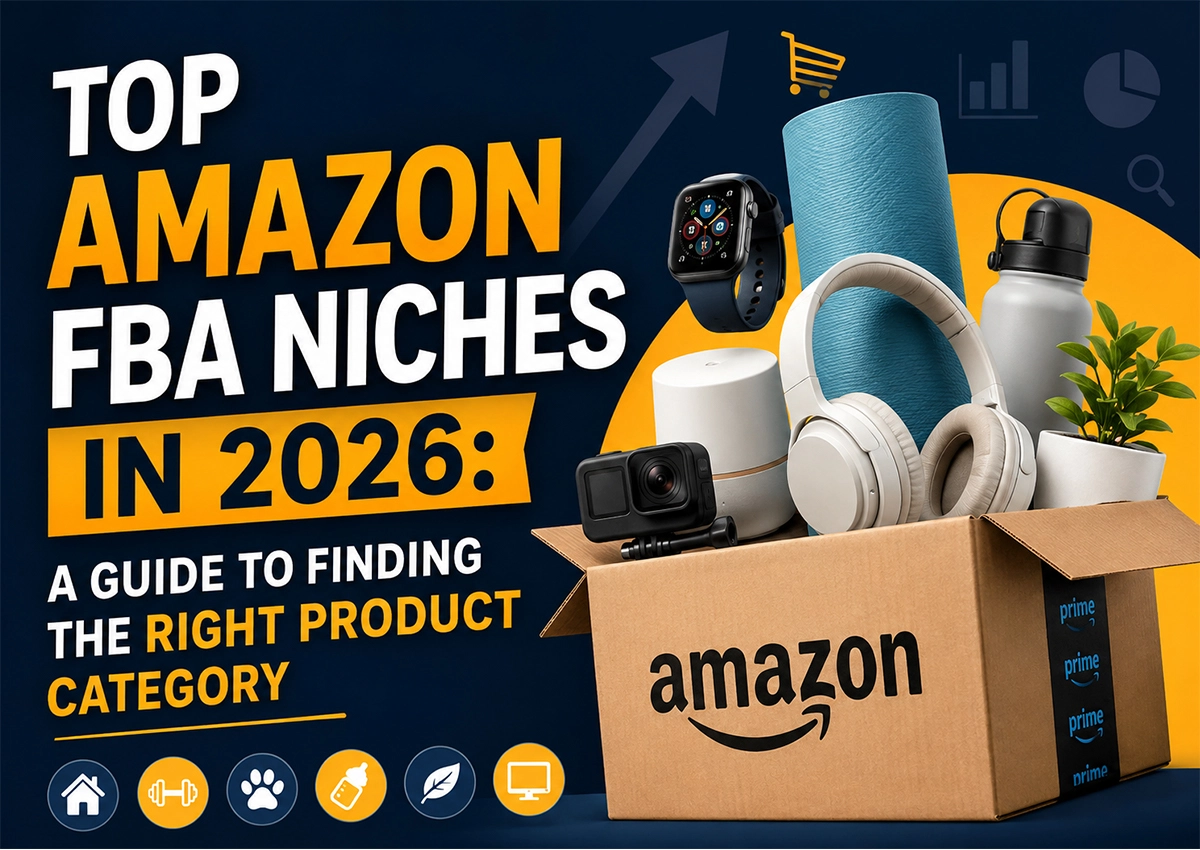
Top Amazon FBA Niches in 2026: A Guide to Finding the Right Product Category
Top Amazon FBA Niches in 2026: A Guide to Finding the Right Product Category Choosing an FBA niche sounds exciting…
Choosing an FBA niche sounds exciting until thousands of sellers choose the same one.
That’s where many new sellers go wrong. They chase trends instead of sustainable Amazon niche markets.
A profitable FBA niche isn’t a secret product. It’s a product that solves a real problem, has consistent demand, and leaves room to grow.
This guide explains how to find a niche on Amazon, validate demand, evaluate competition, and identify profitable niche products to sell on Amazon in 2026.
Choosing the right Amazon niche influences everything.
The best FBA niche combines steady demand, healthy margins, manageable competition, and long-term scalability. Instead of chasing temporary trends, successful sellers focus on solving everyday customer problems through carefully researched niche Amazon products.
Choosing profitable Amazon niches makes scaling significantly easier than competing in overcrowded categories.
Products with consistent year-round demand often outperform seasonal bestsellers over time.
Research competition, search demand, pricing, reviews, and profitability before investing inventory.
Professional research tools and marketplace analysis reduce costly product decisions.
An FBA niche is a focused product category that serves a specific customer need; simple enough.
But finding the right one? That’s where most sellers struggle.
Many beginners think success comes from selling whatever is trending on TikTok or Instagram.
Sometimes it works; usually it doesn’t.
By the time most sellers discover a trending product, competition has already exploded.
The better approach is finding underserved Amazon niche markets where customer demand stays consistent and competition remains manageable. That’s exactly how sustainable Amazon brands are built.
One pattern we’ve noticed at Krolog is that the highest-revenue brands rarely sell the “hottest trending” product. Instead, they dominate a category most competitors overlook.
A product doesn’t need millions of searches; it needs buyers with strong purchase intent.
That difference changes everything.
Everyone wants the “perfect” product. That’s the wrong question.
The better question is: Can this niche still grow two years from now?
A scalable FBA niche isn’t built around hype. It’s built around demand that sticks around.
Before choosing a product, evaluate five things.
People should already be searching for products in the category.
Use an Amazon niche product finder, search volume tools, and Amazon autocomplete to understand what buyers are looking for.
If demand exists throughout the year, you’re off to a good start.
High competition isn’t always bad. But saturated markets with thousands of nearly identical listings leave little room for new sellers.
Look for opportunities where customer demand is healthy but listing quality is average.
Those gaps create opportunities.
Revenue looks impressive, but it’s the profit that matters more. Calculate:
A product generating $100,000 in sales isn’t attractive if margins disappear after advertising.
Products customers buy repeatedly usually create stronger lifetime value.
ThinkΒ
Repeat demand lowers customer acquisition costs over time.
The best Amazon niche often becomes a product line. One successful ASIN can lead to accessories, bundles, premium versions, and complementary products.
That’s how brands grow, not by launching random products.
There isn’t one “best” niche.
Several categories are showing healthy demand, consistent purchasing behavior, and room for innovation.
People continue investing in storage, organization, and space-saving solutions. Products solving everyday household frustrations remain strong performers. Examples include:
Pet owners rarely stop spending. From grooming accessories and toys to feeding solutions, this remains one of the strongest Amazon niche markets.
Quality and convenience often matter more than price.
Consumers increasingly prefer sustainable alternatives.
Demand continues growing across multiple marketplaces.
Simple wellness products continue expanding.
Avoid regulated products that require additional compliance.
Parents constantly search for products that save time and improve convenience.
Products solving everyday parenting challenges often perform well.
Communities create loyal customers.
Specialized audiences often produce better conversion rates than broad categories.
Many sellers chase categories with the highest search volume. We usually recommend the opposite.
Find a niche where customers have a clear problem. If your product solves that problem better than existing listings, you don’t need the biggest category; you need the right one.
Imagine two sellers.
Seller A launches another generic yoga mat; Seller B launches a foldable yoga mat designed specifically for travelers with a carrying sleeve and hotel workout guide.
Same category; different positioning.
Seller B isn’t competing for everyone; they’re solving a very specific problem.
That’s how successful niche items to sell on Amazon are often created.
Discover how the right product category can help you identify profitable opportunities, reduce competition, and build a stronger Amazon FBA business in 2026.
Finding a profitable FBA niche used to involve hours of guesswork; not anymore.
Today’s research tools do much of the heavy lifting.
An Amazon niche product finder doesn’t tell you exactly what to sell. It helps you spot patterns before everyone else does. Most tools analyze:
Instead of randomly browsing Amazon Best Sellers, you can identify products with consistent demand and realistic competition. That saves both time and money.
A product might look profitable on the surface; dig deeper. Sometimes the numbers tell a different story.
Here’s what experienced sellers evaluate before investing.
Steady demand usually beats short-lived spikes.
Products with stable monthly searches often create more predictable revenue than seasonal trends.
Zero competition is rare; extreme competition is risky. The sweet spot sits somewhere in between. Look for listings with room for improvement.
Those gaps create opportunities.
Don’t stop at selling price. Calculate every cost.
Many products look profitable until PPC costs are added.
The best niche products to sell on Amazon usually solve one clear problem.
The stronger the problem, the easier the product becomes to market.
Winning brands rarely stop with one product. One successful launch often becomes an entire collection.
Expansion keeps customer acquisition costs lower over time.
Choosing the wrong niche can delay growth before the first sale even happens.
These mistakes appear more often than most sellers realize.
One mistake we see quite often is sellers falling in love with a product before validating the data.
Emotion enters the decision and logic leaves. Successful brands work the other way around.
It isn’t as exciting, but it is usually far more profitable.
A seller discovers a trending kitchen gadget with thousands of daily sales; it looks promising.
After deeper research, they find:
Instead of entering that crowded market, they shift toward a specialized kitchen organization product with fewer competitors, healthier margins, and year-round demand.
Sales grow slower at first; profit grows much faster.
That’s the kind of difference good niche research makes.
Finding an FBA niche is exciting. Getting stuck with inventory that barely moves? Not so much.
This is where many sellers lose money.Β
A few months later…
The niche wasn’t bad; the validation process was. Before investing, ask yourself a few simple questions:
If the answer to most of these questions is yes, you’re looking at a much stronger opportunity.
A seller found a garlic press with thousands of monthly searches; it looked perfect, until they dug deeper.
The top ten listings all had more than 40,000 reviews.
Meanwhile, CPC kept climbing because everyone wanted the same keyword. Instead of competing there, they shifted toward premium herb scissors.
The result? Less traffic, yes, but significantly higher conversions and healthier profits.
Sometimes the smaller Amazon niche wins.
Finding niche products to sell on Amazon shouldn’t rely on instinct. Good data removes expensive guesswork.
| Tool | Best For |
|---|---|
| Helium 10 | Product research, keyword demand, profitability analysis |
| Jungle Scout | Opportunity scoring and competitor tracking |
| DataDive | Listing optimization and keyword intelligence |
| Amazon Product Opportunity Explorer | Discovering emerging customer demand |
| Amazon Brand Analytics | Search terms and customer behavior for registered brands |
Each platform tells a part of the story. Together, they paint a much clearer picture.
At Krolog, we rarely approve a product idea based on one metric.
Instead, we compare demand, profitability, review trends, advertising costs, and customer intent before recommending an Amazon niche market.
That’s usually where the smarter opportunities appear.
Amazon keeps changing; customer expectations change even faster.
The best niches for Amazon FBA today may not be the leaders next year. That’s why smart sellers watch buying behavior, not just bestseller lists.
Here are the trends shaping Amazon niche markets in 2026.
Amazon Rufus is changing how customers discover products.
Instead of typing: “Water bottle.”
Shoppers now ask: “What’s the best leak-proof water bottle for hiking?”
Listings that clearly answer customer questions, highlight benefits, and showcase real use cases are gaining an advantage.
The product still matters; the way it’s presented matters just as much.
These continue to outperform novelty items.
Customers don’t buy features; they buy solutions.
Price isn’t always the deciding factor anymore. Many shoppers willingly pay more for:
Competing on value often beats competing on price.
Years ago, everyone chased the largest categories. Today, many sellers are finding success inside highly focused Amazon niches.
Sometimes smaller really is better.
Discover how the right product category can help you identify profitable opportunities, reduce competition, and build a stronger Amazon FBA business in 2026.
Every product idea looks promising at first. Our job is finding out whether it still looks promising after the numbers are analyzed.
At Krolog, we evaluate every FBA niche using a practical framework built around real marketplace performance.
We look at:
One lesson keeps repeating itself. The brands growing fastest aren’t always selling revolutionary products; they’re improving ordinary products in meaningful ways.
Small improvements often create a significant competitive advantage. That’s what sustainable growth usually looks like.
Finding the right FBA niche isn’t about chasing the next viral product; it’s about identifying a category where demand is consistent, competition is manageable, and your product genuinely offers something better.
Only then should inventory decisions follow.
We’ve seen brands avoid expensive mistakes simply by spending more time validating the niche before launching. The strongest Amazon businesses aren’t built on luck. They’re built on data, strategy, and continuous optimization.
Choose the right niche, and the rest becomes much easier.
An FBA niche is a focused product category serving a specific customer need. Rather than selling generic products, sellers target a well-defined audience with products that solve particular problems, making it easier to stand out and build long-term sales.
Start by researching customer demand, competition, pricing, reviews, and profitability. Tools like Helium 10, Jungle Scout, and Amazon Product Opportunity Explorer help identify opportunities before you invest in inventory. Krologβs Amazon Product Research Services can also help you discover profitable Amazon niches.Β
Popular opportunities include home organization, pet supplies, eco-friendly products, kitchen accessories, wellness products, hobby equipment, and baby accessories. However, the best niche depends on competition, margins, and your ability to differentiate.
Yes, an Amazon niche product finder helps analyze search demand, sales trends, competition, and profitability, making product selection more data-driven and reducing costly mistakes.
Review the number and quality of competitors, advertising costs, review counts, and listing quality. A niche isn't automatically too competitive if there is room to improve existing products or customer experience.
Absolutely, many successful brands grow faster by dominating a focused Amazon niche market rather than competing in overcrowded categories. Smaller niches often offer higher conversion rates, lower advertising costs, and better long-term profitability.
Profitable Amazon FBA niches usually have consistent demand, manageable competition, healthy margins, and room for differentiation. Popular areas include home organization, pet products, kitchen accessories, wellness, and eco-friendly products.
Evaluate demand, competition, margins, PPC costs, and differentiation potential. Also review customer complaints to identify unmet needs. The right FBA niche should offer demand, profitability, and room to scale.
Sandeep K., Founder & CEO of Krolog, has over a decade of experience helping brands grow across Amazon through product research, marketplace strategy, listing optimization, PPC management, and international expansion. His data-driven approach has helped businesses build profitable, scalable Amazon brands across multiple categories.
Finding the right FBA niche is only the beginning; turning it into a profitable Amazon business takes the right strategy.
Whether you need product validation, listing optimization, Amazon SEO, PPC management, or complete marketplace growth support, Krolog helps brands make smarter decisions before and after their launch.
Request your free Amazon marketplace audit today and discover untapped niche opportunities, product insights, and growth strategies tailored to your business.
Top Amazon FBA Niches in 2026: A Guide to Finding the Right Product Category Choosing an FBA niche sounds exciting…
What Does an Amazon Listing Expert Do? How to Hire the Right One in 2026 Uploading a product on Amazon…
Best Shopify Apps for Amazon Sellers Going DTC in 2026: Top 10 Must-Have Tools Selling on Amazon is still powerful.…
Krolog was born from a simple yet powerful idea: to empower businesses with the tools and strategies needed to thrive in the ever-evolving digital marketplace. Our journey is a testament to the transformative impact of strategic E-commerce solutions.


Copyright Β© 2026 All Right ReservedΒ