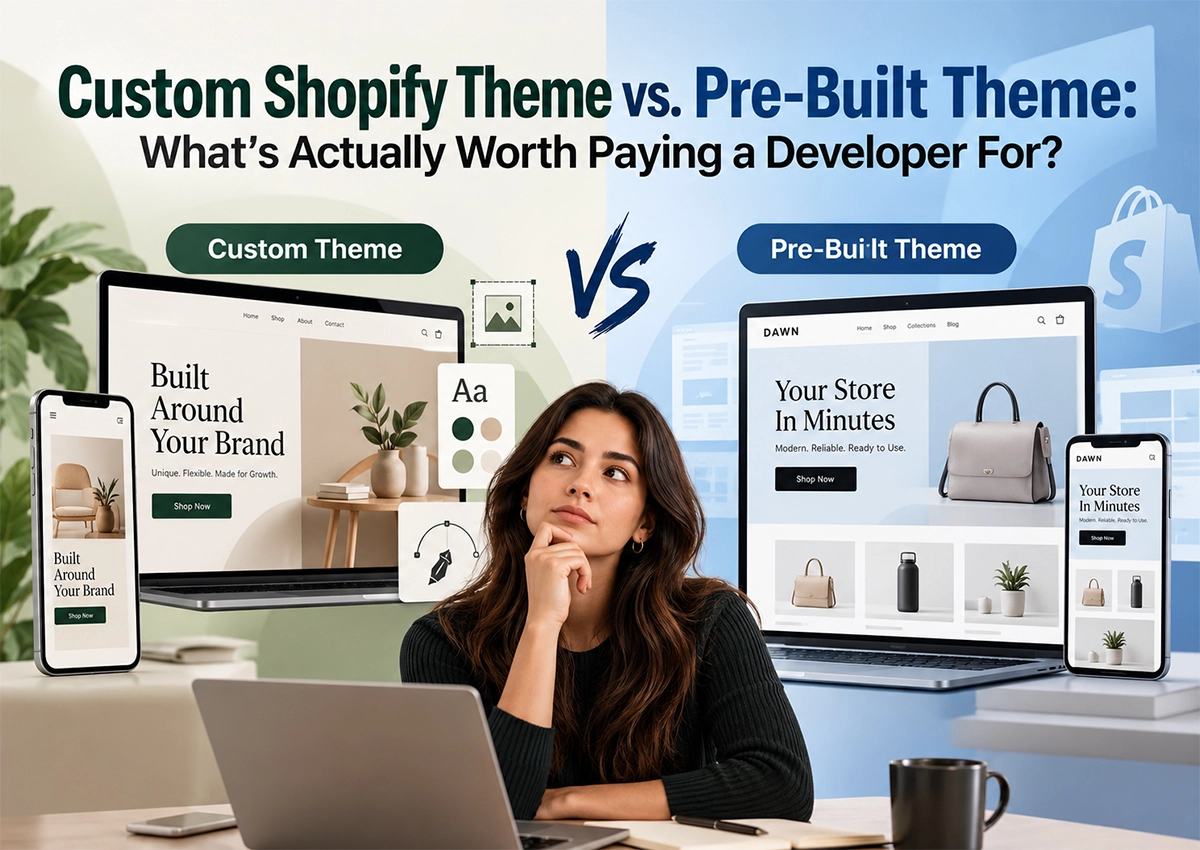
Custom Shopify Theme vs. Pre-Built Theme: What’s Actually Worth Paying a Developer For?
Custom Shopify Theme vs. Pre-Built Theme: What’s Actually Worth Paying a Developer For? Most Shopify stores don’t need a custom…

Most Shopify stores don’t need a custom theme. But some stores waste money trying to make a pre-built theme do something it was never designed to do. Free themes, premium themes, and industry-specific designs. Then there’s custom Shopify development.
So, which one is actually worth paying for?
A strong pre-built theme can often do the job faster and cheaper. But when you need a unique conversion flow, complex functionality, or a distinct brand experience, Shopify custom theme development can make more sense.
This guide compares cost, flexibility, performance, and customization to help you choose the right approach.
A pre-built Shopify theme isn’t automatically cheap or inferior. Likewise, a custom theme isn’t automatically better.
The right choice depends on your store complexity, growth stage, conversion goals, performance requirements, and budget.
Shopify itself offers free themes, while the Shopify Theme Store also provides paid options that merchants can preview and customize before publishing.
The smart approach? Pay a Shopify developer for the parts that actually create business value.
A good pre-built theme can take you surprisingly far.
Don’t rebuild everything just to make the store look different.
Seamless customer journeys and unique features are where development earns its keep.
Extra apps, scripts, animations, and heavy customizations can hurt performance.
The cheapest theme today can become expensive if it creates constant development work later.
Let’s say you’re launching a new skincare brand.
You need a homepage, collections, product pages, reviews, bundles, a cart, and a clean mobile experience. Nothing unusual.
In that case, spending thousands on Shopify theme development from scratch probably isn’t the smartest first move. Start with a solid theme.
The Shopify free themes collection already includes multiple customizable options, and Shopify says its free themes are designed with core features that can be customized without coding.
This is where the conversation gets interesting.
A developer shouldn’t be hired simply because a theme needs a different button colour.
You can handle plenty of visual changes yourself.
A Shopify theme developer becomes valuable when they create stores that operate differently yet seamlessly.
For example:
In other words, you’re paying for problem-solving, not just pixels.
Shopify recommends modular theme architecture using templates, sections, and blocks, while also emphasizing performance and purpose-built experiences.
A growing fashion brand may need a different product journey than a B2B equipment seller.
A furniture brand may need room-based merchandising.
A cosmetics company might need shade selection, bundles, and product education.
That’s where custom Shopify development services can create real value.
The important question isn’t:
“Can a developer build this?” Of course they can.
The better question is: “Will building this differently improve the customer experience or business outcome?”
If yes, custom development may be justified. If not, you’re probably paying for complexity.
Choose the right theme and create a shopping experience built for growth.
There isn’t one universal Shopify theme development cost, and that’s important when comparing quotes.
A developer might charge for:
Likewise, a Shopify developer’s hourly rate can vary considerably based on experience, location, technical complexity, and scope. So don’t compare quotes by price alone.
Compare what you’re actually getting.
A $2,000 project that solves the wrong problem is more expensive than a $5,000 project that improves conversion and reduces future development work.
Yes, but custom doesn’t automatically mean faster. This is one of the biggest misconceptions we see.
A poorly developed custom theme can be bloated with JavaScript, unnecessary animations, oversized assets, and third-party scripts. Meanwhile, a well-built pre-built theme can perform perfectly well.
Shopify’s current performance guidance specifically warns that additional scripts, apps, animations, and complex theme changes can introduce performance regressions.
Shopify also identifies LCP (Largest Contentful Paint), CLS (Cumulative Layout Shift), and INP (Interaction to Next Paint) as Core Web Vitals and recommends testing theme performance using both real-user and lab data.
So when evaluating Shopify website speed optimization, don’t ask whether the theme is custom.
Ask: What is actually slowing the store down?
Here’s a practical rule.
That’s where budgets disappear.
At Krolog, we don’t start by asking, “Do you want a custom theme?”
We start with: What is the store trying to achieve?
If a strong Shopify Theme Store option can handle the requirement, we’ll say so.
If the theme needs strategic customization, our Shopify theme customization services can handle the gaps.
And when the business genuinely needs a purpose-built storefront, we can move into custom Shopify development services and custom theme development.
The objective isn’t to sell more development hours, but to build a store that works better.
That may mean customizing an existing theme, or even building a Shopify custom storefront from the ground up.
For most new stores: start with a strong pre-built theme.
For growing stores: customize the parts affecting conversion, UX, and operations.
For complex brands: consider custom Shopify development when standard themes become a genuine constraint.
In short, don’t pay a developer to reinvent something Shopify already solved. Pay them to solve what Shopify’s standard tools can’t. That’s where the investment starts making sense.
Not always; a good pre-built theme can be faster and more cost-effective. Custom development makes sense when your store needs unique functionality or experiences.
The cost depends on scope, functionality, design requirements, integrations, and developer expertise. A simple customization costs much less than building a theme from scratch.
For many businesses, yes. Shopify's free themes provide customizable foundations and can be a strong starting point for new stores.
Yes, expert developers can modify sections, templates, styling, functionality, and other theme components without necessarily rebuilding the entire storefront.
It can help when development improves site structure, performance, accessibility, and user experience, but custom code alone doesn't guarantee better rankings.
It can be, as premium themes often provide more built-in features and design flexibility than free options. However, the right choice depends on your store’s needs. Paying for a premium theme makes less sense if you’ll still need extensive custom development.
Consider one when your store needs custom functionality, complex integrations, advanced UX, performance improvements, or a storefront that standard themes can’t deliver. For simple design changes, full development may not be necessary.
Krolog helps ecommerce brands build, optimize, and scale Shopify stores alongside their marketplace growth.
From Shopify theme development and migration to conversion optimization and custom development, the focus stays practical: better storefronts, better customer journeys and stronger growth.
Not sure whether you need a premium theme, customization, or a completely custom build?
We can review your current store, identify the gaps, and recommend the most practical route forward.
Custom Shopify Theme vs. Pre-Built Theme: What’s Actually Worth Paying a Developer For? Most Shopify stores don’t need a custom…

Behind the Scenes: How an Amazon Agency Actually Runs PPC and Listing Optimization at Scale What does an Amazon agency…

How to Launch an Amazon Brand from Scratch: From Trademark to First Sale Launching an Amazon brand looks simple from…
Krolog was born from a simple yet powerful idea: to empower businesses with the tools and strategies needed to thrive in the ever-evolving digital marketplace. Our journey is a testament to the transformative impact of strategic E-commerce solutions.


Copyright © 2026 All Right Reserved