
Nav Preview
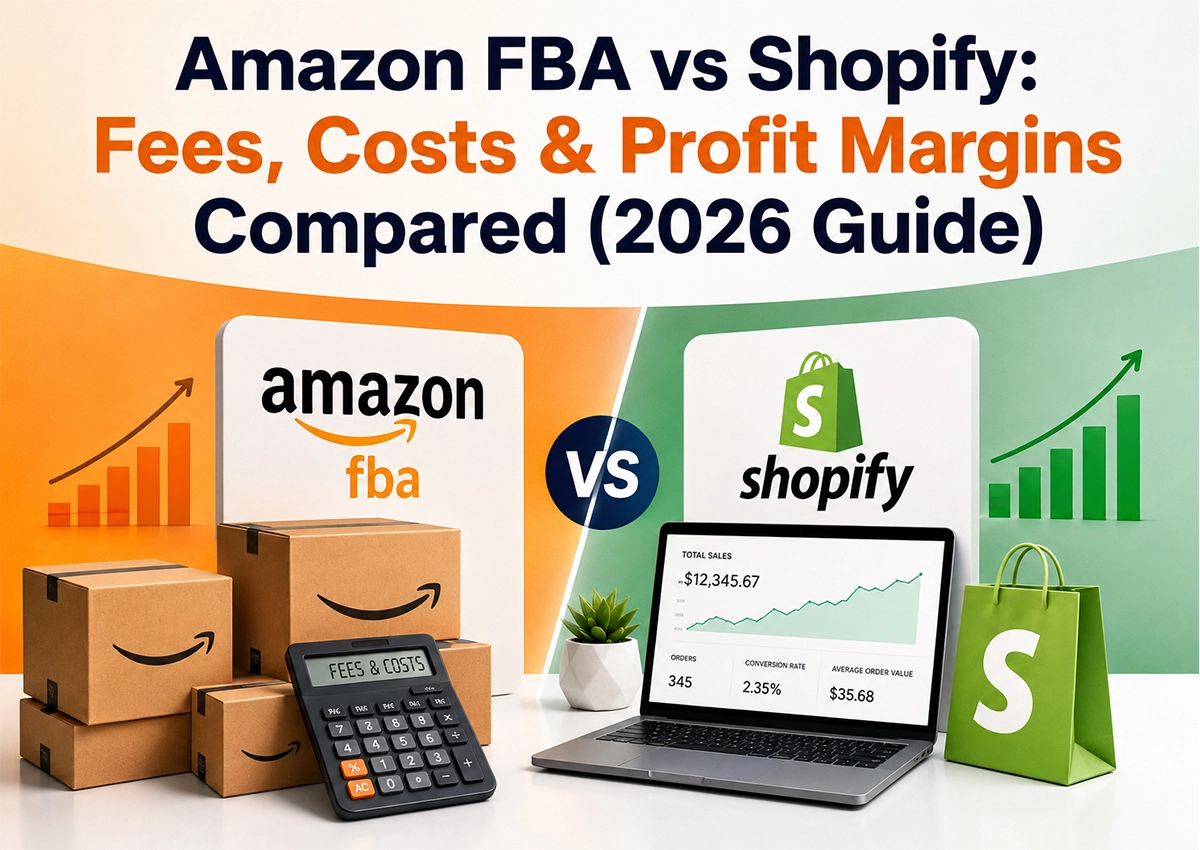
  • Amazon FBA vs Shopify: Fees, Costs & Profit Margins Compared (2026 Guide)

    Amazon FBA vs Shopify isn’t really a battle between two platforms. They’re two very different ways to build an ecommerce business.

    Amazon gives you access to an existing customer base. Shopify gives you more control over your own store, customer experience, and brand.

    But then come the costs. FBA fees, referral fees, storage, shipping, Shopify subscription fees, payment processing, apps, and marketing.

    So, Amazon vs Shopify comes down to more than the monthly platform cost. You need to look at the entire unit economics.

    This guide breaks down Amazon FBA vs Shopify, including fees, fulfillment costs, transaction charges, profit margins, and the situations where each model makes more sense in 2026.

    FBA Niche Research
    Amazon Niche Products
    Marketplace Growth

    Amazon ACoS Strategies

    PPC Performance

    Higher ROAS

    Amazon FBA vs Shopify fees, costs, and profit margins compared in 2026

    Summary

    Amazon FBA and Shopify both offer strong ecommerce opportunities: Amazon usually wins on built-in traffic and fulfillment convenience, while Shopify gives brands more control over the storefront, customer journey, and first-party customer relationships.

    However, neither model is automatically more profitable.

    Your product price, COGS, advertising spend, fulfillment method, conversion rate, repeat purchase rate, and average order value matter just as much.

    In other words, don’t compare platforms; compare profit per order.

    Key Takeaways

    Amazon Gives You Traffic

    Amazon already has millions of shoppers searching for products. That can shorten the path from launch to first sale.

    Shopify Gives You Control

    Shopify lets you control your storefront, branding, customer experience, and marketing ecosystem.

    FBA Costs Stack Up

    Amazon charges selling and fulfillment fees. Storage, returns, aged inventory, advertising, and inbound placement can add further costs.

    Shopify Costs Are More Predictable

    You typically pay a platform subscription plus payment processing and, depending on your setup, third-party transaction fees and app costs.

    Profitability Depends on the Business Model

    A 30% margin on Amazon isn’t necessarily better than a 25% Shopify margin if your Shopify customers purchase repeatedly.

    What Is the Difference Between Amazon FBA and Shopify?

    The simplest way to explain Amazon FBA vs Shopify is this:

    Amazon is a marketplace; Shopify is your ecommerce infrastructure.

    With Amazon FBA, you sell inside Amazon’s marketplace and can use Fulfillment by Amazon to handle picking, packing, shipping, customer service, and returns.

    Shopify works differently. You build your own online store, control the experience, and then decide how to attract customers and fulfill orders.

    That’s a major difference. Amazon helps solve the traffic problem; Shopify helps solve the ownership and brand-control problem.

    Of course, many successful Amazon FBA businesses eventually use both. They don’t choose one forever; they diversify.

    How Much Does Amazon FBA Cost in 2026?

    There isn’t one fixed FBA cost. Amazon’s selling costs depend on your product, category, size, weight, selling plan, fulfillment method, and additional services.

    For US sellers, Amazon currently lists the Individual plan at $0.99 per item sold and the Professional plan at $39.99 per month. Referral fees then vary by category, and FBA adds fulfillment-related costs. These can include:

    • Pick and pack
    • Shipping and handling
    • Customer service
    • Returns processing
    • Monthly storage
    • Aged inventory charges
    • Inbound placement costs
    • Removal or disposal fees

    Amazon states that FBA fulfillment costs depend on product dimensions and shipping weight. Storage costs are based on the space inventory occupies in Amazon’s fulfillment network.Β 

    So, how much does Amazon FBA cost? It depends.

    And that’s why using an Amazon seller fees calculator or Amazon’s Revenue Calculator before launching a product is critical. Amazon’s calculator lets sellers compare estimated FBA costs with their own fulfillment costs.Β 

    What Is an FBA Fee and What Does It Actually Cover?

    A common question is, what is an FBA fee? Think of it as the cost of outsourcing fulfillment to Amazon.Β 

    • Amazon handles the operational side.
    • Your product arrives at its fulfillment network.
    • A customer places an order.
    • Amazon picks the product, packs it, ships it, and manages customer service and eligible returns.

    That convenience has a cost.

    For example, Amazon currently lists a $3.06 fulfillment fee for certain small-standard non-apparel products weighing 2 oz or less, while larger and heavier products cost more.Β 

    That’s why product dimensions matter so much.

    A small packaging change can sometimes improve your economics.

    Expert Observation

    At Krolog, one of the first things we check during FBA profitability analysis is product size.

    Sellers often focus on product cost; they forget packaging. A slightly oversized box can push a product into a different fulfillment tier. Suddenly, the margin looks very different.

    What Are Shopify Transaction Fees and Processing Costs in 2026?

    Shopify follows a different structure. You pay for the Shopify plan. Then you pay payment processing fees when customers purchase.

    The exact rate depends on your country, plan, payment provider, and setup.

    For example, Shopify’s US pricing currently lists online card rates starting at 2.9% + 30Β’ on its Basic plan when using Shopify Payments. Third-party transaction fees can also apply when using an external payment provider.Β 

    So, does Shopify charge transaction fees? It can.

    If you use Shopify Payments, you’re primarily dealing with Shopify’s payment processing rates.

    If you use a third-party processor, Shopify may charge an additional transaction fee depending on your plan. Current US pricing lists third-party transaction fees of 2% on Basic, 1% on Grow, and 0.6% on Advanced.Β  Therefore, don’t look only at the subscription price; calculate the complete payment cost.

    Does Shopify Take a Percentage of Sales?

    Yes, depending on how payments are processed. This is where the question “what percentage does Shopify take?” gets tricky.

    There isn’t one universal percentage. Shopify’s payment processing varies by plan and country.

    Third-party transaction fees also vary.

    For that reason, Shopify transaction fees percentage should always be evaluated alongside your payment gateway and monthly sales volume.

    A brand doing $20,000 a month needs to think differently from a brand doing $200,000.

    At higher volumes, even a small percentage difference can become meaningful.

    Amazon FBA vs Shopify: Which Has Higher Upfront Costs?

    This is where Shopify often looks attractive. You can launch a basic Shopify store without buying inventory for Amazon’s fulfillment network. But don’t confuse lower platform costs with lower business costs.

    A Shopify launch may require:

    Amazon has different startup costs. You may need:

    So, Amazon FBA vs Shopify isn’t about which platform costs less to open; it’s about where your money goes.

    Amazon vs Shopify: Where Are Profit Margins Usually Better?

    This question gets asked constantly. The honest answer? It depends on acquisition cost.

    Amazon provides built-in demand, which is valuable. But you’re competing for that demand alongside thousands of other sellers. You also pay marketplace and fulfillment fees.

    Shopify gives you more control, but you must generate your own traffic. That means your customer acquisition cost can become the biggest expense.

    Imagine two brands selling the same $50 product.

    Amazon Example

    Selling price: $50

    COGS: $15

    Amazon referral + FBA costs: $12

    Advertising: $8

    Estimated contribution: $15

    Shopify Example

    Selling price: $50

    COGS: $15

    Payment processing: $1.75

    Fulfillment: $6

    Advertising: $10

    Estimated contribution: $17.25

    At first glance, Shopify wins. But there’s another piece.

    If the Shopify customer returns three months later and purchases again, the economics can improve dramatically.

    Amazon may win the first transaction, but Shopify can become more attractive over the customer lifetime.

    That’s why profit margin shouldn’t be measured only at the order level.

    Shopify vs Amazon: Which Platform Is Better for Customer Acquisition?

    Amazon has a major advantage: intent. People go there to shop.

    Someone searches “stainless steel water bottle” because they are already considering a purchase. That’s powerful.

    Shopify works differently. You might need to attract that customer through:

    As a result, selling on Shopify vs Amazon often requires a stronger customer acquisition strategy. But the upside is significant.

    • You control the customer journey.
    • You control the storefront.
    • You can build an email list.
    • You can introduce bundles.
    • You can create subscriptions.
    • You can retarget customers.
    • And you can build a brand outside the marketplace.

    Ready to Choose Between Amazon FBA and Shopify?

    Compare Amazon FBA vs Shopify fees, costs, and profit margins to understand which platform fits your business goals and growth strategy in 2026.

    Amazon FBA vs Shopify: What About Fulfillment Costs?

    Fulfillment is one of the biggest differences. FBA handles the operational workload for Amazon orders.

    Amazon’s current FBA structure includes fulfillment and storage costs, plus possible charges for aged inventory, returns, removal, and inbound placement.Β 

    Shopify doesn’t force you into one fulfillment model. You can use:

    • Your own warehouse
    • A 3PL
    • Shopify-compatible fulfillment partners
    • Dropshipping
    • Amazon MCF
    • Other logistics providers

    That flexibility can be useful; but flexibility also means responsibility.

    You need to manage shipping speed, inventory accuracy, returns, packaging, and customer support.

    Shopify Plus vs Amazon FBA: Which Is Better for Scaling?

    Both can scale; they simply scale differently.

    Amazon scales through marketplace demand, catalog expansion, PPC, SEO, reviews, and geographic expansion.

    Shopify scales through customer acquisition, retention, conversion optimization, merchandising, partnerships, and owned marketing channels.

    For example, a brand selling kitchen products might use Amazon to capture high-intent shoppers. Then it can use Shopify to build bundles, collect customer consent for marketing, launch subscriptions, and develop a stronger DTC experience.

    This is why Shopify and Amazon can work better together than separately.

    Common Mistakes Sellers Make When Comparing Amazon vs Shopify

    • Looking Only at Platform Fees: A cheap subscription doesn’t guarantee high profitability. Look at the entire P&L.
    • Ignoring Customer Acquisition Costs: Shopify can look inexpensive until paid acquisition enters the equation. Then the numbers change quickly.
    • Ignoring FBA Storage: Inventory sitting in Amazon’s fulfillment network still costs money. Aged inventory can create additional charges after 181 days.Β 
    • Comparing Revenue Instead of Contribution Margin: $100,000 in sales isn’t impressive if the business keeps only $5,000. Contribution matters.
    • Treating Amazon and Shopify as Enemies: They aren’t. A strong omnichannel strategy can use Amazon for reach and Shopify for customer ownership.

    How Should You Choose Between Amazon FBA and Shopify?

    Start with five questions.

    1. Do You Already Have Demand?Β 

    If yes, Shopify becomes easier. If no, Amazon can provide faster access to existing shopping demand.

    2. Is Your Product Highly Differentiated?

    Strong differentiation can work extremely well on Shopify. Commodity products face tougher acquisition economics.

    3. Do Customers Repurchase?

    If yes, Shopify becomes particularly interesting because retention can improve customer lifetime value.

    4. Can You Manage Fulfillment?

    If you want Amazon to handle fulfillment, FBA offers operational convenience. If you want flexibility, Shopify gives you more fulfillment choices.

    5. What’s Your Actual Contribution Margin?

    This is the big one. Build the numbers before you choose the channel.

    Ready to Choose Between Amazon FBA and Shopify?

    Compare Amazon FBA vs Shopify fees, costs, and profit margins to understand which platform fits your business goals and growth strategy in 2026.

    Expert Framework: Calculate Profit Before You Choose the Platform

    Don’t start with: “Which platform is cheaper?”

    Start with:

    • RevenueΒ 
    • Product CostΒ 
    • FulfillmentΒ 
    • Platform FeesΒ 
    • Payment FeesΒ 
    • Advertising
    • ReturnsΒ 
    • StorageΒ 
    • Other Operating Costs = Contribution Profit

    Then compare the two models.

    For Amazon, use Amazon’s Revenue Calculator to estimate FBA and fulfillment economics.Β 

    For Shopify, include subscription, payment processing, apps, fulfillment, and customer acquisition. This gives you a much clearer answer.

    Should You Sell on Amazon and Shopify Together?

    For many established brands, yes. This is often the strongest approach.

    • Amazon becomes the demand engine; Shopify becomes the brand engine.
    • Amazon can help you acquire shoppers; Shopify can help you develop stronger DTC relationships.

    You can also use shared inventory systems, fulfillment partners, analytics, and advertising data to create a more connected operation. The goal isn’t to move customers away from Amazon overnight; it’s to build more than one reliable revenue channel.

    Final Verdict: Amazon FBA vs Shopify in 2026

    So, Amazon FBA vs Shopify, which one wins? There isn’t a universal winner.

    Amazon FBA is powerful when you want marketplace demand, trusted fulfillment, and access to shoppers who are already ready to buy.

    Shopify becomes powerful when you want brand control, customer ownership, flexible fulfillment, and a stronger DTC ecosystem.

    And the smartest brands often use both.

    At Krolog, we don’t recommend a platform based on hype.Β 

    • We look at the product
    • The margins
    • The customer journey
    • The acquisition cost
    • The fulfillment model

    Then we build the channel strategy around the numbers, because the cheapest platform isn’t always the most profitable one.

    The better question is: Which channel gives your product the healthiest path to sustainable profit?

    That’s where the real Amazon vs Shopify decision starts.

    Frequently Asked Questions

    About the Author

    Sandeep K., Founder and CEO of Krolog Inc., is an E-commerce and Amazon marketplace consultant with over 10 years of experience in Amazon SEO, PPC, marketplace strategy, ecommerce growth, and DTC development.

    He has worked with brands across multiple categories to improve visibility, profitability, and sustainable ecommerce growth.

    Need Help Choosing Between Amazon and Shopify?

    Choosing the platform is only step one. The real work is building a profitable channel strategy.

    Krolog helps brands manage Amazon FBA, Amazon PPC, listing optimization, Amazon SEO, Shopify development, DTC growth, and marketplace expansion.

    If you’re unsure whether Amazon, Shopify, or both make sense for your business, start with the numbers.

    Request a free ecommerce growth consultation and identify where your next profitable growth opportunity sits.

    The fee references are deliberately framed as current examples, not universal rates, because Amazon and Shopify pricing changes by marketplace, category, plan, payment provider, and product characteristics.Β 

    Related Article

    Good ROAS for eCommerce in 2026: Real Benchmarks (And Why the Old β€œ4:1 Rule” Is Dead)

    Good ROAS for eCommerce in 2026: Real Benchmarks (And Why the Old β€œ4:1 Rule” Is Dead)

    Good ROAS for eCommerce in 2026: Real Benchmarks (And Why the Old β€œ4:1 Rule” Is Dead) A campaign shows a…

    Amazon FBA vs Shopify: Fees, Costs & Profit Margins Compared (2026 Guide)

    Amazon FBA vs Shopify: Fees, Costs & Profit Margins Compared (2026 Guide)

    Amazon FBA vs Shopify: Fees, Costs & Profit Margins Compared (2026 Guide) Amazon FBA vs Shopify isn’t really a battle…

    Top Amazon FBA Niches in 2026: A Guide to Finding the Right Product Category

    Top Amazon FBA Niches in 2026: A Guide to Finding the Right Product Category

    Top Amazon FBA Niches in 2026: A Guide to Finding the Right Product Category Choosing an FBA niche sounds exciting…

    Scroll to Top