Nav Preview
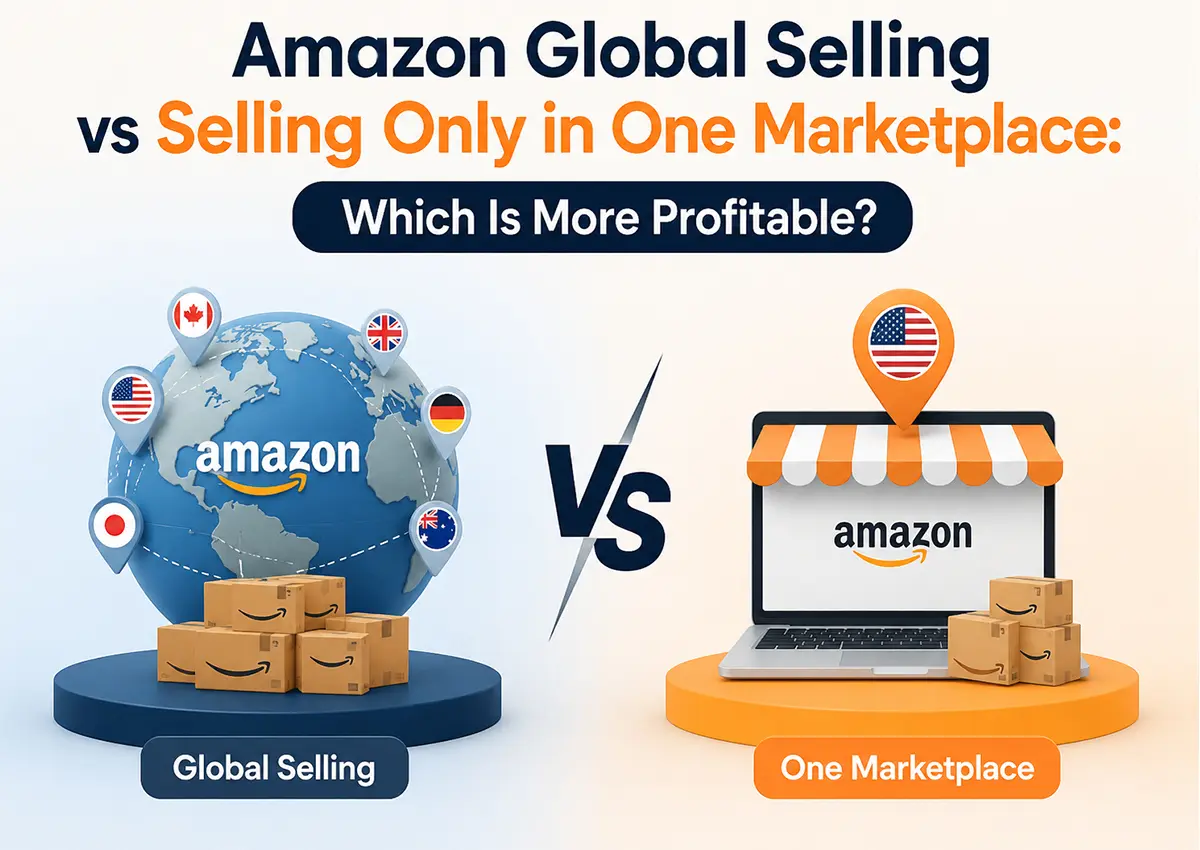
  • Amazon Global Selling vs Selling Only in One Marketplace: Which Is More Profitable?

    Selling on Amazon is one thing; scaling across countries is another. Some brands thrive in one marketplace. Others unlock faster growth through Amazon Global Selling. So, which path makes more money? Let’s break down the numbers, risks, and opportunities to help you decide where your next sale should come from.

    Amazon Global Selling
    Sell on Amazon Globally
    Amazon Global Seller

    Amazon ACoS Strategies

    PPC Performance

    Higher ROAS

    Amazon Global Selling vs Selling Only in One Marketplace – Which Is More Profitable for Amazon Sellers?

    Summary

    Expanding internationally sounds exciting.Β 

    • Bigger audiences
    • More sales
    • New opportunities

    But it also brings new costs, logistics, compliance requirements, and competition.

    This guide compares Amazon Global Selling with selling in a single marketplace, explains profitability, highlights common mistakes, and shares practical advice from Krolog’s marketplace experts.Β 

    Whether you’re launching your first product or planning international expansion, you’ll know which strategy best fits your business.

    Key Takeaways

    Bigger Markets Don't Always Mean Bigger Profits

    Selling globally increases your customer base. It also increases operational complexity.

    Master One Marketplace First

    Strong listings, stable inventory, and profitable advertising create a better foundation for international expansion.

    Every Country Behaves Differently

    Customer preferences, pricing, taxes, and competition vary by marketplace. What works in the US may not work in the UAE or Canada.

    Expansion Needs a Strategy

    Successful brands don’t just translate listings. They localize content, optimize PPC, and plan inventory before launching.

    What Is Amazon Global Selling?

    Imagine you’ve built a successful business on Amazon US.

    • Orders arrive every day.
    • Reviews keep growing.
    • Sales feel predictable.

    Then one question pops up.

    “Could this product sell in Canada?”

    “What about the UK?”

    That’s exactly where Amazon Global Selling comes in.

    The Amazon Global Selling Program allows businesses to list and sell products across multiple Amazon marketplaces from a single selling account. Instead of relying on one country’s demand, you reach customers around the world.

    That doesn’t mean copying your US listing and pressing publish. Every marketplace has different :

    • Customer behavior
    • Regulations
    • Competition
    • Buying habits

    The brands that succeed treat every new country like a new business launch; that’s why planning matters just as much as the product itself.

    Expert Observation

    One mistake we often see is sellers expanding too early. A product isn’t profitable in its home marketplace yet; advertising still struggles; inventory planning isn’t stable. Yet the seller launches into three new countries, hoping sales will fix everything. Usually, the opposite happens.

    • Costs increase
    • Operations become harder
    • Growth slows down.

    The strongest Amazon global sellers build a profitable business first. Then they scale internationally with systems already in place.

    What Does Selling in a Single Amazon Marketplace Mean?

    Not every business needs to sell worldwide. In fact, many seven-figure brands operate successfully in just one marketplace.

    Selling in a single marketplace means focusing your entire strategy on one country, such as the US, Canada, or China.

    Everything becomes simpler.

    • One inventory plan.
    • One advertising strategy.Β 
    • One customer base.
    • One set of tax rules.

    That simplicity creates focus.

    Instead of managing international logistics, you spend more time improving listings, lowering ACoS, increasing repeat purchases, and building brand awareness.

    For newer sellers, that’s often the smarter move. Once systems are working consistently, expanding becomes far less risky.

    Growth doesn’t always come from adding countries. Sometimes it comes from doing one marketplace exceptionally well.

    Amazon Global Selling vs Selling in One Marketplace: Key Differences

    There’s no universal winner. Some brands grow faster by dominating one marketplace. Others multiply revenue after expanding internationally.Β 

    Β 

    The real question isn’t “Which model is better?” It’s “Which model is better for your business right now?”

    Β 

    Here’s how they compare.

    Factor Selling in One Marketplace Amazon Global Selling
    Customer Reach Limited to one country Access to millions of international shoppers
    Revenue Potential Steady, easier to predict Higher growth potential across multiple markets
    Competition Easier to monitor Varies by country and category
    Inventory Simpler to manage Requires international planning
    Advertising One PPC strategy Separate campaigns for each marketplace
    Compliance Local regulations only Taxes, customs, and country-specific requirements
    Risk Lower operational risk Higher complexity but greater opportunity
    Best For New and growing sellers Established brands ready to scale

    Think of it like this.

    Running one marketplace is like managing one successful store. Amazon Global Selling is opening several stores in different countries.

    • More customers
    • More opportunities
    • Also, more responsibility.

    Benefits of Expanding to Multiple Amazon Marketplaces

    For brands that are ready, international expansion can be a game changer. The biggest advantage?

    You’re no longer relying on one country’s demand.

    If sales slow in one region, another marketplace may continue growing. That creates a healthier business over time.

    Here are some of the biggest benefits.

    1. Reach More Customers

    Selling only in one marketplace limits your audience. Whereas, when you sell globally on Amazon, your products become available to millions of additional shoppers across North America, Europe, the Middle East, Asia, and beyond. More visibility often creates more opportunities.

    2. Increase Revenue Streams

    Imagine selling kitchen organizers. Demand may slow after the holiday season in one country.

    Another marketplace might still be entering its busiest shopping period.

    Multiple marketplaces help balance seasonal fluctuations and reduce dependence on a single source of revenue.

    3. Build a Stronger Global Brand

    Customers increasingly discover brands across multiple Amazon marketplaces. Appearing in several countries builds credibility. It also creates consistency for international shoppers who already know your products.

    4. Reduce Marketplace Risk

    Putting all your revenue into one marketplace creates concentration risk.

    • Policy updates
    • Economic slowdowns
    • New competitors
    • Advertising costs.

    Any one of these can affect sales. Diversifying across countries helps spread that risk.

    5. Find Less Competitive Opportunities

    Not every product performs the same everywhere. We’ve seen products struggle in the US while becoming top performers in Canada or Australia.Β  Different markets create different opportunities. Research matters.

    Practical Example

    A home organization brand focused only on Amazon US. Sales were steady; growth wasn’t.

    After reviewing demand, competition, and logistics, the brand expanded into Canada.

    Not five countries, just one.Β 

    • The product already had strong reviews.
    • Inventory planning was solid.
    • Listings were localized instead of simply translated.

    Within months, international sales became an additional revenue stream without disrupting the US business. That’s usually how successful expansion looks. One step at a time.

    Expert Observation

    One assumption we hear often is,

    “If my product sells well in the US, it’ll sell everywhere.”

    Not necessarily.

    • Customer expectations change.
    • Search behavior changes.
    • Pricing changes.

    Even product sizing and packaging preferences can differ from one marketplace to another.

    The businesses that win don’t just sell on Amazon globally. They adapt to every marketplace they enter.

    At Krolog, that’s where we spend most of our time: research first, launch second,Β 

    because expansion without data is just guessing.

    When Should You Stay in One Marketplace?

    Expanding sounds exciting. But it isn’t always the right move. Sometimes, staying focused on one marketplace makes you more money.

    We’ve advised the same to sellers who wanted to launch globally.Β 

    After looking at the numbers, we told them to wait since their foundation wasn’t ready yet.

    You should consider staying in one marketplace if:

    • Your products aren’t consistently profitable.
    • Inventory runs out frequently.
    • PPC campaigns still need optimization.
    • Customer reviews are limited.
    • Cash flow feels tight.
    • Operations already feel overwhelming.

    Growing wider before growing stronger rarely ends well. Master one marketplace first.

    Expansion becomes much easier after that.

    When Is the Right Time to Expand Internationally?

    There’s no perfect revenue number and no magic milestone either.

    Instead, look for signals.

    If most of these apply to your business, you may be ready to expand.

    • Your flagship products generate consistent profits.
    • Inventory forecasting is reliable.
    • Advertising delivers positive returns.
    • Customer feedback is strong.
    • Your operations can support another marketplace.
    • You have enough working capital for inventory and marketing.

    Expansion should feel planned, not rushed. The best Amazon global sellers don’t expand because they’re bored. They expand because the business is ready.

    Ready to Grow Beyond One Marketplace?

    Expand globally and unlock new customers with Amazon Global Selling.

    Amazon Global Selling Fees: What Should Sellers Expect?

    One of the biggest questions we hear is about Amazon Global Selling fees.

    The answer? There isn’t one flat fee.

    Instead, your costs depend on where you sell and how you fulfill orders.

    Typical expenses include:

    • Amazon referral fees
    • FBA fulfillment fees
    • International shipping
    • Customs and import duties
    • Currency conversion fees
    • Local taxes and VAT, where applicable
    • Advertising costs for each marketplace.

    These expenses add up. That’s why profitability matters more than revenue. Selling more products doesn’t always mean making more money.

    Always calculate your margins before entering a new country.

    Do You Need the Amazon Global Selling Solution Provider Network?

    Not always, but it definitely can make expansion much easier.

    The Amazon Global Selling Solution Provider Network (SPN) connects sellers with trusted partners who help with:

    Many growing brands use the SPN when entering unfamiliar markets. Others work with experienced marketplace agencies like Krolog to manage the entire expansion process under one strategy.

    The goal is the same:

    • Avoid expensive mistakes
    • Launch faster
    • Scale smarter

    Is There an Amazon Global Selling Manual?

    Technically, yes. Amazon provides documentation and learning resources that explain international selling requirements.

    Think of the Amazon Global Selling manual as a starting point.

    • It explains policies
    • Requirements
    • Marketplace setup
    • Compliance basics.

    Β 

    What it doesn’t provide is strategy. It won’t tell you which marketplace fits your product.

    It won’t predict demand. And it certainly won’t optimize your listings or PPC campaigns.

    That’s where practical experience becomes valuable.

    Ready to Grow Beyond One Marketplace?

    Expand globally and unlock new customers with Amazon Global Selling.

    Common Mistakes Sellers Make When Expanding Globally

    International expansion creates opportunities. It also exposes weaknesses.

    Here are the mistakes we see most often.

    1. Expanding Too Early: Many sellers chase new markets before fixing problems at home. That usually creates bigger problems.
    2. Ignoring Localization: Direct translations rarely perform well. Customers buy differently in every country. Listings should reflect local language, search behavior, and buying habits.
    3. Underestimating Costs: Many sellers calculate shipping. They forget taxes, currency conversion, advertising, and compliance expenses. Margins disappear quickly.
    4. Treating Every Marketplace the Same: Success in the US doesn’t guarantee success elsewhere. Every marketplace deserves its own strategy.

    Emerging Trends in Amazon Global Selling for 2026

    Cross-border ecommerce keeps evolving. The brands growing fastest are adapting early.

    Some of the biggest trends include:

    • AI-powered marketplace localization.
    • Regional keyword optimization instead of direct translations.
    • Cross-border FBA networks reducing delivery times.
    • Greater use of data to decide expansion markets.
    • More sellers entering emerging Amazon marketplaces before competition increases.

    The opportunity is still growing, and the competition is too.

    Of course, every project is different.

    A small catalog with a premium theme launches much faster than a custom-built ecommerce experience with advanced integrations.Β 

    Planning saves time; skipping discovery usually adds it back.

    Final Verdict

    So, which approach is more profitable? It depends.

    For new sellers, focusing on one marketplace often delivers better margins and fewer operational headaches.

    For established brands, Amazon Global Selling can unlock entirely new revenue streams.

    The trick isn’t expanding everywhere. It’s expanding at the right time.

    At Krolog, we’ve found that the most successful international launches begin with research, and not assumptions. We help brands evaluate demand, optimize listings, localize content, and build marketplace strategies that support sustainable growth.

    Selling globally isn’t just about reaching more customers. It’s about building a business that can grow across borders without losing profitability.

    Frequently Asked Questions

    About the Author

    Sandeep K., Founder and CEO of Krolog Inc., has over 10 years of experience helping brands grow across Amazon marketplaces worldwide.
    His expertise includes Amazon SEO, PPC, marketplace expansion, inte rnational product launches, listing optimization, inventory planning, and cross-border ecommerce strategy.
    He has helped businesses successfully scale from single-market sellers to global Amazon brands.

    Ready to Expand Beyond One Marketplace?

    Selling internationally isn’t just about listing products in another country. It’s about choosing the right markets.

    • Building localized listings
    • Managing inventory
    • Optimizing advertising
    • And protecting your margins every step of the way.

    Whether you’re evaluating Amazon Global Selling, planning your first international launch, or looking to scale across multiple marketplaces, Krolog helps brands expand with confidence.

    Our Amazon growth services include:

    Book your free Amazon expansion consultation and discover where your next profitable marketplace could be.

    Related Article

    Amazon Global Selling vs Selling Only in One Marketplace: Which Is More Profitable?

    Amazon Global Selling vs Selling Only in One Marketplace: Which Is More Profitable?

    Amazon Global Selling vs Selling Only in One Marketplace: Which Is More Profitable? Selling on Amazon is one thing; scaling…

    How Much Does a Shopify Store Cost in 2026? Agency vs Freelancer vs DIY Compared

    How Much Does a Shopify Store Cost in 2026? Agency vs Freelancer vs DIY Compared

    How Much Does a Shopify Store Cost in 2026? Agency vs Freelancer vs DIY Compared Building a Shopify store is…

    How Much Money Can Sellers Really Make on Amazon? The Numbers May Surprise You

    How Much Money Can Sellers Really Make on Amazon? The Numbers May Surprise You

    How Much Money Can Sellers Really Make on Amazon? The Numbers May Surprise You Can you really make money selling…

    Scroll to Top