Amazon FBA Fee Changes 2026: What Sellers Need to Know
Amazon FBA Fee Changes 2026: What Sellers Need to Know Selling on Amazon keeps changing. So do the costs. The…
Selling online looks simple until the fees start adding up.
A sale comes in, and the revenue starts to look great. Then Amazon referral fees, fulfillment costs, advertising spend, and transaction charges slowly eat into your margin.
Shopify, on the other hand, feels different. You pay a monthly subscription, payment processing, and a few transaction costs depending on your setup. So naturally, sellers keep asking: Shopify vs. Amazon fees: which one actually costs less?
There’s no definite answer to this. It depends on your products, fulfillment model, and growth stage.
This guide breaks down Shopify fees and Amazon selling fees from 2022 to 2026. You’ll see how pricing has changed year after year, how much it costs to sell on Amazon versus Shopify, and where brands quietly lose money. More importantly, we’ll show when Amazon makes sense, when Shopify wins, and why many successful brands eventually sell on both.
Amazon gives sellers instant marketplace access, but every sale comes with referral fees, fulfillment costs, storage fees, and advertising expenses. Shopify follows a different model. Sellers pay a monthly subscription, payment processing fees, and optional app costs while keeping more control over customer relationships.
Understanding Shopify transaction fees, Amazon FBA fees, and long-term operating costs helps sellers choose the right growth strategy instead of comparing platforms only by revenue.
Selling on Amazon includes referral fees, FBA fulfillment, storage, and advertising costs that change as your business grows.
Most Shopify sellers pay a fixed monthly subscription plus payment processing fees, making costs easier to forecast.
Amazon helps acquire customers. Shopify helps build repeat customers and higher lifetime value.
The real comparison is margin after fulfillment, advertising, software, and customer acquisition costs.
The fee conversation has changed a lot over the last five years.
Back in 2022, Amazon was still the easiest place to launch products. Referral fees stayed relatively stable, and many sellers accepted FBA costs as the price of convenience. Then storage fees increased, fulfillment pricing changed, and advertising became more competitive almost every year.
Shopify followed a different path. Subscription pricing evolved gradually, payment processing stayed relatively transparent, and sellers gained more flexibility through Shopify Payments and third-party fulfillment.
Here’s the bigger picture.
| Platform | Fee Changes (2022–2026) |
|---|---|
| Amazon (2022–2026) | Referral fees remained category-based, while FBA fulfillment, storage, and operational costs increased across multiple updates. |
| Shopify (2022–2026) | Monthly subscription pricing evolved gradually, while payment processing remained relatively predictable for most merchants. |
Sellers compare Shopify’s monthly cost with only Amazon referral fees. That’s incomplete. The real comparison includes fulfillment, advertising, software tools, returns, payment processing, and customer acquisition. That’s where profitability changes.
This is usually the first question new sellers ask. And honestly, Amazon doesn’t charge just one fee. It charges several fees based on sales, storage, fulfillment, or advertising.
If you’re wondering “how much does it cost to sell on Amazon,” here’s the breakdown.
| Amazon Seller Fees (2026) | Typical Cost |
|---|---|
| Professional Seller Plan | Monthly subscription. |
| Amazon Referral Fees | Around 8–15% depending on category. |
| Amazon FBA Fees | Based on product size and weight. |
| Storage Fees | Monthly inventory storage charges. |
| Advertising Costs | Variable PPC spend. |
The biggest surprise for growing brands? Amazon fulfillment fees keep increasing as inventory grows. Storage during peak season Amazon months can also impact margins if inventory isn’t managed properly.
The answer depends on the product category. Amazon referral fees vary significantly by product category, with many common categories falling around 8%–15%, while some categories have higher or tiered rates. Categories like apparel, electronics, beauty, and home products all have different referral structures.
However, referral fees are only part of the cost of selling on Amazon. You also need to factor in:
Many sellers obsess over referral fees but ignore fulfillment costs. That’s usually where margins disappear.
Shopify works differently. Instead of marketplace commissions, sellers pay platform fees plus payment processing. That makes Shopify fees easier to predict month after month.
Yes, but not exactly the way Amazon does. If you’re using Shopify Payments, Shopify mainly charges payment processing fees.
If you use a third-party gateway, Shopify transaction fees apply in addition to payment processing. That’s why people often ask: “What percentage does Shopify take from each sale?”
The answer depends on:
Let’s simplify it. Imagine a $100 order.
| Example Shopify Sale | Typical Outcome |
|---|---|
| Sale Value | $100 |
| Payment Processing | Small percentage + fixed transaction fee. |
| Shopify Transaction Fee | Often avoided with Shopify Payments. |
| Customer Data | You own it. |
Compared to Amazon, Shopify usually leaves sellers with greater customer ownership, even if customer acquisition costs happen outside the platform.
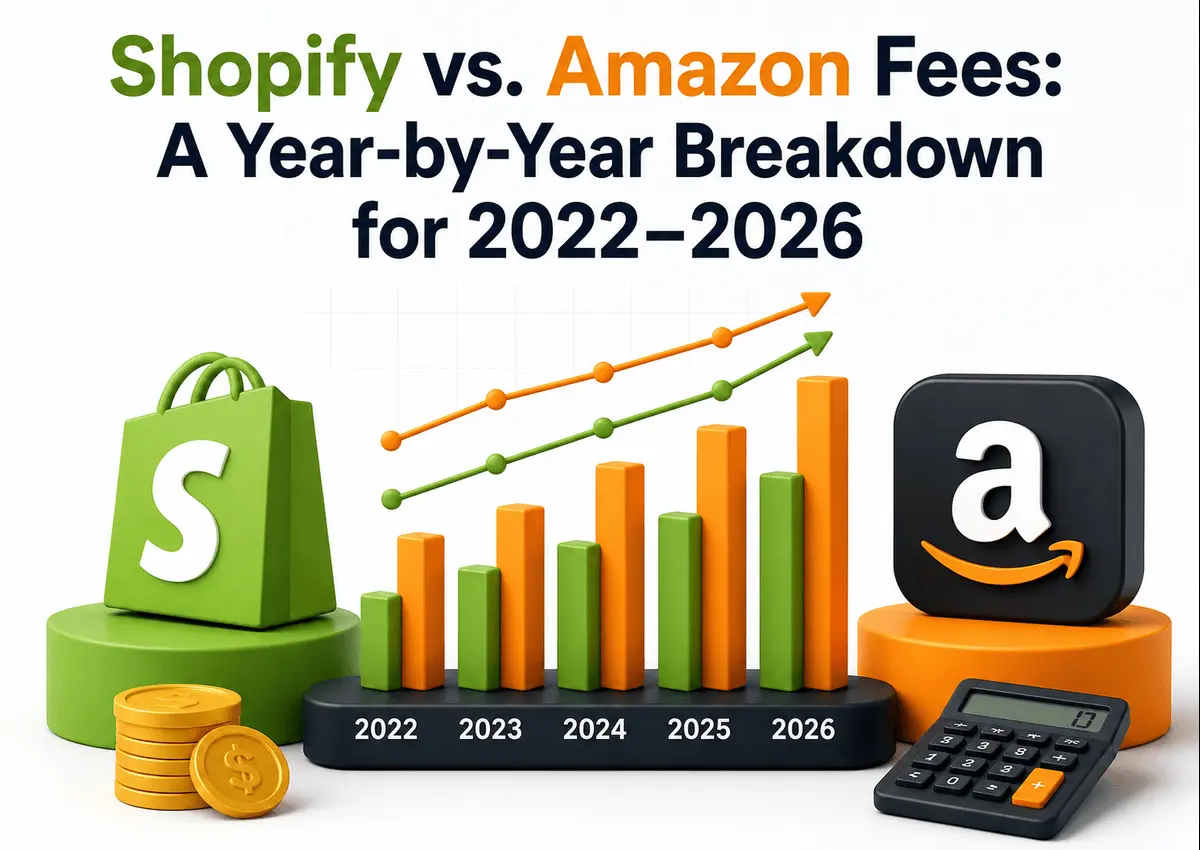
Looking at the fee structure year by year gives a clearer picture than comparing a single commission percentage. Between 2022 and 2026, Amazon introduced multiple updates to FBA fulfillment, storage, and inventory-related fees, while Shopify’s pricing changed more gradually through subscription plans and payment processing updates.
| Year | Amazon Fee Updates | Shopify Fee Updates |
|---|---|---|
| 2022 | Referral fees remained category-based, while FBA fulfillment and storage costs followed the existing pricing structure. | Standard monthly subscription plans and payment processing fees remained unchanged for most merchants. |
| 2023 | Amazon increased FBA fulfillment fees, storage fees, and introduced additional storage utilization charges for some sellers. | Shopify updated subscription pricing in several markets but kept its payment processing model largely consistent. |
| 2024 | Amazon added inbound placement service fees and revised FBA fulfillment pricing for inventory sent to fulfillment centers. | Shopify continued offering tiered plans while expanding Shopify Payments and checkout capabilities. |
| 2025 | Amazon announced no increase to referral or standard FBA fulfillment fees for most U.S. sellers and reduced some inbound placement fees. | Shopify pricing remained subscription-based with transaction fees depending on whether merchants used Shopify Payments. |
| 2026 | Amazon announced an average FBA fulfillment fee increase of approximately $0.08 per unit for U.S. sellers beginning in 2026. | Shopify retained its monthly subscription model while payment processing fees continued to vary by plan and payment provider. |
The fee models are fundamentally different.
We encourage sellers to compare total operating costs instead of looking at a single fee. Marketplace commissions, fulfillment expenses, advertising budgets, software subscriptions, and payment processing together determine actual profitability; not just the platform you sell on.
This isn’t really an Amazon vs Shopify debate anymore. The smartest ecommerce brands use both.
Amazon brings visibility and purchase intent. Shopify builds long-term customer relationships. Together, they create a stronger revenue mix.
Here’s how the model works:
| Platform | What It Gives You |
|---|---|
| Amazon | Discoverability, Prime fulfillment, marketplace traffic, and faster customer acquisition. |
| Shopify | Customer ownership, repeat purchases, subscriptions, email marketing, and better lifetime value. |
One pattern we’ve noticed at Krolog is that brands relying only on Amazon often hit a profitability ceiling. Building a Shopify store creates another sales channel where you control pricing, promotions, and customer retention.
Sometimes fees aren’t the biggest problem. Poor strategy is. Here are mistakes we see often:
A small optimization across these areas can improve margins without increasing sales volume.
Seller costs continue evolving. A few trends worth watching:
The focus is shifting from cheaper platforms to smarter operations.
Reducing fees isn’t about avoiding the platform. It’s about optimizing how you sell on it.
At Krolog, we help brands:
The goal is simple: Lower wasted spend = Higher profitable sales.
So, Shopify or Amazon?
If you’re launching a product, Amazon offers immediate marketplace reach.
If you’re building a long-term brand, Shopify gives you customer ownership and more predictable operating costs.
The strongest ecommerce brands don’t choose one forever; they use Amazon for discovery and Shopify for retention. That’s exactly where sustainable growth starts.
Amazon sellers typically pay referral fees, FBA fulfillment fees, storage costs, advertising spend, and a monthly Professional Seller subscription.
Shopify charges payment processing fees on each sale. Additional Shopify transaction fees apply only when you're not using Shopify Payments.
Yes, Shopify collects payment processing fees, and transaction fees may apply depending on your payment gateway and subscription plan.
Amazon referral fees generally range from 8% to 15%, depending on the product category, excluding fulfillment and advertising costs.
Often, yes. Shopify has predictable monthly and payment processing fees, while Amazon adds referral, fulfillment, storage, and advertising costs.
Absolutely, you can sell on both platforms and sync products, inventory, and orders through Shopify integrations.
Amazon's hidden costs include storage, returns, and advertising fees. Shopify's extra costs usually come from apps, themes, custom development, and third-party payment gateway fees.
Shopify usually has more predictable platform costs, while Amazon offers marketplace traffic but includes referral, fulfillment, storage, and advertising fees that can reduce margins over time.
Sandeep K, Founder & CEO of Krolog, has over 10 years of experience helping ecommerce brands scale through Amazon marketplace growth, Shopify development, PPC management, SEO, and DTC growth strategies.
Revenue doesn’t tell the full story; margins do.
Whether you’re evaluating Shopify fees, auditing Amazon seller fees in 2026, or planning an Amazon-to-Shopify expansion, Krolog helps brands identify hidden costs, improve profitability, and build scalable ecommerce growth strategies.
Request a free Amazon + Shopify cost audit and find out where your business can save more and grow faster.
Amazon FBA Fee Changes 2026: What Sellers Need to Know Selling on Amazon keeps changing. So do the costs. The…
Shopify vs. Amazon Fees (2022–2026): Complete Seller Cost Comparison Selling online looks simple until the fees start adding up. A…
Amazon Sponsored Brand Video: How It Can Improve CTR in 2026 Amazon Sponsored Brand Video is no longer a nice-to-have…
Krolog was born from a simple yet powerful idea: to empower businesses with the tools and strategies needed to thrive in the ever-evolving digital marketplace. Our journey is a testament to the transformative impact of strategic E-commerce solutions.


Copyright © 2026 All Right Reserved