Nav Preview
  • How Klaviyo + Shopify Email Flows Drive Repeat Purchases for DTC Brands

    A customer buys once; then silence. That’s where many DTC brands lose money.

    Getting the first order takes ads, content, discounts, and plenty of effort. Getting the second order can be much easier if the right message reaches the customer at the right time.

    That’s where Klaviyo Shopify integration becomes powerful.

    With the right Klaviyo email flows, Shopify customer data can trigger personalized messages based on purchases, browsing behavior, cart activity, and engagement.

    No random blasts; no β€œHey, we miss you!” emails sent to everyone.

    Instead, brands can build automated journeys that move customers from first purchase to repeat buyer.

    This guide explains how Shopify + Klaviyo works, which flows matter most, common mistakes, and how DTC brands can use email automation to increase customer lifetime value.

    Ecommerce ROAS
    Google Ads ROAS
    Amazon ROAS

    Amazon ACoS Strategies

    PPC Performance

    Higher ROAS

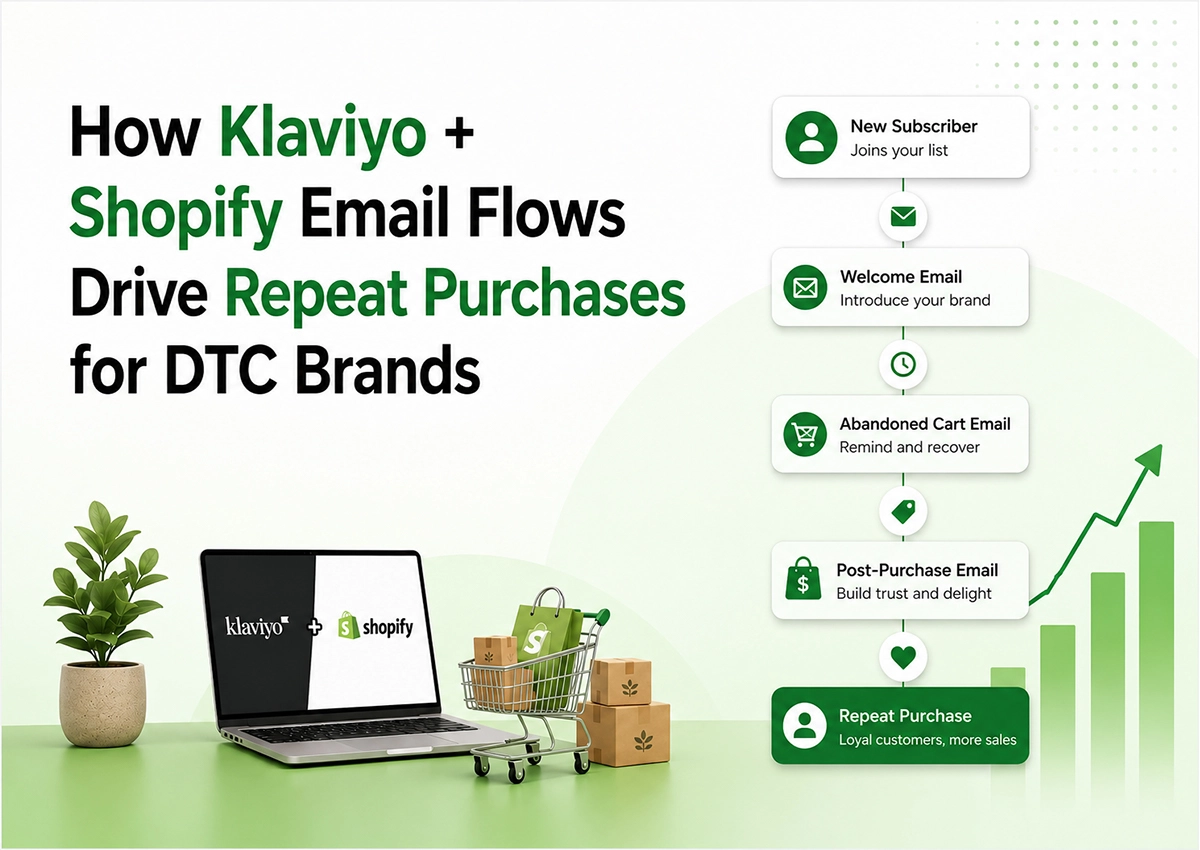
    Klaviyo and Shopify email flows driving repeat purchases for DTC brands

    Summary

    Klaviyo Shopify integration turns customer behavior into automated email journeys.

    Brands can recover abandoned carts, welcome new subscribers, educate first-time buyers, recommend complementary products, and win back inactive customers.

    The key isn’t sending more emails; it’s sending better emails at the right moment.

    Key Takeaways

    Repeat Purchases Start After Checkout

    The customer journey shouldn’t end after the first order. Post-purchase flows create opportunities for education, cross-selling, and retention.

    Automation Beats Manual Campaigns

    Shopify automated emails can respond to customer behavior instantly. That makes them more relevant than generic campaigns.

    Segmentation Improves Revenue

    Not every customer needs the same message. Purchase history, product category, order value, and engagement should shape the journey.

    Retention Matters More as Acquisition Costs Rise

    When paid acquisition gets expensive, getting more value from existing customers becomes even more important.

    What Is Klaviyo Shopify Integration and Why Does It Matter?

    The Klaviyo Shopify integration connects your store with Klaviyo’s customer data and automation system.

    Think of Shopify as the store. Klaviyo becomes the communication layer around it.

    • A customer browses a product.
    • They don’t buy.
    • Klaviyo can trigger a browse-abandonment email.
    • A customer adds something to their cart.
    • Another flow can follow up.
    • They purchase.
    • Now a post-purchase sequence can begin.

    That’s the real advantage of Klaviyo email marketing for Shopify; the system reacts to behavior.

    Expert Observation

    At Krolog, we often see brands focus heavily on acquisition while ignoring what happens after checkout; that’s backwards.

    If you’ve already paid to acquire a customer, don’t let the relationship end with one transaction.

    Build the next step.

    How Do Klaviyo Email Flows Drive Repeat Purchases?

    The best Klaviyo flows create a sequence around the customer’s lifecycle. A typical journey looks like this:

    • VisitorΒ 
    • SubscriberΒ 
    • First-Time BuyerΒ 
    • Repeat BuyerΒ 
    • Loyal Customer

    Each stage needs a different message. For example, a skincare brand could use:

    • Welcome flow for new subscribers.
    • Browse abandonment for product viewers.
    • Cart abandonment for high-intent shoppers.
    • Post-purchase education.
    • Product replenishment reminders.
    • Cross-sell recommendations.
    • Win-back campaigns.

    As a result, the brand doesn’t depend entirely on new traffic. It keeps monetizing existing customers.

    What Are the Best Klaviyo Flows for Shopify Stores?

    Not every automation deserves equal attention. Start with the flows closest to revenue.

    1. Welcome Flow

    Someone joins your email list; don’t immediately push a hard sale.

    • Introduce the brand.
    • Explain the product.
    • Build trust.
    • Then make the offer.

    A simple sequence could be:

    Email 1: Welcome + brand story
    Email 2: Bestsellers + benefits
    Email 3: Social proof
    Email 4: Offer or buying incentive

    2. Abandoned Cart Flow

    This is one of the most important Shopify email automation opportunities. The customer already showed purchase intent; don’t waste it. A strong sequence could include:

    • Reminder
    • Product benefits
    • Reviews or social proof
    • Objection handling
    • Final reminder

    The message should feel helpful, not desperate.

    3. Post-Purchase Flow

    This is where repeat purchases start:Β 

    • Thank the customer
    • Then educate them.
    • Show how to use the product properly.Β 
    • Explain what to expect.Β 
    • Introduce complementary products later.

    For example, someone buys a coffee machine. Don’t immediately sell another machine.

    Recommend coffee beans, filters, cleaning products, or accessories. That’s smarter cross-selling.

    4. Replenishment Flow

    Some products naturally run out.

    • Skincare
    • Supplements
    • Coffee
    • Pet supplies
    • Cleaning products.

    Use purchase history to estimate when the customer may need another order, then send a reminder before they run out. Timing matters.

    5. Cross-Sell Flow

    Customers who buy one product often need another.Β 

    • A running shoe customer may need socks.
    • A skincare customer may need moisturizer.
    • A pet owner buying food may need treats.

    Klaviyo automation can turn these relationships into targeted recommendations.

    6. Win-Back Flow

    Customers go quiet; it happens. The mistake is ignoring them until they’re completely inactive.

    A win-back flow can remind customers why they purchased in the first place. Use:

    • New products
    • Personalized recommendations
    • Customer benefits
    • Limited incentives
    • Brand updates

    Not every win-back email needs a discount.

    Klaviyo vs Shopify Email: Which Is Better for DTC Brands?

    This question comes up often.

    Shopify Email works well for brands that need simple campaign creation and basic automation.

    But growing DTC brands usually need deeper segmentation and behavioral automation.

    Feature Shopify Email Klaviyo
    Email Campaigns Yes Yes
    Basic Automation Yes Yes
    Advanced Segmentation Limited Strong
    Behavioral Triggers Basic Advanced
    Customer Profiles Basic Advanced
    Predictive Analytics Limited Strong
    Complex Flows Limited Extensive
    Personalization Basic Advanced

    So, Klaviyo vs Shopify Email isn’t really about which platform is universally better.

    It’s about complexity.

    If your store has a small customer base and simple requirements, Shopify Email may be enough, but as segmentation, product catalogs, and customer journeys become more complex, Klaviyo becomes much more useful.

    How Should DTC Brands Structure Their Klaviyo Shopify Email Flows?

    Don’t build 30 flows just because you can. Start with the revenue-critical ones.

    A practical structure is:

    Acquisition

    • Welcome
    • Browse abandonment
    • Cart abandonment

    Retention

    • Post-purchase
    • Cross-sell
    • Replenishment

    Reactivation

    • Win-back
    • Sunset or unengaged customer flow

    Then improve each one. For instance, segment customers by:

    • First-time vs repeat buyers
    • Product purchased
    • AOV
    • Purchase frequency
    • Location
    • Email engagement
    • Customer lifetime value

    That’s where Klaviyo for Shopify becomes more than an email tool. It becomes a retention engine.

    What Common Mistakes Hurt Shopify Email Automation?

    1. Sending the Same Email to Everyone: A first-time buyer and a VIP customer shouldn’t receive identical messages.
    2. Overusing Discounts: Discounts can increase short-term sales but train customers to wait for offers.
    3. Building Flows Without Testing: Subject lines, timing, offers, CTAs, and content all need testing.
    4. Ignoring Deliverability: More emails don’t automatically mean more revenue. Poor engagement can hurt sender reputation.
    5. Forgetting Mobile Optimization: Most customers read emails on mobile devices. If the email is difficult to scan, they leave.
    6. Creating Too Many Overlapping Flows: This one gets messy quickly. A customer can enter multiple flows at once and receive five emails in two days, which is not ideal.

    How Can Brands Improve Klaviyo Email Marketing for Shopify?

    Start with customer behavior, not the email template.

    Ask: What did this customer do?

    Then: What should happen next?

    For example:

    A customer viewed a product: remind them.

    A customer abandoned checkout: remove objections.

    A customer purchased: educate them.

    A customer bought product A: recommend product B.

    A customer hasn’t purchased in 120 days: reactivate them.

    This approach makes Klaviyo email marketing strategies for Shopify more useful and less intrusive.

    Emerging Trends in Klaviyo Shopify Email Marketing for 2026

    DTC retention is becoming more personalized. Several trends are shaping Klaviyo for Shopify strategies.

      1. AI-Powered Personalization: Brands can increasingly personalize product recommendations, messaging, and timing based on customer behavior.
      2. Predictive Segmentation: Customer data can help identify shoppers likely to purchase again, churn, or increase their spending.
      3. Zero-Party Data: Preference quizzes, surveys, and product finders help customers tell brands exactly what they want.
      4. SMS + Email Journeys: Email doesn’t have to work alone. Coordinating email and SMS can create stronger lifecycle journeys.
      5. Profit-Based Retention: Smart brands are moving beyond open rates. They track revenue per recipient, repeat purchase rate, customer lifetime value, and contribution margin. That’s a much better picture of performance.

    Krolog's Approach to Shopify Retention

    At Krolog, we don’t treat Klaviyo Shopify integration as a simple technical setup. The strategy comes first.

    • We map the customer journey.
    • Then identify revenue opportunities.
    • Then build the flows around actual customer behavior.

    That can include Shopify setup, Klaviyo integration, segmentation, automated flows, email campaigns, testing, and performance analysis.

    The goal is simple: turn more first-time customers into repeat customers.

    Final Verdict

    DTC growth isn’t only about acquiring more customers; it’s about getting more value from the customers you already have.

    Klaviyo + Shopify gives brands the infrastructure to do that at scale. But automation alone won’t fix a weak retention strategy. The flow needs the right trigger, the right message, the right timing, and a reason for the customer to come back.

    That’s where strategy makes the difference.

    Frequently Asked Questions

    About the Author

    Sandeep K., Founder and CEO of Krolog Inc., is an ecommerce consultant with over 10 years of experience across Amazon, Shopify, DTC growth, SEO, PPC, CRM, and marketing automation.

    He has helped brands build stronger digital storefronts, improve customer journeys, and scale ecommerce operations sustainably.

    Need Help Growing Your Shopify Store?

    Getting traffic is only half the job. Krolog helps DTC brands build, optimize, and grow Shopify stores with Shopify development, Klaviyo automation, email marketing, CRO, SEO, and performance marketing.

    Want to turn more first-time buyers into repeat customers? Talk to Krolog.

    Related Article

    How Klaviyo + Shopify Email Flows Drive Repeat Purchases for DTC Brands

    How Klaviyo + Shopify Email Flows Drive Repeat Purchases for DTC Brands

    How Klaviyo + Shopify Email Flows Drive Repeat Purchases for DTC Brands A customer buys once; then silence. That’s where…

    Good ROAS for eCommerce in 2026: Real Benchmarks (And Why the Old β€œ4:1 Rule” Is Dead)

    Good ROAS for eCommerce in 2026: Real Benchmarks (And Why the Old β€œ4:1 Rule” Is Dead)

    Good ROAS for eCommerce in 2026: Real Benchmarks (And Why the Old β€œ4:1 Rule” Is Dead) A campaign shows a…

    Amazon FBA vs Shopify: Fees, Costs & Profit Margins Compared (2026 Guide)

    Amazon FBA vs Shopify: Fees, Costs & Profit Margins Compared (2026 Guide)

    Amazon FBA vs Shopify: Fees, Costs & Profit Margins Compared (2026 Guide) Amazon FBA vs Shopify isn’t really a battle…

    Scroll to Top